Why Traders Are Switching to AI-Assisted Development
Author : Ranga Technologies
Publish Date : 6 / 11 / 2026 • 1 mins read
Last Updated : 6 / 11 / 2026
Are You Still Manually Coding Pine Script in 2026?
Artificial intelligence is transforming almost every industry, and trading is no exception. Yet many traders are still stuck writing Pine Script line by line, debugging syntax errors, and spending hours trying to turn a simple strategy idea into working code.
If that sounds familiar, you are not alone.
For years, TradingView users relied on manual Pine Script development to build indicators and automated strategies. But in 2026, traders are beginning to realize something important:
The real edge is no longer just strategy ideas.
It is how fast you can build, test, and improve them.
That is exactly why AI-assisted development is growing rapidly among retail traders, algo enthusiasts, and TradingView users. Instead of struggling with technical complexity, traders are now using AI-powered tools to accelerate the entire strategy-building process.
And platforms like PineGen AI are leading this shift.
1. Why AI-Assisted Development Is Growing in 2026
AI-assisted development helps traders create Pine Script strategies using artificial intelligence instead of relying completely on manual coding. Rather than writing every condition from scratch, traders can describe their strategy idea naturally and allow AI to generate the code structure automatically.
This shift is happening because traditional Pine Script workflows are slow, repetitive, and frustrating for many traders.
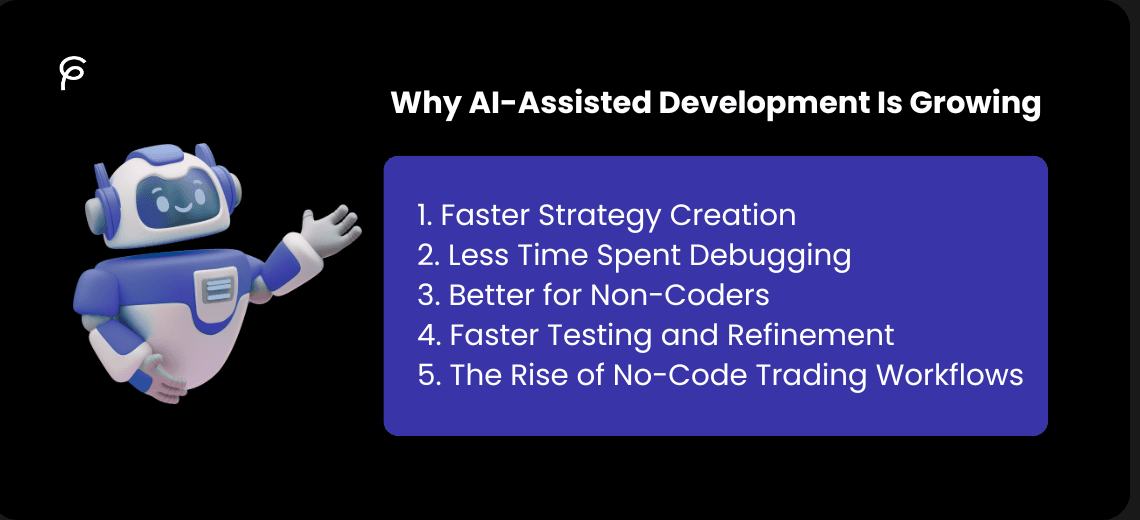
Here is why more traders are moving toward AI-assisted development.
1.1 Faster Strategy Creation
Building Pine Script strategies manually can take hours, especially for beginners. A trader may know exactly how they want a strategy to work but still struggle with coding structure, formatting, or TradingView syntax.
AI-assisted development removes much of that friction.
Instead of manually coding an EMA crossover strategy, a trader can simply type:
“Create a TradingView strategy where EMA 9 crossing above EMA 21 generates a buy signal with RSI confirmation.”
The AI then converts that idea into Pine Script code.
This dramatically reduces development time and allows traders to focus more on strategy logic instead of syntax debugging.
1.2 Less Time Spent Debugging
One of the biggest frustrations in Pine Script development is debugging.
Even small syntax mistakes can completely break a strategy. Missing brackets, incorrect conditions, outdated functions, or Pine Script version issues often force traders to spend hours searching documentation or browsing Reddit threads for solutions.
This is where AI-assisted workflows become valuable.
Platforms like PineGen AI are specifically designed for Pine Script generation and refinement. Instead of acting like a general chatbot, PineGen AI focuses on TradingView workflows, helping traders generate cleaner scripts and reduce coding friction.
For beginners, this can significantly improve the learning experience.
1.3 Better for Non-Coders
Most traders are not professional developers.
They understand charts, price action, indicators, and market behavior, but programming syntax is often a completely different skill.
AI-assisted development helps bridge that gap.
Instead of learning every Pine Script function manually, traders can focus on describing their ideas clearly and refining strategies through testing.
This makes algorithmic trading more accessible for:
-
beginner traders - who want to build and test strategies without spending months learning complex Pine Script syntax from scratch.
-
TradingView users -who want to build and test strategies without spending months learning complex Pine Script syntax from scratch.
-
retail investors - who previously thought algorithmic trading was only possible for hedge funds, developers, or institutional traders.
-
Non-programmers - who understand market behavior and indicators but struggle with coding, debugging, and technical development workflows.
That accessibility is one of the biggest reasons AI-powered strategy development is growing so quickly.
1.4 Faster Testing and Refinement
In manual development, every strategy update requires editing code, checking syntax, recompiling, and retesting.
That process becomes exhausting when traders are experimenting with multiple setups.
AI-assisted workflows make iteration much faster.
Traders can quickly modify conditions, optimize entries, adjust exits, and test different combinations without rebuilding everything from scratch.
This creates a smoother workflow where traders spend less time fixing code and more time improving strategy performance.
1.5 The Rise of No-Code Trading Workflows
The biggest trend in 2026 is not just automation. It is accessible.
More traders want no-code or low-code workflows that allow them to build TradingView strategies without becoming full-time programmers.
This is similar to what happened in website development years ago. People moved from manually coding websites to using visual builders and automation tools.
Trading strategy development is now going through a similar transformation.
AI-assisted development is making Pine Script creation faster, easier, and more beginner-friendly than ever before.
2. The Rise of AI-Assisted Development
Artificial intelligence is transforming the way modern workflows are built across almost every industry, and trading technology is evolving just as quickly. Developers are increasingly relying on AI-powered tools for code generation, debugging, automation, and faster workflow optimization to reduce manual effort and improve productivity.
That same shift is now reshaping TradingView strategy development.
In the past, building Pine Script strategies required traders to manually write conditions, fix syntax errors, debug broken logic, and repeatedly test scripts before they could even begin proper optimization. The process was often slow, technical, and frustrating, especially for traders without a programming background.
Today, AI-assisted development is changing that experience completely.
Traders are now using AI-powered workflows to generate Pine Script code, refine strategy logic, simplify debugging, accelerate backtesting, and test ideas much faster than traditional manual development methods. Instead of spending hours troubleshooting code, traders can focus more on experimentation, optimization, and improving overall strategy performance.
This transformation is one of the biggest reasons AI-powered Pine Script development is growing rapidly in 2026, especially among TradingView users looking for faster and more accessible automation workflows.
3. The Shift From Manual Coding to Intelligent Workflows
Trading strategy development is evolving.
In the past, traders spent most of their time learning syntax and fixing errors. Today, the focus is shifting toward:
-
Strategy refinement - Traders are spending less time debugging code and more time improving entries, exits, confirmations, and overall strategy performance.
-
Faster experimentation - Instead of manually rebuilding strategies every time they test a new idea, traders can quickly modify conditions and explore multiple setups in less time.
-
AI-assisted automation - Artificial intelligence is helping traders generate Pine Script code, simplify development workflows, reduce technical complexity, and speed up strategy creation.
-
Rapid backtesting - Traders can now test and validate strategies much faster, allowing them to analyze performance, identify weaknesses, and optimize setups efficiently.
The workflow is becoming smarter.
Instead of spending hours writing code manually, traders are increasingly using AI to:
-
generate indicators
-
build strategies
-
debug scripts
-
optimize logic
-
accelerate testing
This shift is no longer limited to developers or hedge funds.
Retail traders are embracing it too.
4. PineGen AI: Helping Traders Build Faster
One platform gaining attention in this space is PineGen AI.
Unlike general AI tools, PineGen AI focuses specifically on Pine Script and TradingView workflows. The platform is designed to help traders generate, refine, and improve strategies without dealing with unnecessary coding complexity.
What makes PineGen AI stand out is its workflow-focused approach.
Instead of simply generating random code snippets, the platform supports:
-
Pine Script generation - Traders can turn plain-English trading ideas into TradingView-compatible Pine Script code without manually writing every condition from scratch.
-
Strategy refinement - Users can continuously improve and modify their strategies by adjusting entries, exits, filters, and logic without rebuilding the entire script manually.
-
AI-assisted debugging - The platform helps identify and correct coding issues, reducing the time traders spend fixing syntax errors and broken strategy conditions.
-
TradingView-focused workflows - Unlike general AI tools, the platform is specifically designed around TradingView strategy development, making Pine Script creation more accurate and workflow-friendly.
-
Faster iteration - Traders can quickly test multiple ideas, optimize setups, and experiment with different conditions without slowing down the development process.
This creates a smoother experience for traders who want to move from:
strategy idea to backtest much faster.
5. How AI-Assisted Pine Script Development Actually Works
Many traders hear the phrase “AI-assisted development” but still wonder what the workflow actually looks like in real trading scenarios.
The process is much simpler than most people expect.
Traditionally, a trader would start with a strategy idea and manually convert it into Pine Script by writing conditions, formatting entries, fixing syntax errors, and debugging logic step by step.
With AI-assisted development, the workflow becomes much faster and more intuitive.
A trader can simply describe the strategy idea naturally.
For example:
“Create a TradingView strategy where RSI crossing above 30 generates a buy signal when price is above EMA 50.”
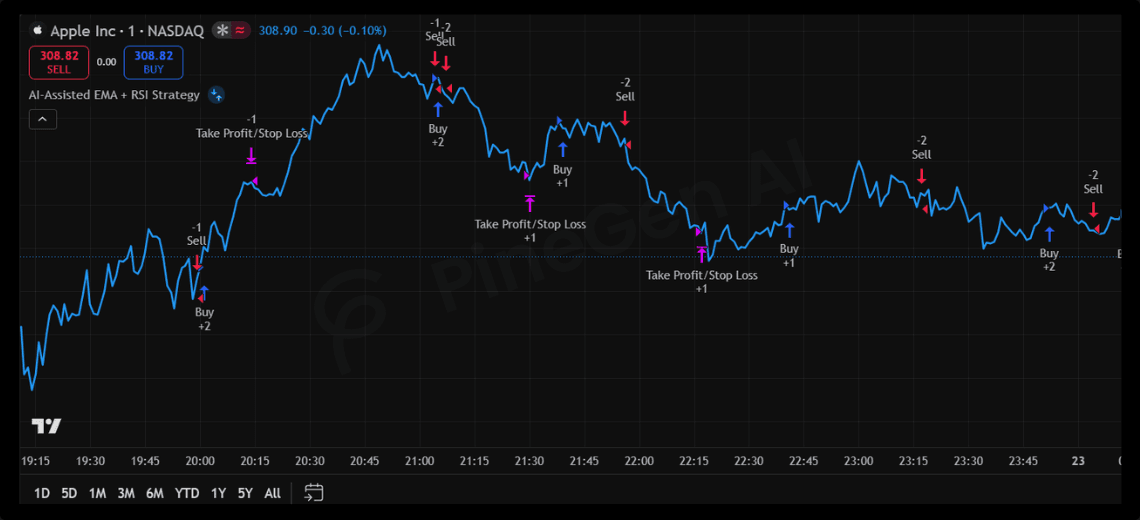
pinescript//@version=6
strategy("AI-Assisted EMA + RSI Strategy", overlay=true)

// Indicators
fastEMA = ta.ema(close, 9)
slowEMA = ta.ema(close, 21)
rsiValue = ta.rsi(close, 14)

// Buy Condition
longCondition = ta.crossover(fastEMA, slowEMA) and rsiValue > 50

// Sell Condition
shortCondition = ta.crossunder(fastEMA, slowEMA) and rsiValue < 50

// Execute Trades
if longCondition
    strategy.entry("Buy", strategy.long)

if shortCondition
    strategy.entry("Sell", strategy.short)

// Risk Management
strategy.exit("Take Profit/Stop Loss",
     profit = 100,
     loss = 50)
This is a simple example of how traders traditionally build Pine Script strategies manually using TradingView. The strategy combines EMA crossovers with RSI confirmation to generate buy and sell signals.
In a manual workflow, traders need to:
-
write every condition manually
-
structure entries and exits correctly
-
debug syntax errors
-
validate TradingView compatibility
-
repeatedly test and refine logic
With AI-assisted development platforms like PineGen AI, traders can generate similar Pine Script structures using plain-English prompts instead of manually coding every section from scratch. This helps reduce development time and allows traders to focus more on strategy refinement and backtesting rather than technical debugging.
The AI then generates the Pine Script structure automatically.
From there, traders can continue refining the strategy by:
-
adjusting conditions
-
adding confirmations
-
modifying stop-loss rules
-
optimizing exits
-
testing different timeframes
Instead of restarting from scratch every time, the workflow becomes iterative.
This allows traders to move from: idea → generation → backtesting → refinement
far more efficiently than traditional manual development.
Platforms like PineGen AI are built around this exact process, helping traders simplify Pine Script creation while keeping the workflow focused on strategy improvement rather than technical debugging.
6. Why Traders Prefer PineGen AI
Many traders initially try using generic AI chatbots for Pine Script generation. While those tools can sometimes help, they often struggle with TradingView-specific syntax, Pine Script versions, and strategy structure accuracy.
PineGen AI is different because it is built specifically around Pine Script development.
That specialization matters.
TradingView automation requires understanding:
-
Pine Script syntax - TradingView strategies depend on precise Pine Script formatting and functions. Even small syntax mistakes can break an entire script or cause compilation errors.
-
strategy structure - A working trading strategy needs properly organized entries, exits, conditions, and risk management logic to function correctly during backtesting.
-
chart logic - Automated strategies must understand how indicators, price movements, and trading conditions behave directly on TradingView charts to generate meaningful signals.
-
TradingView compatibility - Pine Script strategies must follow TradingView-specific rules, versions, and execution behavior to work properly inside the platform.
A specialized AI workflow reduces many of the frustrations traders experience when using broader AI tools.
For traders who want a faster and smoother strategy-building process, that becomes a major advantage.
7. Who Is Moving Toward AI-Assisted Development?
The shift toward AI-assisted Pine Script development is happening across multiple types of traders.
-
Beginner traders are using AI to overcome coding barriers and build their first TradingView strategies faster.
-
Experienced traders are using AI-assisted workflows to accelerate testing and improve iteration speed.
-
Working professionals are using AI tools because they do not have time to manually debug strategies after long workdays.
-
Even traders with coding knowledge are beginning to adopt AI-assisted workflows because it allows them to prototype ideas significantly faster.
The industry is clearly moving toward smarter and more efficient development workflows.
8. Conclusion: The Future of Pine Script Development Is AI-Assisted
Manual Pine Script development is not disappearing overnight.
But the workflow is changing rapidly.
In 2026, traders want:
-
faster experimentation
-
smoother automation
-
less debugging
-
quicker backtesting
-
smarter workflows
That is exactly why AI-assisted development is growing so quickly inside the TradingView ecosystem.
Platforms like PineGen AI are helping traders reduce technical friction and focus more on what actually matters: building and improving profitable strategies.
If you are still spending hours manually debugging Pine Script code, this may be the perfect time to explore a more modern AI-assisted workflow.
Because in the future of trading, traders who build faster often learn faster too.