PDT Rule Is Gone: Day Trade US Stocks Without $25K
Author : Ranga Technologies
Publish Date : 6 / 8 / 2026 • 3 mins read
Last Updated : 6 / 8 / 2026

The Biggest US Trading Regulation Change in 25 Years Just Happened. Are You Ready?
For 25 years, a single rule shaped how tens of millions of American retail traders could operate in the US stock market.
The Pattern Day Trader rule, embedded in FINRA Rule 4210 since 2001, required any trader making four or more round-trip trades within five business days to maintain a minimum of $25,000 in their margin account. Fall below that threshold and your broker locked you out of intraday trading for 90 days. No exceptions. It was the most complained-about barrier in retail trading. It forced millions of small-account traders into workarounds: cash accounts with T+1 settlement constraints, futures contracts with leverage that most weren't prepared for, or the constant discipline of rationing their three weekly day trades like a precious resource.
On April 14, 2026, the SEC approved FINRA's amendments to Rule 4210. On June 4, 2026 ,days ago, those amendments took effect.
The $25,000 minimum is gone. The four-day-trade counter is gone. The PDT designation itself is gone.
This is the most significant change to retail trading access since online brokers eliminated commissions.
What comes next is not a free pass. The new framework replaces an arbitrary capital threshold with real-time risk-based margin requirements, which means the rules are actually more sophisticated now, not more lenient. But the structural barrier that stopped millions of US traders from developing and deploying systematic day trading strategies is removed.
If you've been waiting for this moment, the question is no longer when. It's what's your plan.
1. What Was the PDT Rule, and Why Did It Exist?
Understanding what just changed requires understanding what the old rule actually did, because for every trader who lived under it, the mechanics mattered daily.
The Pattern Day Trader rule was introduced in 2001 by FINRA's predecessor organisation, in the aftermath of the dot-com bubble. During the late 1990s day-trading boom, undercapitalised retail accounts were taking on 4-to-1 intraday leverage on volatile tech stocks and suffering catastrophic losses when the bubble collapsed. Regulators' response was blunt: require a $25,000 minimum capital buffer for anyone trading frequently intraday.
Under FINRA Rule 4210, the definition of a pattern day trader was: any margin account holder executing four or more round-trip day trades within any five successive business days, where those day trades represent more than 6% of the customer's total trading activity over that period.
Once flagged as a pattern day trader, you were required to maintain $25,000 in account equity at every market close. Fail to maintain it and your account moved to "close-only" status, you could exit existing positions but couldn't open new ones. Violate the rule and you could face a 90-day trading suspension.
The workarounds traders used were real but imperfect. Cash accounts avoided the PDT rule but required T+1 fund settlement, limiting capital recycling. Futures markets (ES, NQ, RTY) had no PDT rule but carried extreme leverage that destroyed underprepared accounts. Many traders just capped themselves at three trades per week and missed setups.
The rule did what it was designed to do, it raised the capital floor for active intraday trading. Whether it actually protected retail traders from themselves, or simply blocked them from legitimate systematic trading strategies, was debated for two decades.
That debate is now historical.
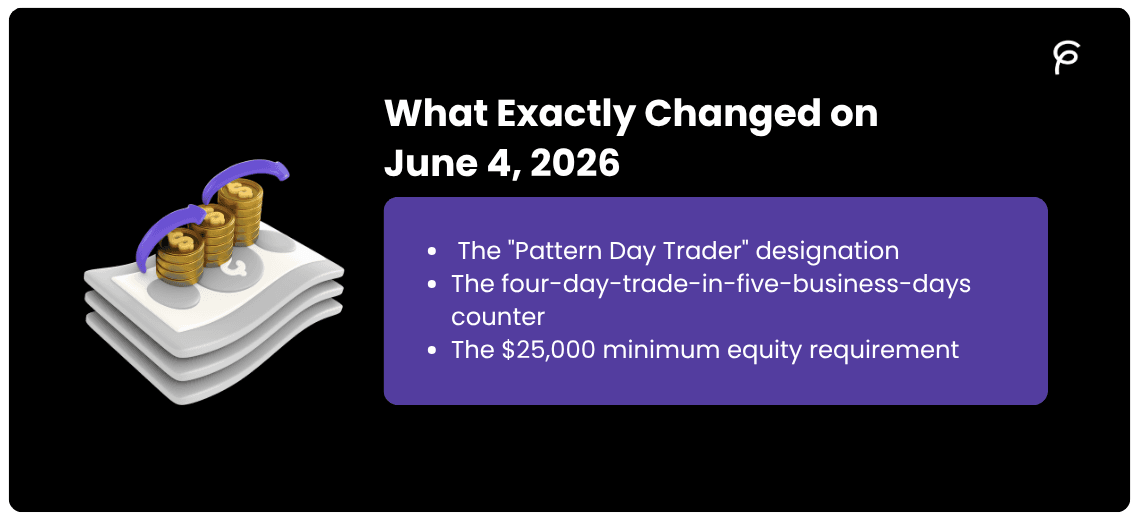
2. What Exactly Changed on June 4, 2026
Three specific things were eliminated entirely. These aren't reductions or modifications, they are complete removals.
-
The "Pattern Day Trader" designation. Broker-dealers are no longer required, or permitted, to classify customers as pattern day traders. The definition, the tracking obligation, and all requirements tied to that label are removed from the rule. Your broker cannot flag your account as PDT regardless of how frequently you trade intraday.
-
The four-day-trade-in-five-business-days counter. The four-day-trades-in-five-business-days restriction no longer applies. Day trades will no longer be counted. There is no trigger number. There is no rolling five-day window. Intraday trade frequency is no longer a regulated metric.
-
The $25,000 minimum equity requirement. The $25,000 minimum equity requirement for PDT accounts is removed. Intraday buying power will be calculated dynamically based on your account's real-time margin excess. The standard margin account minimum, $2,000, is now all that's required to access intraday margin.
What replaces all of this is a real-time intraday margin framework. Intraday trades are governed by the same 25% maintenance margin requirement that applies to other margin positions under Rule 4210. Hold a $10,000 position intraday, you need $2,500 in margin. Buying power updates dynamically throughout the day based on your actual positions and market exposure, not based on a fixed account threshold.
3. How Individual Brokers Are Rolling This Out
The rule itself took effect June 4, 2026. Brokers have an 18-month phase-in window through October 20, 2027. As of early June 2026:
Charles Schwab: Stops counting day trades June 8, 2026. No longer restricts accounts previously flagged as pattern day traders.
E*TRADE: Implements the new framework June 9, 2026.
Firstrade: Implemented June 4, 2026. All existing PDT restrictions and liquidation-only flags were lifted immediately.
Webull: Built real-time intraday margin infrastructure ahead of the change, launched June 4.
If your broker hasn't updated yet, confirm their timeline directly. The rule is eliminated, but your broker's enforcement timeline may still be in transition.
4. Who This Actually Affects
4.1 The Sub-$25K Day Trader
This is the trader the PDT rule hit hardest, and the one who gains the most from its elimination. Scalping, momentum trading, and breakout strategies all require multiple round trips per week. The old rule forced small accounts into cash workflows or multi-day waits between trades. A $5,000 or $10,000 account can now run a full intraday strategy, as many trades per day as the setup generates, without restriction.
4.2 Options Day Traders
Options day trading sees the largest unlock. A trader with $3,000 can now run an options scalping playbook without hitting the trade-count limit. Options intraday strategies, particularly 0DTE (zero-days-to-expiry) SPY or QQQ options, were brutally constrained by the PDT rule on small accounts. That constraint is gone.
4.3 Systematic and Algorithmic Traders with Small Accounts
This is the group most relevant to PineGen AI's community. Systematic traders who deliberately kept intraday trade frequency below four per rolling five-day window to avoid PDT status, artificially constraining their strategy's natural signal generation, no longer need that constraint. A strategy that generates five clean setups in a week can now take all five.
4.4 Long-Term Investors
Minimal impact. If you hold positions for days or weeks, nothing about your workflow changes.
5. The Real Risk Nobody Is Talking About Loudly Enough
The PDT rule removal is broadly positive for retail trading access. But the honest version of this story includes what the change also creates.
FINRA itself states directly: frequent trading with margin remains a high-risk activity that requires careful management of your funds.
The old PDT rule had one accidental benefit: it forced small-account traders to be selective. With only three allowed day trades per week, every trade had to count. Traders couldn't chase setups, revenge-trade losses, or overtrade ranging markets. The constraint created discipline, even if it was the wrong kind of constraint for the wrong reasons.
That external guardrail is now gone. The new intraday margin system adds its own complexity: position concentration feeds directly into buying power in real time. One large concentrated trade can shrink your available margin on other positions immediately. That dynamic didn't exist in the simple old binary framework.
The traders who will thrive in the post-PDT environment are not the ones who simply trade more. They're the ones who replace the removed external discipline with internal discipline, meaning a systematic, backtested, rule-defined strategy that specifies exactly when to enter, when to exit, how much to risk, and when to sit on hands entirely.
That is exactly what PineGen AI was built to help you build.
6. Why Systematic Day Trading Is the Right Response to the PDT Removal
There's a version of the post-PDT story that ends badly: millions of newly unconstrained small-account traders enter the intraday market without a system, trading on gut feel and social media tips, and experience the outcome retail day traders have always experienced without an edge.
There's another version that ends differently: traders who respond to the new access by building a systematic framework, defined entries, defined exits, defined risk per trade, backtested logic, and use the unlimited trade frequency to deploy that system consistently rather than simply trade more.
The difference between those two versions isn't capital. It's preparation.
A systematic day trading strategy on TradingView does four things that discretionary trading can't. It removes decision fatigue. It gives you backtested expectations before you risk real money. It enforces risk management automatically on every single trade. And it scales with your edge, under the old PDT framework, a strategy generating seven clean setups per week was capped at three entries. Now it takes all seven.
Building that system used to require Pine Script knowledge. With PineGen AI, it requires a clear description of your strategy.
7. How to Build Your Post-PDT Day Trading System in 5 Steps
Step 1: Define your setup in plain English. What market? What timeframe? What conditions create a valid entry? What do the stop-loss and target look like? Write it out before touching any tools: "I trade SPY on the 5-minute chart. I buy when the price breaks above the opening 15-minute high with above-average volume. Stop below the opening range low. Target at 2x the opening range height."
Step 2: Generate your Pine Script strategy with PineGen AI. Take that description and prompt it, specifying Pine Script v6, timeframe, instrument, indicator settings, every exit type, risk management, visuals, and alerts. PineGen AI generates validated, compilable v6 code from the first prompt.
Step 3: Review on the live chart preview. Before running the full backtest, check visually. Confirm entry signals fire where expected. Confirm stop-loss and target levels look sensible. Catch logic errors before they affect backtest numbers.
Step 4: Backtest in TradingView's Strategy Tester. Paste the code into TradingView's Pine editor, load it on your instrument and timeframe, and open the Strategy Tester. Evaluate profit factor (target above 1.3), win rate, maximum drawdown (target under 20%), total trade count (minimum 50 for statistical relevance), and average trade duration.
Step 5: Refine through PineGen AI's chat and paper trade. Use the chat to modify parameters, add filters, or adjust risk management based on backtest results. Each refinement takes seconds. Paper trade the final version for a minimum of two weeks before going live with real capital.
8. The Code: Opening Range Breakout Strategy for US Stocks
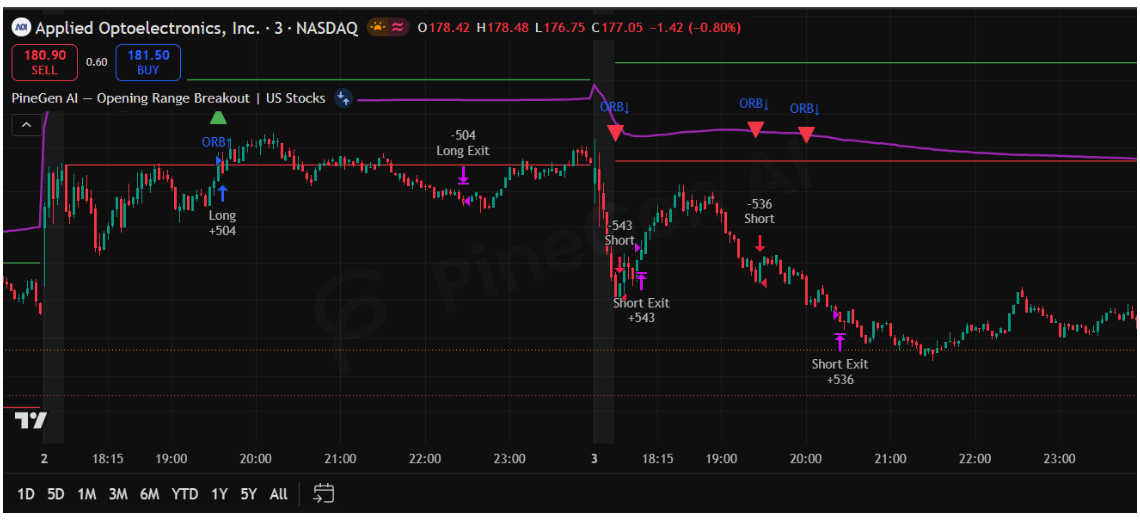
The Opening Range Breakout (ORB) with VWAP filter is one of the most well-documented systematic day trading frameworks for US equities. It captures breakouts from the first 15 minutes of the NYSE session, filtered by VWAP direction and volume, with ATR-based risk management and a hard close before market end.
The prompt that built this:
"Pine Script v6 day trading strategy for US stocks on the 5-minute chart. Long when price breaks above the high of the first 15-minute candle (opening range high) with VWAP rising and volume above its 20-bar average. Short when price breaks below the opening range low with VWAP falling and volume confirming. Stop-loss at 1x ATR below the entry bar low for longs, above entry bar high for shorts. Take-profit at 2x ATR. Force-close all positions at 3:45 PM ET. Only trade during NYSE regular hours. Plot the opening range levels and VWAP. Add alerts."
pinescript//@version=6
strategy("PineGen AI — Opening Range Breakout | US Stocks", overlay=true,
     default_qty_type=strategy.percent_of_equity, default_qty_value=10,
     commission_type=strategy.commission.percent, commission_value=0.05)

// ── INPUTS ─────────────────────────────────────────────
orMinutes  = input.int(15, "Opening Range (minutes)", group="Opening Range")
atrLen     = input.int(14, "ATR Length", group="Risk")
slMult     = input.float(1.0, "SL ATR Multiplier", group="Risk", step=0.1)
tpMult     = input.float(2.0, "TP ATR Multiplier", group="Risk", step=0.1)
volLen     = input.int(20, "Volume MA Length", group="Volume")
closeHour  = input.int(15, "Force-Close Hour (ET)", group="Session")
closeMin   = input.int(45, "Force-Close Minute (ET)", group="Session")

// ── SESSION & TIME ─────────────────────────────────────
nyOpen    = timestamp("America/New_York", year, month, dayofmonth, 9, 30, 0)
orEnd     = timestamp("America/New_York", year, month, dayofmonth, 9, 30 + orMinutes, 0)
closeTime = timestamp("America/New_York", year, month, dayofmonth, closeHour, closeMin, 0)

inSession = time >= nyOpen and time = nyOpen and time = orEnd and not orSet
    orSet := true

    orHighLine := line.new(bar_index, orHigh, bar_index + 1, orHigh,
         extend=extend.right, color=color.green, width=1)

    orLowLine := line.new(bar_index, orLow, bar_index + 1, orLow,
         extend=extend.right, color=color.red, width=1)

// ── INDICATORS ─────────────────────────────────────────
vwapVal  = ta.vwap(hlc3)
vwapRise = vwapVal > vwapVal[3]
vwapFall = vwapVal  ta.sma(volume, volLen)

// ── ENTRY CONDITIONS ───────────────────────────────────
orbLong  = orSet and ta.crossover(close, orHigh) and vwapRise and volPass and inSession
orbShort = orSet and ta.crossunder(close, orLow) and vwapFall and volPass and inSession

// ── RISK LEVELS ────────────────────────────────────────
longSL  = low  - atrVal * slMult
longTP  = close + atrVal * tpMult
shortSL = high + atrVal * slMult
shortTP = close - atrVal * tpMult

// ── EXECUTION ──────────────────────────────────────────
if orbLong and strategy.position_size == 0
    strategy.entry("Long", strategy.long)
    strategy.exit("Long Exit", "Long", stop=longSL, limit=longTP)

if orbShort and strategy.position_size == 0
    strategy.entry("Short", strategy.short)
    strategy.exit("Short Exit", "Short", stop=shortSL, limit=shortTP)

// Force-close all positions before market close
if time >= closeTime and strategy.position_size != 0
    strategy.close_all(comment="EOD Close")

// ── VISUALS ────────────────────────────────────────────
bgcolor(time >= nyOpen and time < orEnd ? color.new(color.gray, 90) : na)

plot(orSet ? orHigh : na, "OR High", color=color.green, linewidth=1, style=plot.style_linebr)
plot(orSet ? orLow  : na, "OR Low",  color=color.red, linewidth=1, style=plot.style_linebr)
plot(vwapVal, "VWAP", color=color.purple, linewidth=2)

plotshape(orbLong, location=location.belowbar, color=color.green,
     style=shape.triangleup, size=size.small, text="ORB↑")

plotshape(orbShort, location=location.abovebar, color=color.red,
     style=shape.triangledown, size=size.small, text="ORB↓")

// ── ALERTS ─────────────────────────────────────────────
alertcondition(orbLong, "ORB Long", "PineGen AI ▲ ORB LONG — {{ticker}} @ {{close}}")
alertcondition(orbShort, "ORB Short", "PineGen AI ▼ ORB SHORT — {{ticker}} @ {{close}}")
This works on SPY, QQQ, and high-volume individual stocks. It works because the opening range represents the market's first price discovery after the open, the first 15 minutes establish the day's directional bias, and breakouts from that range, when confirmed by institutional flow (VWAP) and genuine participation (volume), tend to continue in the direction of the break.
9. Why PineGen AI Is the Right Tool for This Moment
The PDT rule's removal will bring a wave of newly unconstrained US retail traders into active intraday markets. Most will arrive without a system. PineGen AI specifically addresses what these traders need in the post-PDT environment.
Generates US-market-specific logic natively. Opening Range Breakout, VWAP, NYSE session filter, force-close before market close, PineGen AI understands these terms in US equity context and generates the correct Pine Script v6 implementation. The code that came out of the prompt above compiles and runs the first time.
Zero compile errors. When your alert fires and you act on it, the strategy had better work as designed. In a published 20-trader benchmark, PineGen AI produced zero compile errors versus ChatGPT's 70% failure rate. What you deploy actually does what you designed it to do.
Backtesting before any real money. The TradingView Strategy Tester on a 5-minute chart over 2+ years generates hundreds of ORB backtest trades, enough statistical data to know whether your edge is real before you put capital behind it.
Chat-based refinement. "Add a filter that skips entries when the VIX is above 30", one sentence in the PineGen AI chat, the strategy regenerates with that condition. No rewriting from scratch. Build incrementally.
10. The Bigger Picture: The Barrier Fell. The Work Begins.
The PDT rule was created in response to a specific crisis: undercapitalised 1990s traders using 4-to-1 leverage on dot-com stocks without any risk framework. The solution was a blunt capital threshold that made no distinction between a reckless gambler and a disciplined systematic trader with a $15,000 account and a backtested edge. For 25 years, those two traders were treated identically. Both locked out equally.
The new framework recognises what FINRA noted in Regulatory Notice 26-10: modern real-time trading systems can manage intraday risk exposure dynamically, in ways that the 2001 rule's rigid trade-counting framework was never equipped to address.
What every serious US retail trader now owes themselves is a system that matches the level of access they've been given. The barrier to entry just fell. The bar for preparation should not.
Build the strategy before you trade it. Backtest it before you risk real money. Paper trade for two weeks. And use tools specifically built for this, not general-purpose chatbots that generate code that fails to compile, but a platform trained on verified TradingView strategies that understands ORB, VWAP, and NYSE session mechanics.
The rule is gone. Your edge is what matters now.
Build Your Post-PDT Day Trading Strategy Today
The $25K barrier is gone. Build, backtest, and deploy a systematic day trading strategy before you place your first post-PDT trade. No coding required. Validated Pine Script v6. Live chart preview and backtesting summary included.