Multi-Timeframe Pine Script v6 Strategy Using request.security() (No Repainting)
Author : Ranga Technologies
Publish Date : 5 / 4 / 2026 • 2 mins read
Last Updated : 5 / 4 / 2026
Many traders start building strategies in TradingView using signals from a single chart timeframe. At first the strategy may appear profitable during testing, but once market conditions shift, the signals become inconsistent.
One major reason is that the strategy does not account for the broader market context. Professional traders rarely rely on a single timeframe when making trading decisions. Instead, they analyze price action across multiple timeframes.
In TradingView Pine Script version 6, developers can build these types of strategies using the request.security() function. This function allows a script to retrieve price or indicator data from another timeframe.
However, if this function is used incorrectly, strategies may produce repainting signals, leading to misleading results in the TradingView strategy tester.
Before building advanced strategies, it is useful to understand how Pine Script strategies work and how TradingView evaluates them.
In this guide, we’ll explore how multi-timeframe strategies work in Pine Script version 6, how request.security() retrieves higher timeframe data, and how to implement it correctly to avoid repainting.
1. Why Multi-Timeframe Analysis Matters
Financial markets behave differently depending on the timeframe being analyzed.
For example: • A 5-minute chart may show rapid short-term volatility. • A 1-hour chart may still show a clear trend direction. • A daily chart may reveal the broader market structure.
If a trading strategy uses signals only from the lower timeframe, it may open trades that go against the dominant trend.
Multi-timeframe analysis solves this issue by combining signals from different time horizons.
A typical structure used by many trading systems looks like this:
- Higher timeframe → determine overall trend
- Lower timeframe → determine entry signals
This approach helps reduce noise and improves signal reliability.
Algorithmic trading strategies frequently use multi-timeframe confirmation to improve strategy robustness.
2. Why Repainting Happens in Multi-Timeframe Strategies
Repainting occurs when an indicator changes past values after new price data appears.
This issue is especially common in multi-timeframe scripts.
For example: A strategy running on a 5-minute chart retrieves a 1-hour moving average. Until the 1-hour candle closes, its value continues to update as new price data arrives.
If the strategy reacts to these temporary values, the historical signals may appear perfect during backtesting but behave differently in live markets.
To avoid this issue, strategies should rely only on confirmed higher timeframe data.
3. How to Build a No-Repaint Multi-Timeframe Strategy
When designing multi-timeframe Pine Script strategies, developers typically follow several guidelines.
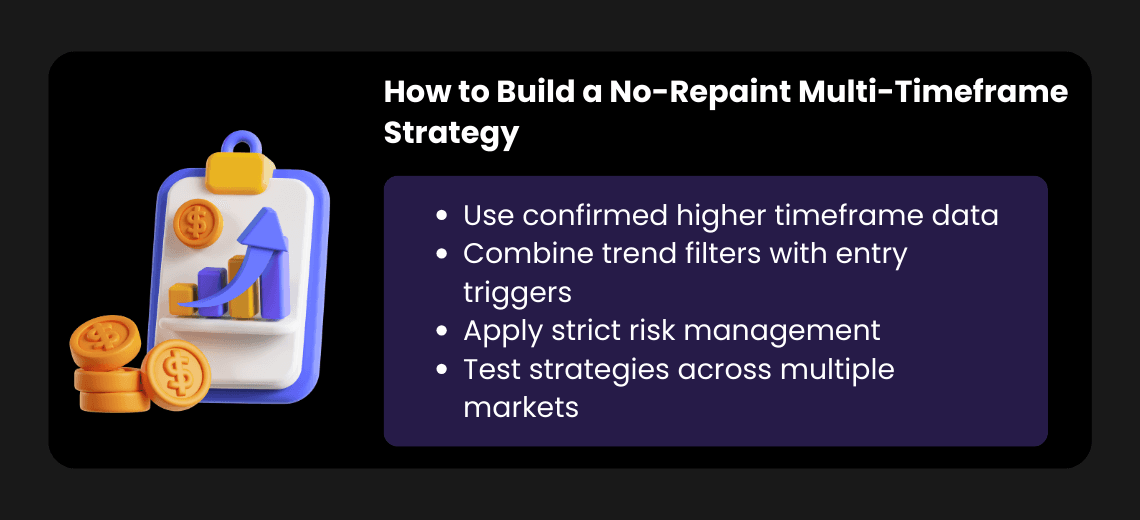
Use confirmed higher timeframe data
Signals should be based only on completed candles rather than partially formed ones.
Combine trend filters with entry triggers
Higher timeframe indicators usually determine the market direction, while lower timeframe indicators determine when to enter trades.
Apply strict risk management
Strategies should always include stop-loss levels and position sizing rules.
Test strategies across multiple markets
A strategy that works on one asset may not perform the same on another market.
4. How request.security() Works in Pine Script
The request.security() function allows a Pine Script to access data from a different timeframe.
For example, a strategy running on a 5-minute chart can retrieve: • a 1-hour moving average • a 4-hour RSI • a daily volatility indicator
This makes it possible to combine multiple layers of market analysis within a single script.
Example: higherTFEMA = request.security(syminfo.tickerid, "1H", ta.ema(close, 50))
In this example, the script retrieves the 50-period exponential moving average from the 1-hour timeframe, even if the user is viewing a lower timeframe chart.
Developers often use this function to build strategies that confirm signals across multiple timeframes.
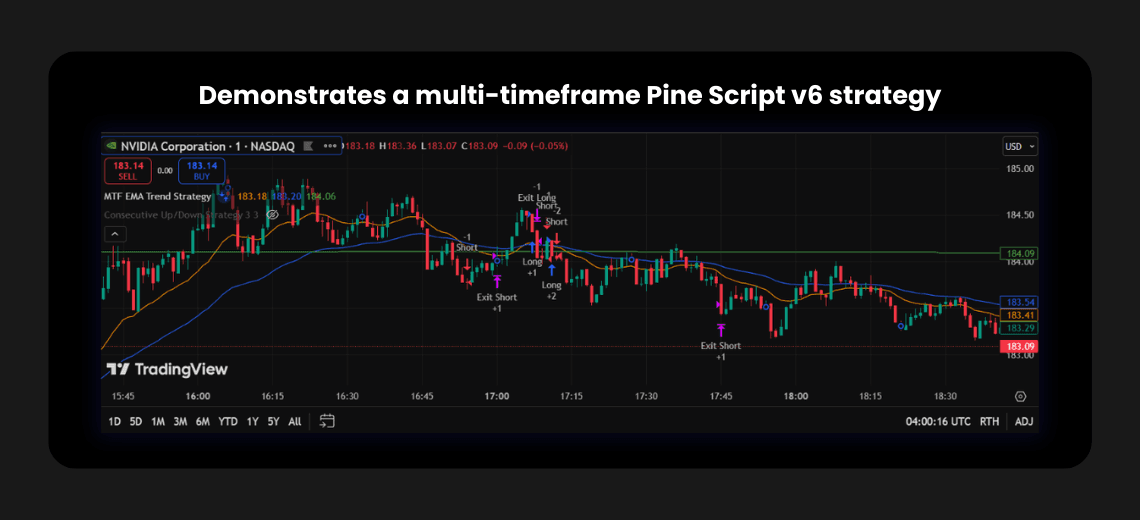
5. Pine Script v6 Multi-Timeframe Strategy
The following example demonstrates a multi-timeframe Pine Script v6 strategy using: • EMA crossover entry signals • higher timeframe trend confirmation • RSI momentum filter • ATR-based risk management
//@version=6
strategy("MTF EMA Trend Strategy", overlay=true, initial_capital=10000)

fastEMA = ta.ema(close, 20)
slowEMA = ta.ema(close, 50)

rsi = ta.rsi(close, 14)
atr = ta.atr(14)

// Higher timeframe trend filter
higherTrend = request.security(
    syminfo.tickerid,
    "1H",
    ta.ema(close, 100),
    lookahead = barmerge.lookahead_off
)

bullTrend = close > higherTrend
bearTrend = close  50 and
    bullTrend

shortSignal =
    ta.crossunder(fastEMA, slowEMA) and
    rsi < 50 and
    bearTrend

if longSignal
    strategy.entry("Long", strategy.long)

if shortSignal
    strategy.entry("Short", strategy.short)

longStop = strategy.position_avg_price - atr * 1.5
longTarget = strategy.position_avg_price + atr * 3

shortStop = strategy.position_avg_price + atr * 1.5
shortTarget = strategy.position_avg_price - atr * 3

strategy.exit("Exit Long", "Long", stop=longStop, limit=longTarget)
strategy.exit("Exit Short", "Short", stop=shortStop, limit=shortTarget)

plot(fastEMA)
plot(slowEMA)
plot(higherTrend)
6. Why Multi-Timeframe Confirmation Improves Strategies
Strategies that rely on a single timeframe often generate many false signals.
By confirming signals across multiple timeframes, traders can significantly improve signal reliability.
A typical workflow looks like this:
- Higher timeframe → identify trend direction
- Lower timeframe → detect entry signals
- Risk management → control position exposure
This layered structure helps strategies avoid trading against the broader market trend.
7. Conclusion
Multi-timeframe analysis plays an important role in building reliable trading strategies. By combining signals from multiple time horizons, traders can reduce noise and avoid entering trades that go against the broader market trend.
In Pine Script version 6, the request.security() function provides a powerful way to retrieve higher timeframe data and integrate it into automated strategies. When used correctly with confirmed candle data, it allows developers to build strategies that behave consistently in both backtesting and live markets.
As automated trading continues evolving, many traders are combining multi-timeframe logic with AI-assisted Pine Script development tools. This combination helps accelerate strategy development while maintaining strong analytical foundations.