How Geopolitical Tensions Are Reshaping US Stock Market Behavior
Author : Ranga Technologies
Publish Date : 3 / 25 / 2026 • 2 mins read
Last Updated : 3 / 25 / 2026
Global financial markets are no longer driven purely by earnings reports or technical indicators. In recent periods, geopolitical tensions, especially conflicts involving major economies, have started influencing price movements across equities, commodities, and indices.
Events such as war escalation, supply chain disruptions, and energy instability have created an environment where market reactions are increasingly triggered by news headlines rather than traditional fundamentals.
For example, recent coverage from Reuters highlights how global markets react instantly to geopolitical developments and oil supply risks.
This case study explores how geopolitical tensions affect US stock market behavior, how different asset classes react, and how trading strategies perform under such conditions.
Problem Statement
Traditional trading strategies are typically designed under relatively stable market conditions. However, during geopolitical uncertainty:
-
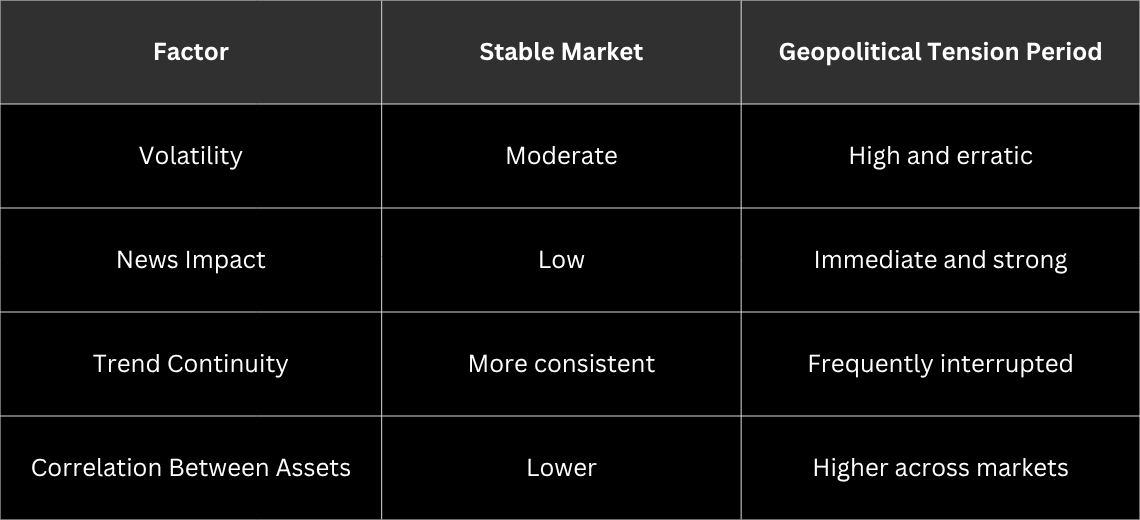
volatility increases sharply
-
correlations between assets shift
-
sudden news events override technical setups
-
strategies generate false signals more frequently
As discussed in JPMorgan Chase market outlook reports, investors often underestimate the impact of geopolitical risks, leading to misaligned expectations and increased market instability.
Why This Matters
Geopolitical tensions introduce macro-level shocks into financial systems:
-
energy supply disruptions
-
inflation expectations
-
interest rate uncertainty
-
investor risk aversion
According to analysis reported by Business Insider, prolonged geopolitical conflicts can increase recession risks and create uncertainty across equity markets.
What Happens in the Market During Geopolitical Tensions
Key Observations:
-
Markets react immediately to breaking headlines
-
Oil prices become highly sensitive to supply risks
-
Tech-heavy indices like
-
NASDAQ-100 show increased volatility
-
Safe-haven assets gain attention
-
Cross-market correlations increase
Academic research also supports this behavior. A study available on arXiv shows that negative geopolitical sentiment directly increases market volatility and uncertainty.
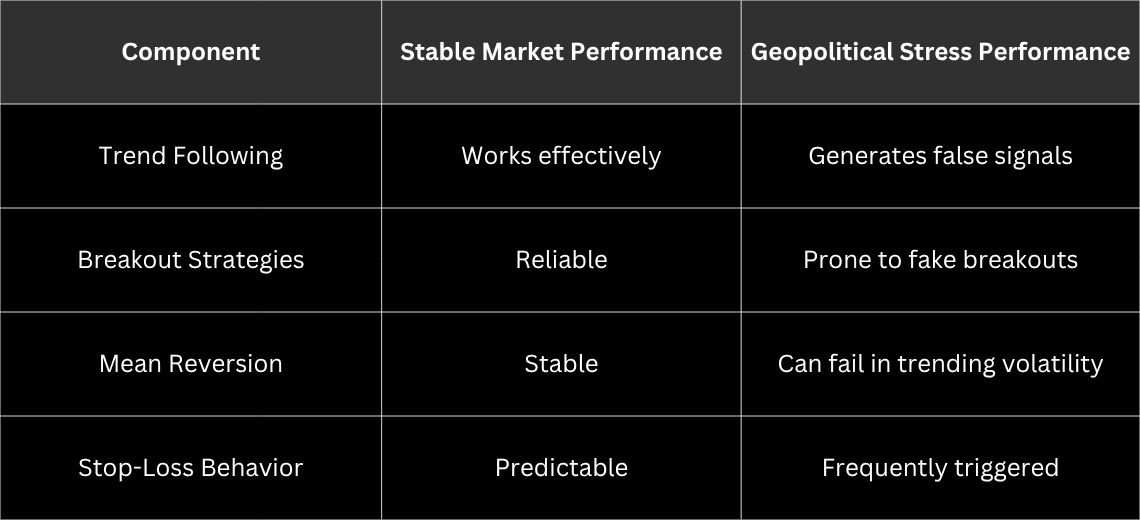
Trading Strategy Performance
How Markets React (Mechanism)
Geopolitical events influence markets through a chain reaction:
Headlines → Sentiment → Risk Perception → Capital Flow → Price Movement
For example:
-
News about conflict escalation → triggers fear
-
Investors shift capital into safer assets
-
Equity markets become volatile
This phenomenon is frequently analyzed in reports by
The Wall Street Journal, where markets are shown reacting within minutes to geopolitical updates.
Strategy Impact in Volatile Conditions
Strategies that perform well in stable markets may struggle under geopolitical stress due to:
-
increased false breakouts
-
rapid reversals
-
inconsistent trend continuation
-
widening stop-loss triggers
This aligns with insights from
TradingView community discussions, where traders report increased difficulty maintaining consistent strategy performance during volatile macro conditions.
Market Behavior (Stable vs Geopolitical Conditions)
Practical Insights for Traders
Based on observed behavior during geopolitical tension:
-
Avoid relying on single-indicator strategies
-
Incorporate volatility-based risk controls (e.g., ATR)
-
Use higher timeframe filters to reduce noise
-
Expect increased drawdowns during unstable periods
-
Validate strategies beyond backtesting
Geopolitical tensions do not just move markets, they change how markets behave.
This leads to:
-
shifts in volatility structure
-
changes in correlation patterns
-
increased influence of external events over technical setups
Conclusion
Geopolitical events introduce uncertainty that directly impacts stock market behavior across the globe. US equities, along with other global indices, react not only to economic data but also to headlines, sentiment, and macro-level disruptions.
For traders and system builders, this means:
-
strategy robustness matters more than complexity
-
risk management becomes central
-
adaptability is essential
If you are building trading strategies in today’s environment:
-
focus on adaptability
-
validate across volatile conditions
-
reduce dependency on static assumptions
Markets are evolving faster than ever, and relying on manual coding or slow testing cycles can hold you back.
Instead of spending hours fixing errors or adjusting scripts, you can shift your focus to what actually matters, testing ideas, refining logic, and improving performance.
With PineGen AI , you can:
-
turn trading ideas into structured Pine Script strategies instantly
-
reduce debugging time with cleaner, ready-to-use code
-
test and iterate faster in volatile market conditions
-
build strategies aligned with real market behavior
If you want to stay competitive in a market driven by uncertainty, speed, and adaptability matter more than ever.