The 2-Minute Strategy Build That Changed How Traders Use Pine Script
Author : Ranga Technologies
Publish Date : 6 / 14 / 2026 • 4 mins read
Last Updated : 6 / 14 / 2026
Are Traders Still Spending Hours Building Pine Script Strategies?
Not long ago, building a TradingView strategy meant sitting in front of charts for hours manually writing Pine Script, fixing compiler errors, restructuring conditions, and repeatedly debugging TradingView logic.
For many traders, the workflow felt slower than the actual trading process itself.
Even relatively simple TradingView strategies often required extensive manual work before they became usable. Traders had to structure indicators carefully, validate entries and exits, fix formatting issues, optimize backtesting behavior, and repeatedly adjust conditions just to create a functional workflow.
That technical barrier prevented many traders from exploring algorithmic trading, even when they already understood trading concepts very well.
But in 2026, that workflow is changing rapidly.
AI-assisted Pine Script development is helping traders move from a strategy idea to a working TradingView structure in minutes instead of hours. Instead of spending most of their time debugging syntax and rebuilding strategies manually, traders are increasingly focusing on experimentation, optimization, and strategy refinement.
And one of the biggest reasons behind that shift is the rise of specialized TradingView-focused AI workflows like PineGen AI.
TradingView strategy development is evolving rapidly as traders move away from slow manual Pine Script workflows and toward AI-assisted development. Instead of spending hours fixing syntax errors, restructuring conditions, and debugging TradingView logic repeatedly, traders are increasingly using Pine Script AI tools to accelerate strategy creation and simplify TradingView automation.
1. Why Traditional Pine Script Development Felt Slow
Traditional Pine Script development required traders to manage both trading logic and technical implementation at the same time. That combination created a major learning barrier for many TradingView users.
A trader might fully understand RSI confirmations, EMA crossover systems, breakout strategies, trend filters, and risk management concepts but still struggle to convert those ideas into functioning Pine Script because coding introduces an entirely separate technical challenge.
Even experienced TradingView users often spent hours fixing syntax issues, debugging strategy conditions, restructuring TradingView workflows, and validating backtesting behavior before a strategy became usable.
As strategies became more advanced, the workflow usually became slower and more frustrating.
Adding multiple confirmations often meant restructuring large sections of Pine Script manually. Integrating higher timeframe filters introduced additional complexity because timeframe synchronization needed to behave correctly during live TradingView execution.
Custom alerts and stop-loss structures also required extra coding layers, especially when traders wanted more advanced execution logic and automated conditions.
This is one of the biggest reasons many traders avoided TradingView automation altogether despite understanding trading concepts extremely well.
2. The Rise of Faster AI-Assisted TradingView Workflows
Artificial intelligence is rapidly changing how software workflows operate across multiple industries, and TradingView strategy development is evolving alongside it.
Instead of manually building every Pine Script condition line by line, traders are increasingly using AI-assisted workflows to accelerate strategy generation and simplify TradingView automation.
The biggest shift is not simply faster code generation.
The real transformation is workflow efficiency.
In the past, traders spent most of their development workflow fixing Pine Script formatting, correcting compiler issues, debugging TradingView compatibility, and rebuilding strategies repeatedly.
Today, traders are increasingly spending more time on strategy refinement, market analysis, optimization, experimentation, and backtesting performance.
That shift is fundamentally changing how Pine Script development works.
AI-assisted workflows are making TradingView automation significantly more accessible for beginner traders, non-programmers, retail investors, TradingView users, and strategy researchers.
For beginner traders, AI-assisted workflows reduce the overwhelming technical learning curve that traditionally came with Pine Script development.
For non-programmers, AI makes it possible to experiment with TradingView automation without needing extensive coding knowledge first.
Retail investors can now test strategy ideas faster without spending weeks learning Pine Script syntax manually.
TradingView users benefit from quicker experimentation cycles and faster backtesting workflows.
Strategy researchers can move through optimization and testing phases much more efficiently because AI-assisted workflows reduce repetitive development tasks.
This accessibility is one of the biggest reasons Pine Script AI workflows are growing so quickly in 2026.
3. What Changed in Modern Pine Script Development
Modern TradingView development workflows are becoming increasingly strategy-focused instead of syntax-focused.
In the past, traders spent most of their time learning Pine Script formatting, debugging TradingView functions, and repeatedly restructuring strategy logic. Even small modifications often required rebuilding large sections of code manually.
Today, AI-assisted workflows are helping traders simplify much of that technical process.
Instead of manually coding RSI confirmations, EMA crossover conditions, stop-loss logic, breakout confirmations, and trend filters individually, traders can now generate strategy foundations much faster and focus more on improving strategy quality.
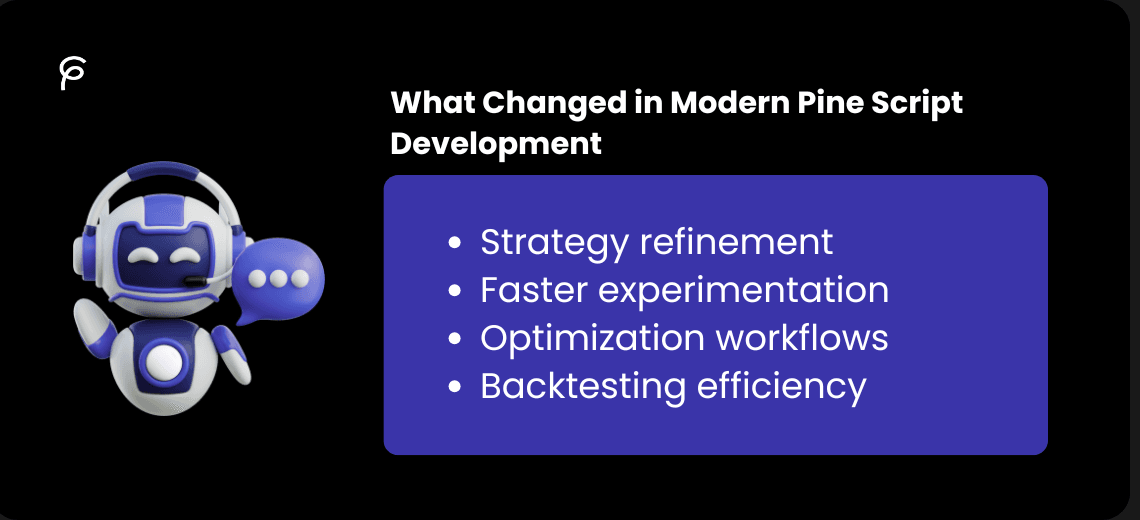
Strategy refinement - Has become more important because traders can now focus more on improving entries, exits, confirmations, and overall execution quality instead of spending hours correcting formatting problems.
Faster experimentation - Allows traders to test multiple TradingView strategy ideas quickly. Instead of rebuilding Pine Script structures repeatedly, traders can iterate through ideas more efficiently and compare multiple approaches faster.
Optimization workflows - Have also improved because traders can refine parameters, confirmations, and execution logic through quicker iteration cycles. This makes strategy testing more dynamic and less time-consuming.
Backtesting efficiency - Becomes significantly faster because AI-assisted workflows help traders move from strategy idea to TradingView testing much more quickly. Instead of waiting hours to build and debug structures manually, traders can focus more on analyzing performance results.
The workflow is becoming smarter, faster, and less dependent on deep programming knowledge.
4. How PineGen AI Simplifies Strategy Building
Many AI coding tools can generate code, but Pine Script development requires TradingView-specific understanding.
That specialization matters because TradingView automation depends heavily on Pine Script syntax, TradingView compatibility, strategy structure, backtesting behavior, and indicator logic.
General AI systems sometimes generate outdated Pine Script syntax, unsupported TradingView functions, broken strategy logic, or incomplete TradingView workflows. Those issues become especially frustrating when traders are trying to build and test strategies quickly.
Instead of acting like a general chatbot, PineGen AI focuses specifically on Pine Script and TradingView workflows.
Traders can describe strategy ideas naturally and generate Pine Script structures much faster without manually building every component from scratch.
For example, instead of manually coding RSI confirmations, EMA crossover systems, stop-loss structures, breakout confirmations, or trend filters individually, traders can focus more on strategy quality and optimization.
RSI confirmations - Help traders validate momentum strength before entering trades. AI-assisted workflows simplify integrating those conditions into TradingView strategies without manually rebuilding the structure repeatedly.
EMA crossovers - Remain one of the most widely used TradingView workflows. PineGen AI helps traders organize crossover logic more efficiently while reducing repetitive coding tasks.
Stop-loss logic - Critical for risk management. AI-assisted workflows simplify the process of integrating protective conditions and execution structures into TradingView strategies.
Breakout confirmations - are frequently used to validate momentum-based entries. AI-assisted workflows help traders build breakout logic faster while reducing technical complexity.
Trend filters - allow traders to align entries with broader market direction. This becomes especially important when combining multiple indicators and confirmations across different market conditions.
Instead of spending most of the workflow fixing syntax and restructuring code manually, traders can focus more on experimentation, optimization, execution quality, backtesting workflows, and strategy refinement.
-
Experimentation
-
Optimization
-
Execution quality
-
Backtesting workflows
-
Strategy refinement
That workflow significantly reduces repetitive Pine Script development work and helps traders move from strategy idea to TradingView testing much faster.
5. Why Faster Workflows Matter for Traders
One of the biggest changes happening in TradingView development is psychological.
When traders spend hours debugging syntax and fixing Pine Script formatting, experimentation slows down significantly. Many traders become hesitant to test new ideas because every strategy modification requires additional technical work.
AI-assisted workflows reduce that friction.
Instead of feeling trapped inside repetitive development tasks, traders can explore ideas faster, test variations more efficiently, and move through experimentation cycles with less technical frustration.
That faster iteration cycle encourages broader strategy exploration because traders are more willing to test creative ideas when the development process becomes less overwhelming.
It also improves learning speed. Traders can analyze more setups, compare multiple conditions, and understand market behavior faster through quicker testing cycles.
Optimization workflows become smoother because traders can refine entries, exits, and confirmations continuously without rebuilding strategies repeatedly.
The workflow becomes more focused on trading ideas instead of technical obstacles.
6. Why Specialized Pine Script AI Matters
One of the biggest frustrations traders discuss online is that general AI coding tools are not always optimized for TradingView workflows.
Pine Script development depends heavily on TradingView execution behavior, Pine Script compatibility, strategy structure, indicator behavior, and backtesting reliability.
Because of that, general AI systems sometimes generate unreliable TradingView workflows.
Specialized Pine Script AI workflows focus specifically on Pine Script generation, TradingView automation, AI-assisted debugging, strategy refinement, TradingView compatibility, and Pine Script optimization.
That focused workflow helps reduce many of the frustrations traders experience when using broader AI coding tools.
Instead of spending most of their time fixing technical implementation problems, traders can focus more on strategy quality, confirmations, execution logic, optimization, and realistic testing.
That specialization is one of the biggest reasons Pine Script AI workflows are growing so rapidly among TradingView users.
7. Common Mistakes Traders Still Make
Even with AI-assisted workflows, traders still make several important mistakes.
One of the most common problems is assuming AI-generated Pine Script is automatically profitable without proper validation. Some traders rely too heavily on historical backtesting results without understanding how strategies behave during live market conditions.
Another major issue is over-optimization. Traders sometimes continuously adjust parameters until historical performance looks unrealistically strong, creating strategies that fail during real trading because they were optimized too heavily around past data.
Some traders also ignore proper risk management entirely and focus only on entries instead of drawdown control, stop-loss logic, and realistic execution behavior.
AI-assisted workflows improve efficiency significantly, but traders still need realistic testing, proper validation, market understanding, execution analysis, and strong risk management principles.
AI can accelerate TradingView workflows, but it should never replace critical trading knowledge.
8. The Future of AI-Assisted TradingView Development
TradingView development is becoming increasingly AI-assisted.
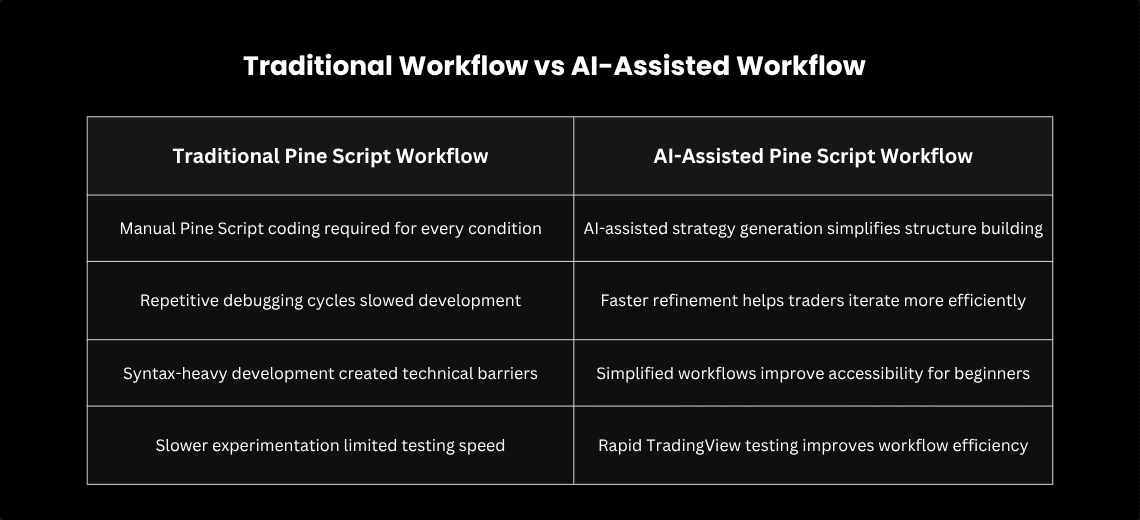
Traders are moving away from workflows that require repetitive coding, manual debugging, syntax-heavy development, and slower experimentation cycles.
Instead, the focus is shifting toward rapid testing, workflow efficiency, AI-assisted generation, faster optimization, and strategy refinement.
Rapid testing allows traders to validate ideas much faster without spending hours rebuilding Pine Script structures manually.
Workflow efficiency improves because traders spend less time fixing technical implementation problems and more time analyzing market behavior.
AI-assisted generation accelerates TradingView strategy creation while reducing repetitive coding tasks.
Faster optimization allows traders to refine entries, exits, confirmations, and execution logic through quicker iteration cycles.
But AI is not replacing trading expertise.
The strongest TradingView workflows still depend heavily on human analysis, realistic backtesting, proper risk management, trading experience, and market understanding.
The future of Pine Script development will likely combine AI-assisted Pine Script generation, TradingView-focused workflows, faster experimentation, human validation, and realistic strategy testing.
That balance is what will define the next generation of TradingView automation.
9. Conclusion: Pine Script Development Is Becoming Faster and Smarter
TradingView development is evolving rapidly.
What once required hours of manual Pine Script coding, repetitive debugging, and slow experimentation can now be simplified through AI-assisted workflows that dramatically accelerate strategy generation and TradingView testing.
Platforms like PineGen AI are helping traders spend less time fixing syntax and more time refining strategy logic, confirmations, optimization, execution quality, and backtesting performance.
But successful TradingView automation still depends on proper validation, realistic testing, market understanding, risk management, and strong trading logic.
Because while AI can accelerate Pine Script workflows, profitable trading still requires human experience and decision-making.
Ready to Build TradingView Strategies in Minutes Instead of Hours?
The biggest shift happening in TradingView development is not just faster coding.
It is faster learning, faster experimentation, and faster strategy refinement.
Modern traders no longer want workflows filled with repetitive debugging, syntax-heavy development, and slow optimization cycles. They want systems that allow them to move quickly from strategy ideas to testing, refinement, and execution.
That is exactly why AI-assisted Pine Script workflows are growing so rapidly.
Whether you are building your first TradingView strategy, experimenting with AI trading systems, optimizing existing workflows, or exploring advanced TradingView automation, faster development cycles can completely change how you approach strategy creation.
Platforms like PineGen AI help traders reduce technical friction by simplifying Pine Script generation, accelerating backtesting workflows, improving experimentation speed, and streamlining TradingView development.
Instead of spending most of your time fixing syntax and rebuilding code manually, you can focus more on:
-
improving strategy quality
-
refining confirmations
-
optimizing execution logic
-
testing market behavior
-
building smarter trading systems
Because in modern TradingView automation, the traders who iterate faster often improve faster.
And in algorithmic trading, faster improvement can become a major competitive advantage.