When Solid Trade Entries Still Fail
Author : Ranga Technologies
Publish Date : 3 / 17 / 2026 • 1 mins read
Last Updated : 3 / 17 / 2026

For a long time, I assumed bad results meant bad entries.
If a strategy had clean signals and logical confirmations, I expected it to behave well once deployed. But after revisiting multiple Pine Script strategies, including ones that looked great in backtests, I noticed something uncomfortable.
The entries weren’t failing.
The exits were.
The Quiet Weak Spot in Many Strategies
Risk logic is often added last.
After hours spent refining indicators and conditions, exits are usually reduced to:
- a fixed stop
- a basic take-profit
- a quick percentage tweak
Across scripts I reviewed and maintained, the same issues kept showing up:
- stops that ignored volatility
- take-profits that behaved inconsistently across assets
- exits triggering during normal price movement
- Strategy Tester results drifting away from live behavior
- logic breaking subtly after Pine Script updates
None of this failed immediately, which made it harder to catch.
Different Ways AI Gets Used in Strategy Work
I noticed that AI tools are often applied too broadly in trading workflows. The difference wasn’t about intelligence, it was about scope.
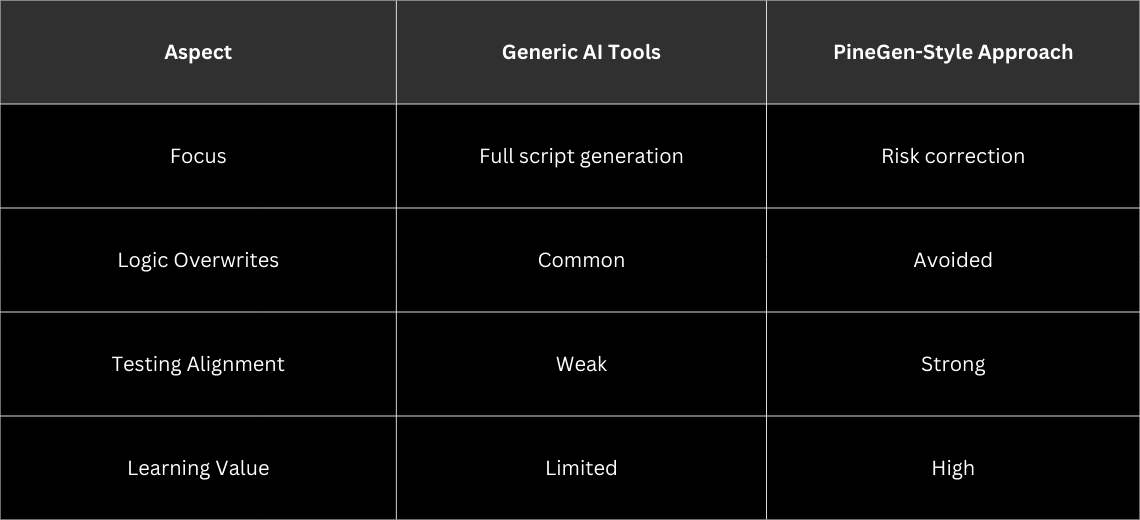
The more focused the role, the more useful the output became.
Fixing the Risk Layer Without Touching the Idea
Instead of rebuilding strategies, I treated risk logic as a separate layer.
What I adjusted:
- stop-loss structure
- take-profit behavior
- volatility handling
- bar confirmation logic
What I deliberately left unchanged:
- entry rules
- indicators
- market bias
- proprietary filters
The goal wasn’t improvement through complexity.
It was consistency through structure.
Why Risk Logic Needs More Than Simple Math
A stop-loss isn’t just a number on a chart.
It represents assumptions about:
- acceptable noise
- timing
- volatility regimes
When those assumptions aren’t explicit:
- trades exit too early
- position sizing behaves unpredictably
- backtest statistics become misleading
This is where structured review helped more than endless tweaking.
Manual Risk Logic vs Structured Review
Here’s what changed when exits were rebuilt with clearer constraints and confirmation rules:
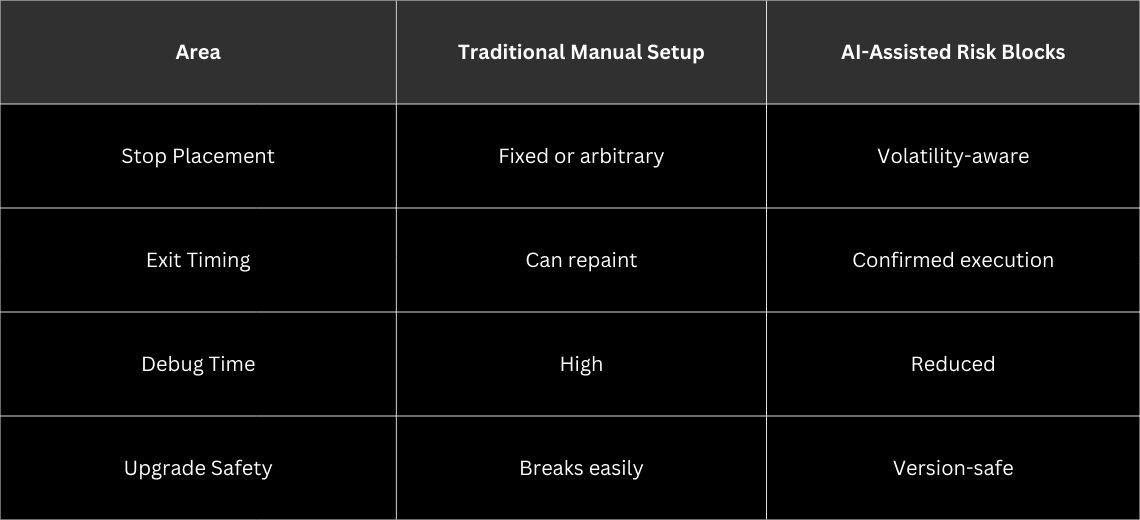
The logic didn’t become smarter. It became more deliberate.
What Changed After Rebuilding Exits
Once the risk layer was properly structured:
- exits stopped reacting to normal price noise
- Strategy Tester behavior stabilized
- scripts handled version updates more safely
- debugging cycles shortened
- confidence in live execution improved
Nothing else in the strategy changed, and that was intentional.
Entries Get Attention. Exits Decide Survival.
Entries are easy to analyze visually.
Risk logic isn’t.
But most strategies don’t fail because an entry was slightly late. They fail because the exit logic doesn’t respect volatility, confirmation, or context.
Used carefully, AI helped slow down that part of the process — not by inventing ideas, but by questioning assumptions.
What This Shift Changed for Me
I stopped chasing better entries. Instead, I started asking:
- Does this exit behave the same across conditions?
- Would this logic survive a market shift?
- Would I trust this execution live?
That change improved my strategies more than any new indicator ever did.