How AI is Transforming Risk Management in Trading Strategy Design
Author : Ranga Technologies
Publish Date : 6 / 29 / 2026 • 3 mins read
Last Updated : 6 / 29 / 2026
Are Traders Optimizing Entries While Ignoring the Biggest Threat to Their Strategy?
Most traders spend countless hours searching for better entries.
-
They test RSI signals.
-
They build breakout confirmations.
-
They optimize indicators repeatedly.
But very few traders spend the same amount of time improving the one thing that often determines whether a strategy survives:
Risk management. A strategy can have excellent entries and still fail.
A strategy can have average entries and remain profitable for years. The difference is often how risk is managed.
That reality is becoming even more important as TradingView strategies become increasingly sophisticated.
-
Markets move faster.
-
Volatility changes more frequently.
-
Strategies process larger amounts of data.
And traders need better ways to protect capital while maintaining performance.
This is exactly where artificial intelligence is beginning to reshape modern strategy development.
Instead of focusing only on signal generation, traders are increasingly using AI-assisted workflows to analyze risk, improve backtesting, optimize stop-loss structures, refine position sizing, and build more resilient TradingView systems.
Platforms like PineGen AI are helping accelerate that shift. Artificial intelligence is rapidly changing how traders approach risk management in TradingView strategy development. Instead of relying entirely on fixed rules and manual analysis, traders are increasingly using AI-assisted workflows to improve stop-loss logic, optimize risk-reward structures, accelerate backtesting, analyze drawdowns, and strengthen overall strategy performance.
This article explores why risk management matters more than ever, what AI is changing in modern strategy design, and how PineGen AI is helping traders build stronger TradingView workflows.
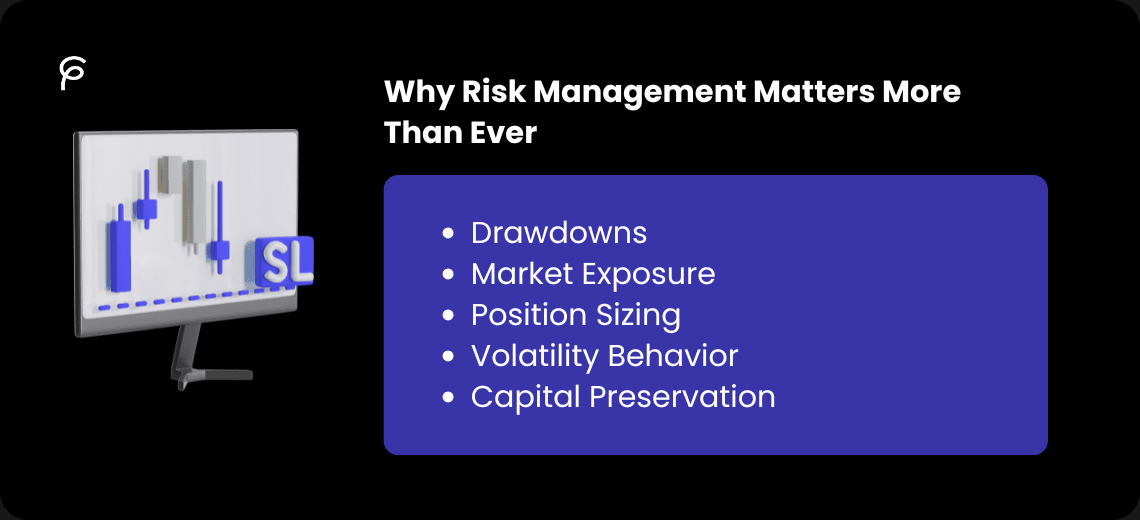
1. Why Risk Management Matters More Than Ever
Most traders enter the market believing profitability comes from finding better signals. Over time, experienced traders discover something very different. The market does not reward traders simply for finding opportunities. It rewards traders who can survive uncertainty.Every strategy eventually experiences losses. Every system faces drawdowns.Every trader encounters market conditions that differ from historical expectations.
This is why professional traders spend significant time analyzing risk.
-
Drawdowns – Understanding how much capital a strategy can lose before recovering. A strategy with strong returns but severe drawdowns may be difficult to trade consistently in real market conditions.
-
Market Exposure – Evaluating how much risk is concentrated in a particular asset, sector, or market environment. Excessive exposure can amplify losses during unexpected market events.
-
Position Sizing – Determining how much capital should be allocated to each trade. Even profitable strategies can become dangerous when position sizes are too aggressive.
-
Volatility Behavior – Measuring how strategies react when market conditions become unstable. Some systems perform well during trends but struggle when volatility suddenly increases.
-
Capital Preservation – Protecting trading capital during unfavorable conditions so traders can continue participating when opportunities return.
Because long-term profitability is often the result of effective risk management rather than perfect entries.
As markets become increasingly complex, manually evaluating all these factors becomes more difficult. And that is one reason AI-powered workflows are becoming increasingly valuable.
2. What Is AI-Powered Risk Management?
AI-powered risk management refers to the use of artificial intelligence to analyze, optimize, and improve how trading strategies handle risk. Traditionally, traders relied on manual analysis.
-
They reviewed charts.
-
They tested stop-loss levels.
-
They adjusted risk parameters one change at a time.
While those methods still work, they can be slow. Artificial intelligence helps accelerate that process.
Instead of manually reviewing every scenario, traders can evaluate larger datasets, test more configurations, and identify hidden weaknesses significantly faster. The goal is not to eliminate risk. No technology can remove risk from financial markets. The goal is to understand risk more clearly and respond to it more intelligently. That distinction is extremely important.
3. Why Traditional Risk Management Is Becoming Harder
Traditional risk management methods were designed around relatively static assumptions.
Many traders still rely on fixed stop-loss percentages, fixed risk-reward ratios, and static position sizing.
The problem is that markets rarely remain static.
3.1 ATR-Based Stop-Losses
Average True Range (ATR) measures market volatility. AI-assisted strategy development can help traders build stop-loss systems that automatically adjust based on current market conditions.
During high-volatility periods, stops can widen to reduce unnecessary exits.
During lower-volatility periods, stops can tighten to improve capital efficiency.
3.2 Volatility-Aware Exits
Some strategies perform well when markets trend smoothly but struggle during sudden volatility spikes.
AI can help identify these situations and optimize exit behavior accordingly, reducing the likelihood of being stopped out by temporary market noise.
3.3 Trailing Stop Optimization
Many traders use trailing stops to protect profits.
However, determining the ideal trailing distance often requires extensive testing.
AI-assisted workflows allow traders to compare multiple trailing-stop configurations much faster, helping identify structures that balance profit protection with trend participation.
3.4 Market Structure-Based Exits
Rather than exiting based solely on price percentages, AI can help traders design exits around support levels, resistance zones, swing highs, and swing lows.
These exits often align more closely with actual market behavior and can improve overall strategy robustness.
The result is not simply tighter stop-losses.
The result is smarter stop-losses designed to adapt to changing market conditions.
A stop-loss that performs well during a low-volatility environment may become ineffective during a high-volatility event.
A position size that appears conservative during a strong trend may become overly aggressive during uncertainty.
The challenge is not that traditional methods are wrong.The challenge is that markets have become increasingly dynamic.
Artificial intelligence helps traders evaluate how strategies behave across changing market environments.
This creates a more adaptive approach to risk management and strategy development.
4. How AI Is Transforming Risk Analysis
One of AI's greatest advantages is its ability to process large amounts of information quickly. Human traders naturally focus on visible metrics.
-
Win rate.
-
Recent performance.
Artificial intelligence can analyze much deeper relationships.
For example, AI-assisted workflows can help reveal whether a strategy performs poorly during high-volatility conditions, becomes dependent on a small number of winning trades, or carries hidden exposure risks that are difficult to identify manually. Some strategies appear profitable on the surface while hiding significant weaknesses underneath. Others perform exceptionally well during trends but struggle during ranging markets.
These weaknesses often remain unnoticed until traders begin risking real capital. AI helps uncover those issues earlier. That allows traders to improve strategy quality before deployment rather than discovering weaknesses through expensive mistakes.
5. How AI Is Improving Stop-Loss Design
Stop-losses remain one of the most important components of any trading strategy. Yet many traders continue using fixed stop-loss levels simply because they are easy to implement. Markets do not move with fixed levels of volatility. A stop-loss that works perfectly today may become ineffective tomorrow.
Artificial intelligence helps traders experiment with more adaptive approaches.
-
ATR-based stop-loss systems can automatically adjust according to changing market volatility rather than relying on fixed percentages.
-
Volatility-aware exits can respond differently during unstable market conditions, helping reduce unnecessary stop-outs.
-
Trailing stop structures can be optimized to protect profits while still allowing trends to develop naturally.
-
Market-structure exits can react to support and resistance behavior rather than arbitrary price distances.
The goal is not creating tighter stops.The goal is creating smarter stops.And AI is helping traders achieve that much faster.
6. How AI Improves Position Sizing Decisions
Position sizing is one of the most overlooked areas of trading strategy development. Many traders focus heavily on entries while spending very little time evaluating how much capital should actually be allocated to each position.
Yet position sizing often determines whether a strategy survives difficult market conditions. Even profitable strategies can fail if positions become too large. AI-assisted workflows help traders analyze how different allocation models impact overall strategy performance. Capital efficiency analysis helps determine whether available funds are being used effectively.
Risk exposure evaluation identifies situations where too much capital becomes concentrated in a single market condition. Portfolio stability analysis helps traders understand how position sizing affects drawdowns and equity fluctuations. Long-term consistency testing allows traders to compare allocation models across multiple market environments.
This creates a more balanced and resilient approach to strategy design.
7. How AI Is Changing Drawdown Analysis
Ask a beginner trader about performance and they usually talk about profits.
Ask a professional trader and they often talk about drawdowns.
Drawdown measures the decline from a strategy's highest equity point to its lowest point before recovery. Understanding drawdowns is critical because they affect both capital and psychology. A strategy may eventually recover.
The real question is whether the trader can tolerate the losses required to reach that recovery. Artificial intelligence helps traders analyze drawdown behavior much more efficiently. Instead of manually reviewing a small number of backtests, traders can evaluate how drawdowns behave across many different market conditions.
This helps answer important questions.
-
How severe can losses become?
-
What environments create the largest drawdowns?
-
Can the strategy recover consistently?
-
Does risk remain stable over time?
Those insights help traders build systems designed for long-term survival rather than short-term performance.
8. How AI Is Transforming Backtesting Workflows
Backtesting has always been a critical part of TradingView strategy development. Traditionally, traders adjusted parameters manually, reran tests, and compared results repeatedly. The process worked. But it was slow. AI-assisted workflows accelerate experimentation.
Instead of spending hours manually testing every possible variation, traders can identify stronger configurations significantly faster. Risk-reward structures can be evaluated more efficiently. Stop-loss systems can be compared across multiple conditions. Position sizing models can be optimized faster. Strategy weaknesses can be identified earlier.
This allows traders to spend less time performing repetitive testing and more time understanding strategy behavior.
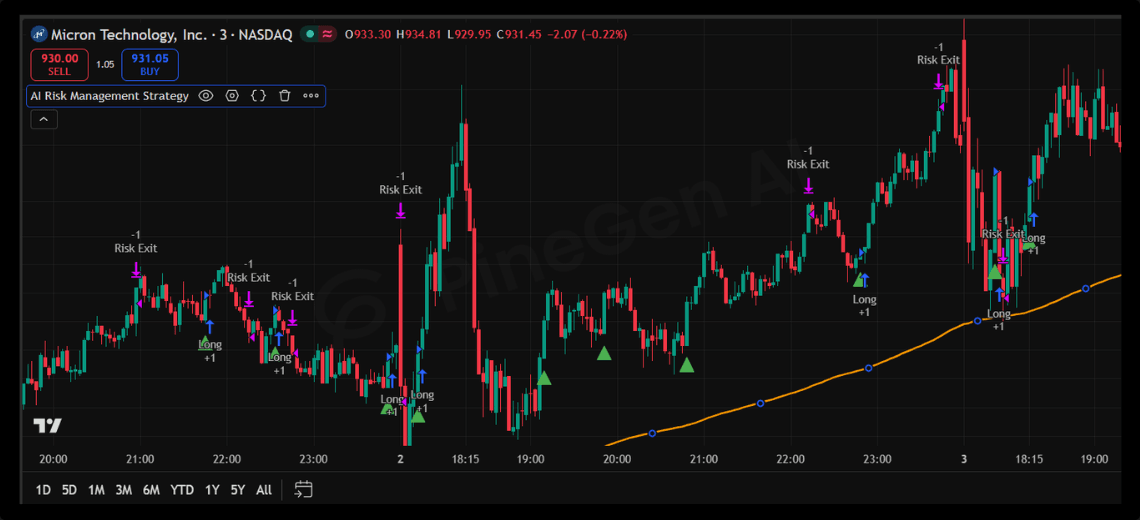
9. Example: AI-Assisted Risk Management Strategy in Pine Script
One of the most common uses of Pine Script AI tools is building risk-aware TradingView strategies that combine trend filtering, dynamic stop-loss logic, and risk-reward management.
pine//@version=6
strategy("AI Risk Management Strategy", overlay=true, initial_capital=10000)

// Indicators
ema200 = ta.ema(close, 200)
rsiValue = ta.rsi(close, 14)
atrValue = ta.atr(14)

// Trend and confirmation
bullTrend = close > ema200
rsiConfirmation = ta.crossover(rsiValue, 50)

// Entry condition
longCondition = bullTrend and rsiConfirmation

// Execute entry
if longCondition
    strategy.entry("Long", strategy.long)

// Risk management
stopLoss = strategy.position_avg_price - (atrValue * 2)
takeProfit = strategy.position_avg_price + ((strategy.position_avg_price - stopLoss) * 3)

// Exit orders
strategy.exit(
     "Risk Exit",
     from_entry = "Long",
     stop = stopLoss,
     limit = takeProfit
)

// Plot EMA
plot(ema200, title="EMA 200", color=color.orange, linewidth=2)

// Visual buy signal
plotshape(
     longCondition,
     title="Buy Signal",
     location=location.belowbar,
     color=color.green,
     style=shape.triangleup,
     size=size.small
)
This example combines trend confirmation, volatility-aware stop-loss logic, and predefined risk-reward management into a single TradingView workflow.
AI-assisted Pine Script generation helps traders create and refine structures like these significantly faster.
10. How PineGen AI Simplifies Risk-Aware TradingView Development
Many AI coding tools can generate code. But TradingView strategy development requires much more than code generation. It requires understanding:
-
TradingView compatibility.
-
Strategy structure.
-
Backtesting workflows.
-
Execution logic.
-
Risk-management behavior.
That specialization matters.
General AI tools often generate outdated Pine Script versions, unsupported TradingView functions, or incomplete strategy structures.
PineGen AI focuses specifically on Pine Script and TradingView workflows.
Instead of acting like a general-purpose coding assistant, PineGen AI helps simplify:
Pine Script generation, allowing traders to move from idea to TradingView code significantly faster.
AI-assisted debugging, helping identify workflow issues without spending hours manually reviewing scripts.
Strategy refinement, enabling traders to improve logic, confirmations, and risk-management behavior more efficiently.
TradingView optimization, supporting faster experimentation and workflow iteration.
Prompt-to-strategy generation, helping traders transform natural language descriptions into TradingView-compatible Pine Script structures.
This specialized approach creates a smoother development experience for traders building AI trading strategies on TradingView.
11. Why AI-Assisted Risk Management Is Becoming a Competitive Advantage
Markets are generating more data than ever before. Strategies are becoming more complex. Traders are expected to make better decisions faster. Artificial intelligence helps bridge that gap. The competitive advantage is not simply generating Pine Script faster. It is understanding risk more effectively.
Traders who can identify weaknesses sooner, optimize strategies faster, and adapt to changing conditions more efficiently often gain a significant edge. That advantage compounds over time. And it is one of the biggest reasons AI-powered TradingView development continues to grow.
12. Conclusion: Smarter Risk Management Creates Stronger Trading Systems
The future of trading strategy development is not simply about finding better entries. It is about building more resilient systems.
Artificial intelligence is helping traders move beyond static risk-management frameworks and adopt more adaptive, data-driven approaches.
From stop-loss optimization and position sizing to drawdown analysis and backtesting, AI is transforming how risk is evaluated throughout the strategy development process.
Platforms like PineGen AI are helping accelerate that transformation by simplifying Pine Script generation, improving TradingView workflows, and making advanced strategy development more accessible. Because successful trading is not simply about finding opportunities. It is about surviving uncertainty. And smarter risk management remains one of the most effective ways to do that. Many TradingView traders face the same challenge.
-
They spend hours testing stop-loss levels.
-
They repeatedly rebuild risk-management workflows.
-
They manually optimize position sizing structures.
And they spend valuable time debugging Pine Script instead of improving strategy quality.
That workflow slows experimentation. It slows optimization. And ultimately it slows growth.
PineGen AI was built specifically to simplify Pine Script and TradingView development. Instead of spending most of your workflow managing repetitive development tasks, you can focus more on:
-
Building stronger AI trading strategies.
-
Improving risk-management frameworks.
-
Accelerating TradingView optimization.
-
Refining execution quality.
Because in modern TradingView development, the traders who understand risk better often build stronger systems.
Start exploring PineGen AI today and discover how AI-assisted Pine Script development can help you build more resilient TradingView strategies.