How Can Pine Script Traders Apply Machine Learning Concepts?
Author : Ranga Technologies
Publish Date : 3 / 17 / 2026 • 1 mins read
Last Updated : 3 / 17 / 2026
Key Highlights
Machine learning (ML) can inspire adaptive and data-driven Pine Script strategies, even though TradingView’s scripting language can’t handle full-scale ML models. By understanding ML basics and pairing Pine Script with AI-powered code generation, traders can implement simplified ML features like adaptive indicators, clustering, and confidence scoring.
What Is Machine Learning in Trading?
Machine learning is about enabling computers to learn patterns from data and make predictions or decisions without explicit programming for every situation. In trading, ML is often applied to:
-
Neural Networks – Capture complex, nonlinear relationships in market data.
-
k-Nearest Neighbors (kNN) – Classify market states based on historical similarities.
-
Clustering (K-Means) – Group market conditions into regimes, such as trending or ranging.
-
Reinforcement Learning – Learn optimal actions through trial and error with feedback.
These techniques can help traders detect regime changes, adapt parameters automatically, and create strategies that respond to evolving market conditions.
What Can Be Done in Pine Script?
While Pine Script isn’t a full ML engine, it can replicate simplified ML-inspired logic:
-
Basic Neural Networks – Implement small feedforward models with basic backpropagation.
-
Adaptive Indicators – Adjust indicator parameters dynamically based on recent volatility or momentum.
-
Clustering and Regime Detection – Use volatility patterns to switch strategies between trend and range conditions.
-
Signal Confidence Scoring – Estimate the likelihood of a trade’s success using historical performance data.
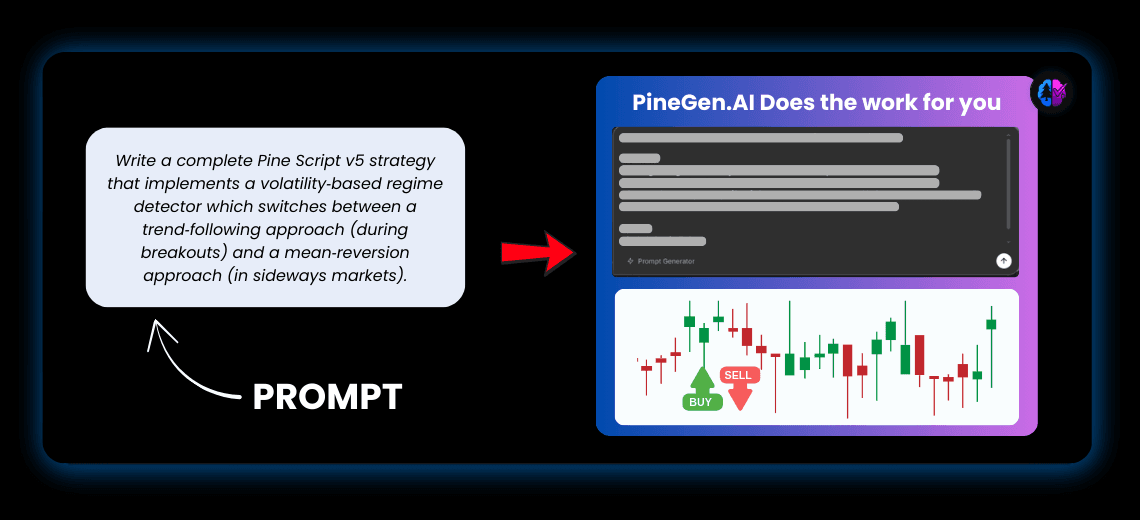
Example: You could build a volatility-based regime detector that changes from a trend-following approach during breakouts to a mean-reversion approach in sideways markets.
What Pine Script Can’t Do
Because Pine Script runs in a sandboxed environment with no persistent storage, it cannot:
-
Train deep neural networks or other large ML models.
-
Directly integrate TensorFlow, PyTorch, or similar ML libraries.
-
Continuously learn between TradingView sessions.
-
Dynamically fetch and process large external datasets.
How AI Tools Bridge the Gap
AI-powered tools like Pine Script AI allow traders to take ML ideas and translate them into executable Pine Script code. They help by:
-
Generating Pine Script Code from ML-inspired logic.
-
Preprocessing and Feature Engineering outside TradingView, then importing optimized parameters or signals.
-
Hybrid Workflow Creation where complex ML runs offline and Pine Script handles real-time visualization and trade execution.
-
Educational Guidance to explain how ML concepts can fit into Pine Script’s limitations.
Real-World Examples of ML-Inspired Pine Script
-
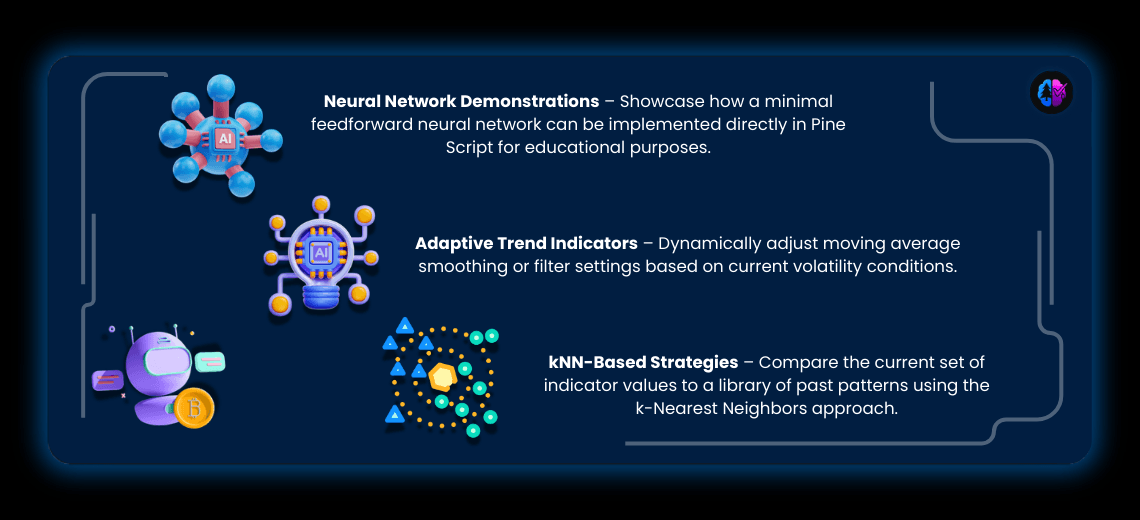
Neural Network Demonstrations – Educational scripts that forecast prices using small-scale neural networks.
-
Adaptive Trend Indicators – Indicators that use volatility clustering to adjust smoothing factors in real time.
-
kNN-Based Strategies – Classify current market states by comparing indicator patterns to historical ones.
Key Takeaways
Pine Script supports ML-inspired adaptability, but not large-scale model training.
AI-powered code generation bridges the gap between ML concepts and Pine Script’s capabilities.
The most effective workflows combine offline ML with real-time Pine Script execution.