Options Expiration (OpEx) Shock: How Trillions in Expiring Contracts Are Reshaping U.S. Market Behavior
Author : Ranga Technologies
Publish Date : 4 / 22 / 2026 • 1 mins read
Last Updated : 4 / 22 / 2026
When a massive wave of options expires, markets don’t just “reset.” They lost a layer of structure that was quietly influencing price movement.
This case study examines how large-scale options expiration events (OpEx) affect U.S. market behavior, focusing on dealer hedging flows, volatility shifts, liquidity conditions, and strategy performance.
The goal is to understand what actually changes inside the market when trillions in contracts disappear.
1. Why Options Expiration Matters
Modern U.S. markets are heavily influenced by derivatives activity, especially index options tied to benchmarks like the S&P 500.
During active options cycles:
-
market makers (dealers) hold positions
-
they hedge dynamically to manage risk
-
this hedging directly impacts price movement
As expiration approaches:
-
hedging activity intensifies
-
price behavior becomes more “controlled”
But once expiration hits:
-
contracts settle
-
hedges are removed or reduced
-
the stabilizing effect disappears
2. What This Means Structurally
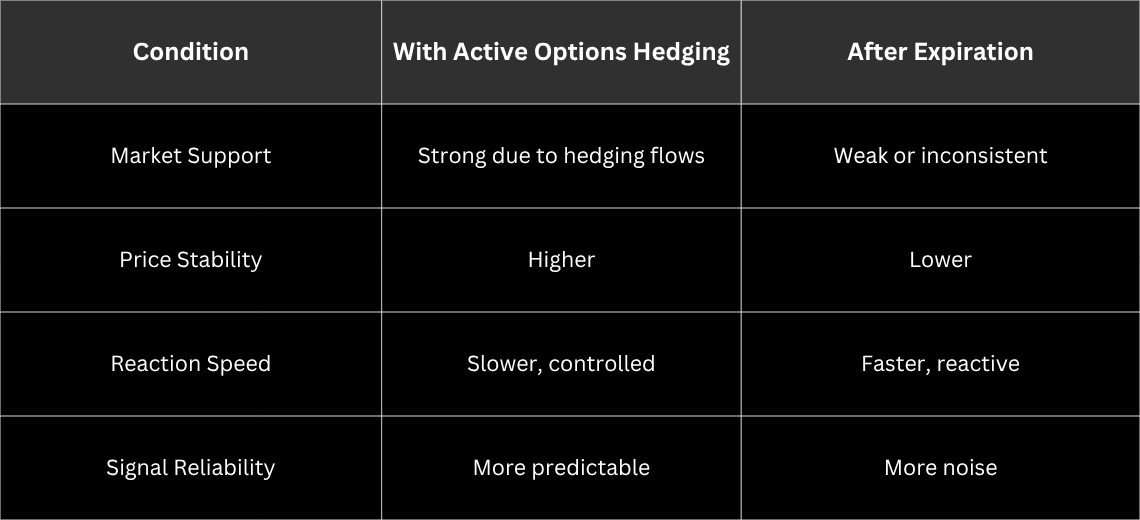
Before OpEx → price influenced by hedging flows
After OpEx → price driven more by raw supply & demand
This shift is subtle, but powerful.
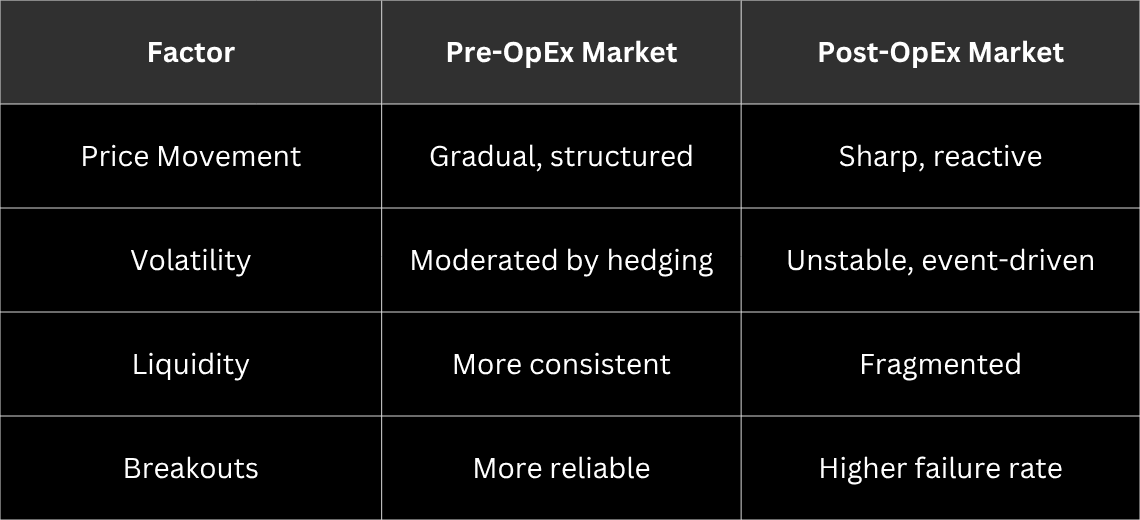
3. Market Conditions: Before vs After OpEx
4. What Changes in Market Structure
4.1 Hedging Flow Collapse
During the options cycle:
-
dealers hedge continuously
-
this creates support/resistance-like behavior
After expiration:
-
hedging demand drops sharply
-
price becomes less anchored
4.2 Volatility Regime Shift
Markets transition from:
-
structured volatility (controlled movement) to
-
reactive volatility (news + flow driven)
This leads to:
-
sharper intraday moves
-
less predictable trends
-
more frequent reversals
4.3 Liquidity Rebalancing
Liquidity doesn’t disappear, but it becomes uneven:
-
pre-OpEx → deeper order books
-
post-OpEx → thinner zones in certain price levels
Result:
-
faster price movement
-
increased slippage risk
4.4 Intraday Behavior Changes
After expiration, traders often notice:
-
breakouts failing more often
-
sudden spikes without strong catalysts
-
shorter trend cycles
This is not random, it’s structural.
5. Dealer Hedging Impact on Price Behavior
6. How Trading Behavior Adapts
6.1 Short-Term Traders
-
shift focus to volatility spikes
-
trade failed breakouts and reversals
-
reduce reliance on clean trend continuation
6.2 Swing Traders
-
face difficulty holding positions
-
trends break earlier than expected
-
require stronger confirmation signals
6.3 Institutional Traders
-
reduce exposure around expiration
-
rebalance portfolios post-OpEx
-
adjust hedging frameworks
6.4 Systematic Traders
modify parameters:
-
ATR thresholds
-
stop-loss distances
-
position sizing
7. Why Strategies Break After OpEx
Many strategies assume:
-
stable volatility
-
consistent liquidity
-
predictable trend continuation
After expiration, those assumptions fail.
8. Data-Backed Behavior Patterns
Market observations around expiration cycles show:
-
increased volatility immediately after expiry
-
reduced gamma exposure from dealers
-
stronger price reactions to smaller orders
-
equity indices becoming more sensitive to macro triggers.
9. Strategy Implications in OpEx Conditions
Traditional strategies struggle because:
-
they are built on historical stability
-
they ignore execution friction
-
they assume consistent structure
10. More Effective Approaches
-
adaptive stop-loss models
-
confirmation-based entries
-
reduced position sizing during transitions
11. Where PineGen AI Fits in This Environment
During OpEx-driven shifts, the biggest challenge is adapting quickly.
PineGen AI helps by:
-
generating strategy variations faster
-
allowing rapid testing across conditions
-
reducing debugging time
-
enabling structured iteration
Instead of manually adjusting strategies over hours or days, traders can:
-
test multiple logic variations
-
refine risk models
-
respond to changing market structure
12. Conclusion
Options expiration doesn’t just close contracts, it removes a structural layer from the market.
Markets shift from:
-
controlled → reactive
-
stable → uneven
-
trend-driven → volatility-driven
This explains why:
-
strategies suddenly stop working
-
breakouts fail more often
-
price becomes harder to interpret
The problem is not always the strategy.
Sometimes, the market environment itself has changed.
If your strategies behave differently around expiration cycles, it’s not random.
Use PineGen AI to:
-
test strategies across different conditions
-
adjust logic quickly
-
build systems that adapt instead of break
Because in markets influenced by options flows, flexibility matters more than prediction.