Advanced Insights into Large Language Models (LLMs)
Author : Ranga Technologies
Publish Date : 4 / 5 / 2026 • 1 mins read
Last Updated : 4 / 5 / 2026
If AI can write code, explain markets, and even generate trading ideas…
Why do most strategies still fail?
That gap between idea and consistent results is where Large Language Models sit.
Large Language Models (LLMs) are AI systems trained on massive datasets to generate and understand text. They are widely used in coding, automation, and content generation. In trading, they help with strategy creation, debugging Pine Script, and improving workflow efficiency. This blog explains how LLMs work, their real limitations, and how traders can practically use them with tools like PineGen AI.
1. Why LLMs Matter
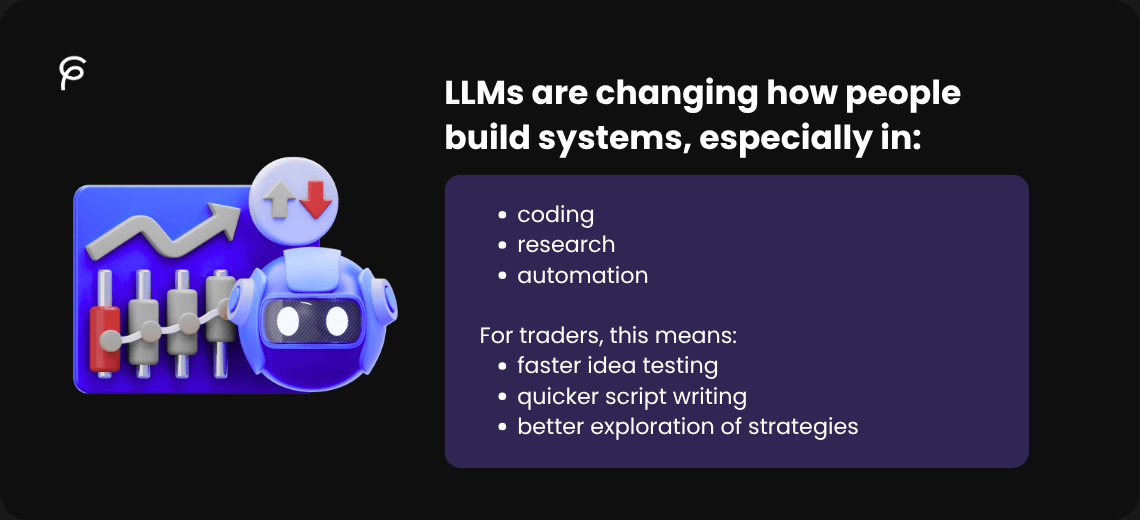
LLMs are changing how people build systems, especially in:
-
coding
-
research
-
automation
For traders, this means:
-
faster idea testing
-
quicker script writing
-
better exploration of strategies
They don’t trade for you, they help you build faster and think clearer.
2. What LLMs Are
Large Language Models are trained on huge amounts of text data.
They learn:
-
patterns in language
-
structure of information
-
relationships between concepts
They do not think or reason like humans.
They predict the next most likely word based on input.
3. How LLMs Work
At a simple level:
-
Input text is broken into tokens
-
Tokens go through a transformer model
-
Model predicts the next token
-
Output is generated step by step
This is why LLMs can:
-
write code
-
explain concepts
-
summarize ideas
4. Why Traders Use LLMs
In trading workflows, LLMs help with:
1. Strategy Ideas
Convert concepts into structured logic.
2. Pine Script Assistance
Help generate or fix scripts faster.
3. Debugging
Identify errors in code logic.
4. Workflow Efficiency
Reduce time spent on repetitive tasks.
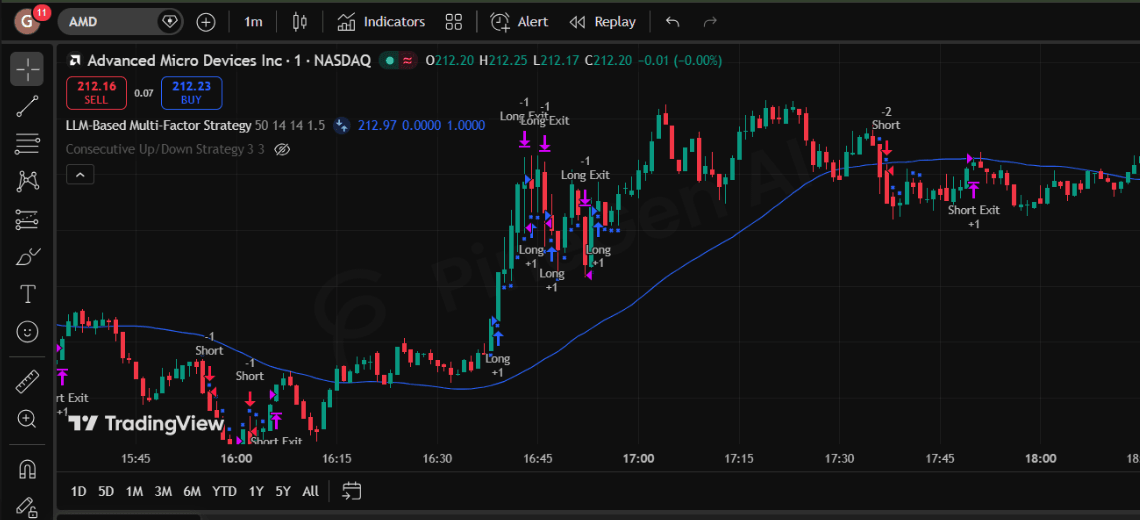
5. Practical Trading Code Example
//@version=6
strategy("LLM-Based Multi-Factor Strategy", overlay=true)

// ==========================
// INPUTS
// ==========================
trendLen = input.int(50, "Trend Length")
rsiLen   = input.int(14, "RSI Length")
atrLen   = input.int(14, "ATR Length")
riskMult = input.float(1.5, "ATR Risk Multiplier")

// ==========================
// INDICATORS
// ==========================
trend = ta.sma(close, trendLen)
rsi   = ta.rsi(close, rsiLen)
atr   = ta.atr(atrLen)

// ==========================
// LOGIC (LLM-STYLE RULE COMBINATION)
// ==========================

// Trend condition
isBullTrend = close > trend
isBearTrend = close  55
bearMomentum = rsi  ta.sma(atr, atrLen)

// Entry signals
longCondition  = isBullTrend and bullMomentum and volExpand
shortCondition = isBearTrend and bearMomentum and volExpand

// ==========================
// RISK MANAGEMENT
// ==========================
stopLoss = atr * riskMult
takeProfit = stopLoss * 2

// ==========================
// EXECUTION
// ==========================
if (longCondition)
    strategy.entry("Long", strategy.long)
    strategy.exit("Long Exit", from_entry="Long", stop=close - stopLoss, limit=close + takeProfit)

if (shortCondition)
    strategy.entry("Short", strategy.short)
    strategy.exit("Short Exit", from_entry="Short", stop=close + stopLoss, limit=close - takeProfit)

// ==========================
// VISUALS
// ==========================
plot(trend, title="Trend MA")

plotshape(longCondition, title="Buy", location=location.belowbar)
plotshape(shortCondition, title="Sell", location=location.abovebar)
This shows how LLM-generated logic becomes structured trading rules.
6. Limitations You Should Know
LLMs are helpful, but they have clear limits:
1. No real understanding
They generate based on patterns, not reasoning.
2. Incorrect outputs
Sometimes they produce wrong or incomplete logic.
3. No live market awareness
They don’t access real-time data.
4. Overconfidence in outputs
They can sound correct even when they are not.
This is why validation is always required.
7. Why PineGen AI Fits Better for Trading
General AI tools are broad.
They don’t specialize in trading logic.
PineGen AI focuses on:
-
Pine Script generation
-
TradingView strategies
-
trading-specific structure
That means:
-
fewer errors
-
faster scripting
-
better alignment with trading logic
Compared to general LLMs, it reduces friction when building actual strategies.
8. Conclusion
Large Language Models are powerful tools, but they sit in the background of trading workflows, not at the decision layer.
They help you:
-
think faster
-
structure logic
-
generate code
-
explore ideas
But the real edge comes from:
-
how well you validate
-
how disciplined your system is
-
how strong your risk control is
When combined with tools like PineGen AI , LLMs become practical assistants rather than abstract concepts.
If you’re building strategies, focus on:
-
testing
-
refining
-
and consistency
That’s where results actually come from.