A/B Backtest Comparison: Human-Written vs AI-Generated Scalping Logic
Author : Ranga Technologies
Publish Date : 6 / 18 / 2026 • 8 mins read
Last Updated : 6 / 18 / 2026
Can AI Really Build Better Scalping Strategies Than Human Traders?
Scalping has always been one of the fastest and most demanding forms of trading.
Unlike swing trading or long-term investing, scalping strategies rely heavily on speed, precision, rapid execution, and tight risk management. Even small delays in entries or poorly structured conditions can completely change how a strategy performs during live market conditions.
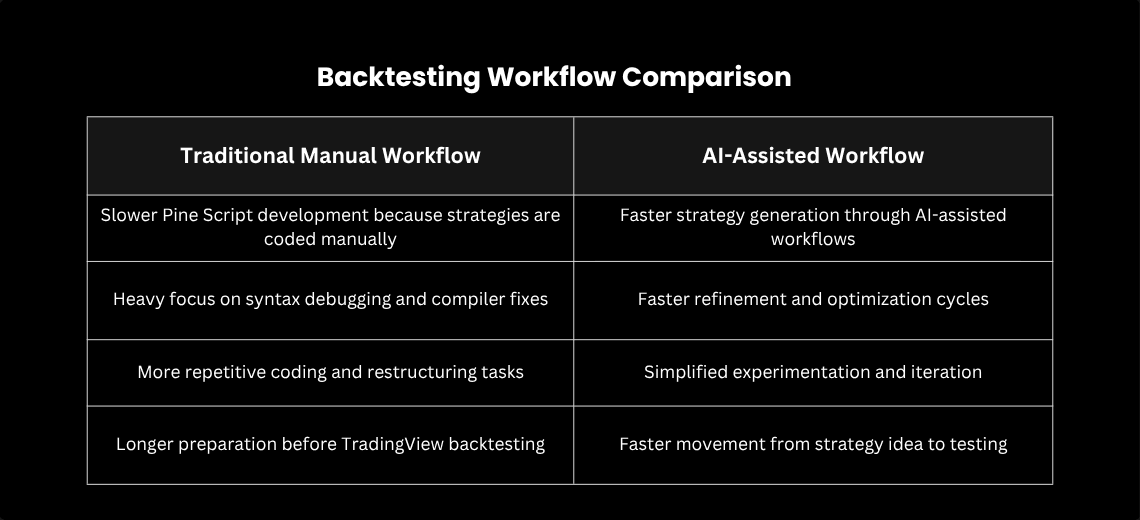
Traditionally, building a TradingView scalping strategy required traders to manually write Pine Script code, structure confirmations, optimize entries and exits, debug conditions, and repeatedly validate backtesting performance.
Can AI-generated scalping logic actually compete with human-written strategies?
To explore that question, traders are increasingly running A/B backtest comparisons between manually written Pine Script strategies and AI-generated TradingView workflows.
And the results are changing how many traders think about Pine Script development.
AI-assisted TradingView development is rapidly changing how traders build and test scalping strategies. Instead of spending hours manually coding Pine Script structures, traders can now generate strategy frameworks much faster using AI-assisted workflows.
This article explores the differences between human-written and AI-generated scalping logic, how traders compare both approaches through TradingView backtesting, and why specialized Pine Script AI platforms like PineGen AI are becoming increasingly important in modern TradingView automation workflows.
1. Why Scalping Strategies Are Difficult to Build
Scalping strategies are extremely sensitive to timing and execution quality.
Unlike slower trading systems that allow wider margins for error, scalping workflows depend heavily on rapid confirmations, precise entries, tight stop-loss structures, quick exits, and efficient execution logic.
Even small mistakes inside Pine Script conditions can dramatically affect strategy performance.
Many traders initially underestimate how difficult scalping automation actually becomes inside TradingView.
A strategy that appears simple visually often requires multiple layers of logic working together simultaneously. Traders usually need confirmation filters, volatility conditions, execution rules, trend direction logic, and risk management structures all operating together without conflicts.
Confirmation filters help traders avoid weak entries by validating whether momentum or trend conditions support the trade setup.
Volatility conditions are important because scalping strategies behave differently during calm and aggressive market environments. Poor volatility filtering can create excessive false signals.
Execution rules determine how and when trades are triggered. Even slight delays or incorrect trigger behavior can impact short-term trading results significantly.
Trend direction logic helps traders align scalping positions with broader market momentum instead of trading against strong directional moves.
Risk management structures control losses and position exposure. In fast-moving scalping environments, weak stop-loss behavior can quickly damage overall strategy performance.
All of those conditions must behave correctly during both historical backtesting and live market execution.
That complexity is one of the biggest reasons many traders spend significant amounts of time debugging Pine Script workflows manually.
2. The Rise of AI-Generated TradingView Logic
Artificial intelligence is rapidly changing how traders approach Pine Script development.
Instead of manually writing every TradingView condition line by line, traders are increasingly using AI-assisted workflows to accelerate strategy generation and reduce repetitive development tasks.
The biggest transformation is not simply faster code generation.
The real shift is faster experimentation.
In the past, traders often spent most of their workflow fixing syntax issues, restructuring conditions, debugging TradingView behavior, and rebuilding strategy logic repeatedly.
Today, traders can move through those stages much faster using AI-assisted Pine Script workflows.
Instead of spending hours building strategy structures manually, traders can focus more on strategy refinement, optimization, backtesting analysis, execution quality, and market behavior.
Strategy refinement becomes easier because traders can continuously improve entries, confirmations, and exits without rebuilding the full strategy structure manually.
Optimization improves because AI-assisted workflows make it faster to adjust parameters and compare multiple TradingView variations quickly.
Backtesting analysis becomes more efficient because traders can spend more time reviewing strategy performance instead of fixing compiler errors.
Execution quality becomes a larger focus because traders can evaluate how strategies behave during live-like market conditions rather than spending most of their workflow debugging syntax.
Market behavior analysis improves because traders can experiment with different market conditions faster and observe how strategies adapt.
That faster iteration cycle is one of the biggest reasons AI-assisted Pine Script development is growing so quickly among TradingView users.
3. Human-Written vs AI-Generated Scalping Workflows
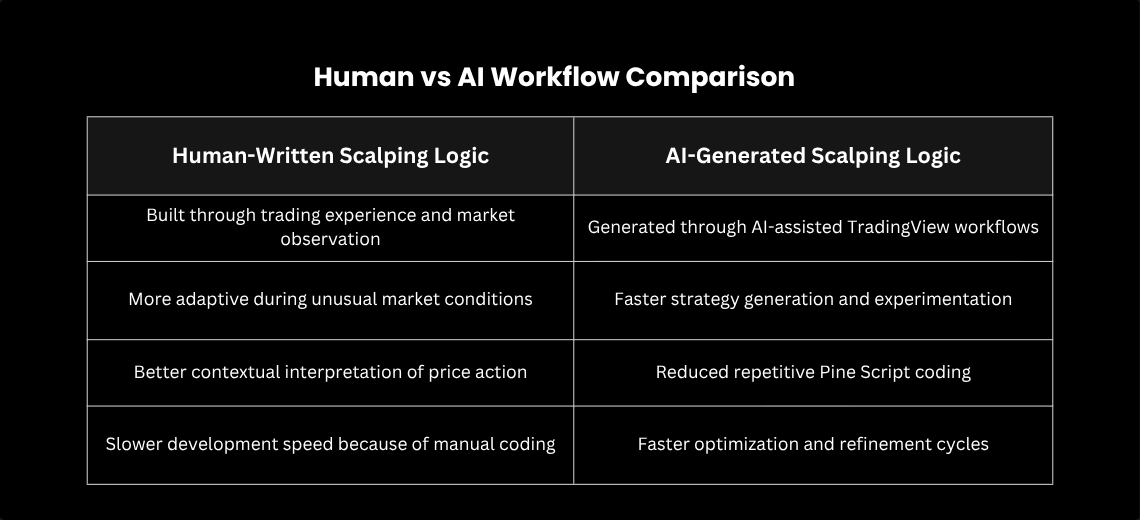
Human-written scalping strategies are usually built through experience-driven decision-making.
A trader manually structures confirmations, risk management, and execution behavior based on market observations and trading experience. Human traders often recognize nuances in price behavior that are difficult to describe purely through code.
For example, experienced scalpers frequently adjust entry timing, volatility thresholds, momentum conditions, trend filters, and execution logic based on changing market behavior.
Entry timing adjustments help traders avoid weak entries during unstable or choppy conditions.
Volatility thresholds allow traders to avoid low-quality market environments where scalping setups become unreliable.
Momentum conditions help traders confirm whether price movement has enough strength to support short-term trades.
Trend filters reduce unnecessary counter-trend positions and improve directional alignment.
Execution logic controls how trades are triggered, managed, and exited during rapid price movement.
That flexibility remains one of the strongest advantages of human-written strategies.
However, manual Pine Script development is also slower.
Building and testing multiple variations often requires significant amounts of repetitive coding and debugging.
AI-generated workflows approach the process differently.
Instead of manually structuring every condition from scratch, traders can generate TradingView strategy frameworks much faster and iterate through ideas more efficiently.
AI-assisted workflows are particularly effective at generating strategy foundations, accelerating experimentation, restructuring logic, simplifying repetitive coding, and speeding up optimization cycles.
-
Generating strategy foundations
-
Accelerating experimentation
-
Restructuring logic
-
Simplifying repetitive coding
-
Speeding up optimization cycles
4. The A/B Backtesting Process
Many traders are now comparing human-written and AI-generated scalping workflows through A/B backtesting processes inside TradingView.
Typically, traders create one manually written Pine Script strategy and one AI-generated variation while using identical market conditions, identical timeframes, and identical testing windows.
This allows traders to compare win rate, drawdown, execution consistency, trade frequency, and profitability behavior more objectively.
Win rate measures how frequently the strategy produces successful trades under specific conditions.
Drawdown helps traders evaluate how much the strategy declines during losing periods and whether the risk exposure remains realistic.
Execution consistency determines whether entries and exits behave reliably across different market conditions.
Trade frequency helps traders analyze how often the strategy generates opportunities and whether the system becomes too aggressive or too restrictive.
Profitability behavior evaluates how stable and realistic overall performance appears across multiple market environments.
In many cases, traders discover that AI-generated strategies can produce surprisingly competitive structures, especially during early-stage experimentation.
However, experienced traders also frequently notice that raw AI-generated strategies still require refinement, optimization, risk management adjustments, realistic validation, and manual review before becoming reliable.
That is why many traders now use AI-assisted workflows as acceleration tools rather than complete replacements for human analysis.
5. Where Human Traders Still Perform Better
Despite rapid AI improvements, human traders still maintain several important advantages.
Experienced traders often understand market psychology, volatility behavior, liquidity conditions, momentum shifts, and unusual market environments in ways that are difficult for automated workflows to fully interpret.
Market psychology understanding helps traders recognize emotional market behavior that algorithms may not fully detect.
Volatility behavior analysis allows experienced traders to adapt strategies during unstable conditions.
Liquidity awareness becomes important because execution quality can change dramatically during low-volume periods.
Momentum shift recognition helps traders identify when market direction is weakening or strengthening unexpectedly.
Unusual market environment awareness allows traders to react more intelligently during news events or abnormal price action.
Human traders also adapt faster during changing market conditions.
For example, experienced scalpers may recognize when market structure changes, volatility suddenly increases, news events distort price movement, or execution behavior becomes unreliable and adjust strategy behavior accordingly.
AI-generated logic may not recognize those contextual changes automatically.
Human intuition and market experience still remain extremely valuable, especially during live trading environments.
6. Where AI-Assisted Workflows Gain an Advantage
AI-assisted Pine Script workflows excel in speed and experimentation.
Instead of spending hours rebuilding TradingView logic manually, traders can test multiple strategy structures much faster.
AI-assisted workflows improve development speed, iteration cycles, workflow efficiency, optimization speed, and backtesting preparation.
Development speed improves because traders can generate TradingView structures significantly faster than manual coding workflows.
Iteration cycles become shorter because traders can test and modify strategy logic more efficiently.
Workflow efficiency increases because repetitive Pine Script tasks are reduced dramatically.
Optimization speed improves because traders can compare multiple parameter variations quickly.
Backtesting preparation becomes faster because traders can move from strategy generation to TradingView testing more efficiently.
For example, instead of manually rebuilding RSI confirmations, EMA filters, stop-loss logic, or breakout conditions repeatedly, traders can generate variations faster and compare performance more efficiently.
This dramatically reduces repetitive development work.
AI-assisted workflows are especially valuable during idea generation, early-stage experimentation, strategy refinement, optimization workflows, and TradingView testing cycles.
That speed advantage is one of the biggest reasons traders are increasingly adopting Pine Script AI workflows.
7. Common Mistakes in AI Scalping Strategies
Even when AI-generated Pine Script appears highly profitable during backtesting, traders still encounter several important problems.
One of the biggest issues is over-optimization.
Some AI-generated workflows become too heavily optimized around historical data and fail during live trading conditions because the strategy adapts too closely to past market behavior.
Another common issue involves unrealistic backtesting assumptions.
Some strategies may repaint signals, use delayed confirmations, generate unrealistic fills, ignore slippage, or underestimate volatility risk.
Repainting signals can create misleading historical results because past signals appear more accurate than they would during live trading.
Delayed confirmations sometimes produce unrealistic entries that would not execute properly in real-time conditions.
Unrealistic fills can distort profitability by assuming perfect execution behavior.
Ignoring slippage creates inaccurate expectations because real market execution often behaves differently than idealized backtests.
Underestimating volatility risk can expose traders to unexpected losses during aggressive market movement.
That is why AI-generated scalping strategies still require realistic validation, manual review, proper optimization, execution testing, and strong risk management.
AI-assisted workflows improve efficiency, but they should never replace critical strategy analysis.
8. Why PineGen AI Changes the Workflow
Many general AI coding tools can generate code, but Pine Script development requires TradingView-specific understanding.
That specialization matters because TradingView automation depends heavily on Pine Script syntax, TradingView compatibility, execution behavior, strategy structure, and backtesting logic.
General AI systems sometimes generate outdated Pine Script syntax, unsupported TradingView functions, or incomplete strategy structures.
Platforms like PineGen AI focus specifically on Pine Script and TradingView workflows.
Instead of acting like a general coding assistant, PineGen AI helps traders simplify Pine Script generation, TradingView strategy creation, AI-assisted debugging, workflow refinement, and TradingView optimization.
Pine Script generation becomes faster because traders can move from strategy ideas to TradingView structures more efficiently.
TradingView strategy creation becomes easier because the workflow focuses specifically on TradingView compatibility.
AI-assisted debugging helps reduce repetitive troubleshooting during Pine Script development.
Workflow refinement improves because traders can restructure and optimize strategies faster.
TradingView optimization becomes more efficient because traders can iterate through variations quickly.
That specialized workflow reduces many of the frustrations traders experience during manual Pine Script development.
Instead of spending most of their workflow fixing syntax and rebuilding structures manually, traders can focus more on strategy quality, optimization, experimentation, execution analysis, and backtesting refinement.
9. The Future of AI-Assisted Scalping Development
TradingView strategy development is becoming increasingly AI-assisted.
Traders are moving away from workflows that require repetitive coding, manual debugging, and slower experimentation cycles.
Instead, the focus is shifting toward faster iteration, workflow efficiency, AI-assisted generation, optimization speed, and rapid experimentation.
Faster iteration helps traders test and improve strategies more efficiently.
Workflow efficiency reduces the amount of repetitive development work required during TradingView automation.
AI-assisted generation accelerates Pine Script strategy creation and experimentation.
Optimization speed allows traders to refine entries, exits, and confirmations more quickly.
Rapid experimentation helps traders compare more TradingView variations within shorter timeframes.
But AI is not replacing trading expertise.
The strongest workflows still combine AI-assisted Pine Script generation, realistic validation, market understanding, human analysis, and proper risk management.
The future of TradingView automation will likely belong to traders who combine AI-assisted development speed with strong trading experience and disciplined execution.
10. Conclusion: AI Is Changing Scalping Development, Not Replacing Traders
AI-assisted Pine Script development is dramatically changing how traders build and test TradingView scalping strategies.
What once required hours of manual coding, repetitive debugging, and slow experimentation can now be accelerated through AI-assisted workflows that simplify TradingView strategy generation and backtesting.
Platforms like PineGen AI are helping traders spend less time fixing syntax and more time refining strategy quality, optimization, execution behavior, market analysis, and backtesting performance.
But profitable trading still depends heavily on market understanding, realistic validation, execution discipline, risk management, and human decision-making.
Because while AI can accelerate TradingView development, successful trading still requires critical analysis and trading experience.
Ready to Test AI-Assisted TradingView Strategies Faster?
Modern traders are no longer relying entirely on slow Pine Script workflows filled with repetitive debugging and manual restructuring.
Instead, they are adopting AI-assisted TradingView development workflows that simplify Pine Script generation, accelerate backtesting, improve experimentation speed, and reduce repetitive coding work.
Whether you are building scalping systems, testing AI trading strategies, refining TradingView automation, optimizing Pine Script workflows, or experimenting with faster strategy development, AI-assisted workflows can dramatically improve how quickly you move from idea to testing.
Platforms like PineGen AI help traders spend less time fixing technical implementation problems and more time improving strategy quality, execution logic, optimization, and market analysis.
Because in modern TradingView development, the traders who test faster often improve faster.
And in fast-moving markets, that advantage matters.