Building Volatility-Proof Strategies Using AI-Powered Pine Script Generation
Author : Ranga Technologies
Publish Date : 5 / 8 / 2026 • 2 mins read
Last Updated : 5 / 8 / 2026
Why Do Trading Strategies Break When Markets Get Volatile?
Every trader has experienced it.
A strategy performs well during calm periods, produces clean backtests, and seems logically sound, until volatility enters the market.
Then suddenly:
-
breakout setups fail without continuation
-
stop losses trigger more frequently
-
price ignores levels that previously mattered
-
strategy performance becomes inconsistent
This happens because many trading systems are designed around static assumptions. They assume markets behave similarly over time, that volatility is temporary, and that price structure remains relatively stable.
But modern markets do not behave that way.
Volatility is no longer a rare disruption. It is part of the environment traders operate in every day.
That means building profitable TradingView strategies today requires more than simply combining indicators. It requires designing systems that can respond intelligently when market behavior changes.
This is where volatility-proof strategy design, and increasingly, AI-powered Pine Script generation, becomes important.
1. What Does “Volatility-Proof” Actually Mean?
A volatility-proof strategy is not a strategy that never loses during high-volatility conditions.
No strategy can guarantee that. Instead, a volatility-proof strategy is one built to remain structurally functional when market behavior shifts.
That means the strategy can:
-
recognize when volatility expands or contracts
-
adjust risk exposure dynamically
-
avoid low-quality setups during unstable conditions
-
widen or tighten exits depending on market aggression
-
require stronger confirmation when noise increases
In other words, it adapts instead of assuming.
This distinction matters because many traders confuse good historical backtests with robust strategy design.
A strategy can perform well historically and still fail structurally if it cannot handle regime changes.
2. Why Static Trading Strategies Underperform in Modern Markets
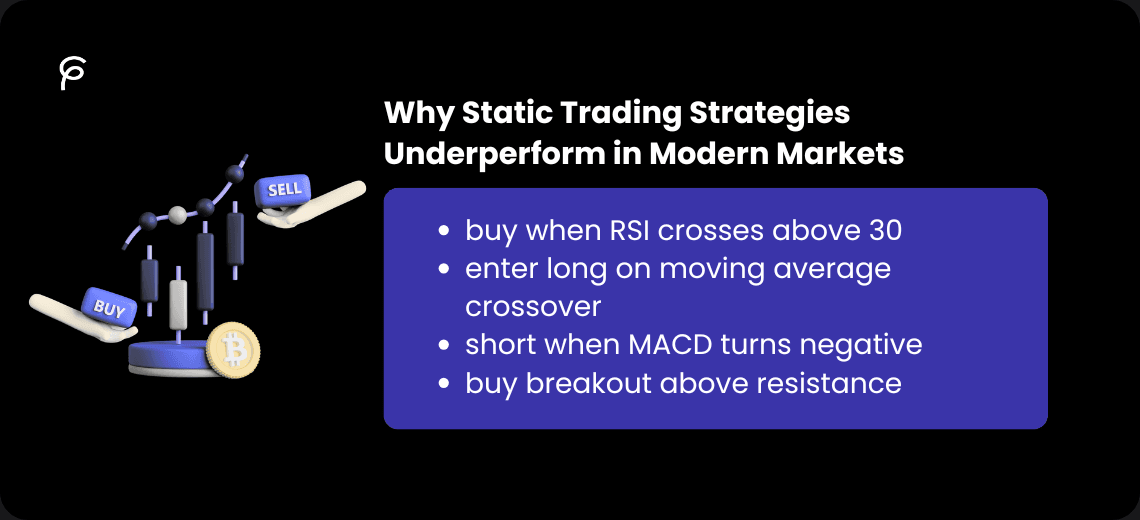
Traditional Pine Script strategies often rely on fixed logic.
Examples include:
-
buy when RSI crosses above 30
-
enter long on moving average crossover
-
short when MACD turns negative
-
buy breakout above resistance
While these conditions can work in specific environments, they usually fail when the market becomes unstable.
The reason is simple:
A moving average crossover behaves very differently in:
-
a low-volatility trend
-
a high-volatility expansion
-
a choppy event-driven session
Yet most strategies treat all three environments identically.
That is the core flaw. Markets evolve constantly, but static strategies do not.
3. The Foundation of a Volatility-Adaptive Trading Strategy
Building a volatility-aware strategy starts with measuring market conditions first, before deciding whether a signal is even worth trading. One of the most common ways to do this in Pine Script is by using Average True Range (ATR), which measures average price movement over time.
ATR helps traders determine whether the market is:
-
compressed
-
expanding
-
abnormally volatile
When combined with trend filters and confirmation logic, ATR becomes a powerful way to build adaptive systems.
Rather than taking every breakout, for example, a volatility-aware strategy may only trade breakouts when volatility is expanding and trend alignment is present.
This simple change can dramatically improve strategy stability.
4. Pine Script Example: Building a Volatility-Aware Strategy
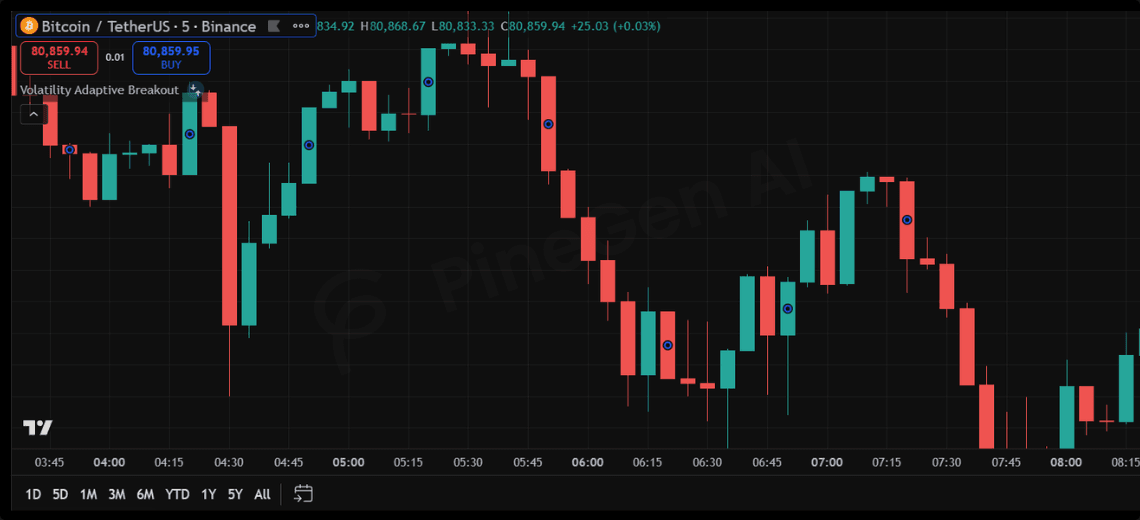
//@version=6
strategy("Volatility Adaptive Breakout", overlay=true)

atrLen = input.int(14)
emaLen = input.int(200)
atrMult = input.float(2.0)

atrVal = ta.atr(atrLen)
emaTrend = ta.ema(close, emaLen)

volatilityExpansion = atrVal > ta.sma(atrVal, 20)
trendUp = close > emaTrend
breakout = close > ta.highest(high, 20)[1]

enterLong = volatilityExpansion and trendUp and breakout

if enterLong
    strategy.entry("Long", strategy.long)

strategy.exit(
    "Exit Long",
    from_entry="Long",
    stop=close - atrVal * atrMult,
    limit=close + atrVal * atrMult * 2
)
This strategy does more than trigger on breakouts.
It checks whether:
-
volatility supports movement
-
trend direction confirms bias
-
breakout strength exceeds recent range
It also adjusts exits dynamically based on ATR rather than using fixed distances.
That is the difference between static logic and adaptive logic.
5. Why AI Is Becoming Essential for Pine Script Strategy Development
Designing adaptive strategies manually is possible, but it is slow.
Each variation requires:
-
rewriting logic
-
adjusting risk models
-
retesting outputs
-
refining edge cases
That is why more traders are using Pine Script AI tools.
A strong Pine Script AI generator can reduce hours of manual development into minutes by helping traders:
-
build strategy frameworks faster
-
test more variations
-
refine logic iteratively
-
debug Pine Script errors efficiently
But this only works if the AI understands Pine Script properly.
6. Why PineGen AI Fits Volatility-Based Strategy Development Better Than Generic AI Tools
Most general AI coding tools can generate Pine Script syntax.
However, syntax alone is not enough.
The real challenge is producing code that reflects how TradingView strategies actually function in live testing.
That includes:
-
proper strategy() block structure
-
realistic stop/target modeling
-
dynamic volatility exits
-
safe multi-condition logic
-
execution-aware order handling
PineGen AI is built specifically for Pine Script workflows, which makes it more suitable for strategy development than broad AI tools.
It helps traders move beyond “code generation” into structured strategy building.
Instead of producing isolated snippets, PineGen AI supports the full development loop:
-
idea generation
-
strategy construction
-
debugging
-
refinement
-
optimization
That is especially valuable when building adaptive strategies, where iteration speed matters.
7. Why Volatility-Proof Strategies Matter More Than Ever
Markets today are shaped by:
-
faster information flow
-
fragmented liquidity
-
options-driven volatility
-
macro event sensitivity
This creates an environment where static strategies degrade faster than before.
The traders who remain consistent are not necessarily the ones with the best initial strategy ideas.
They are often the ones who can adapt their systems fastest.
That is why volatility-aware design is no longer optional.
It is becoming a requirement.
8. Conclusion
Building a strategy that works only in calm conditions is no longer enough.
Modern markets demand systems that can recognize changing volatility, adjust risk dynamically, and filter low-quality setups when conditions become unstable.
That is what separates robust trading systems from fragile ones.
And as strategy complexity increases, AI-powered development tools are becoming a practical advantage.
If you want to build TradingView strategies that adapt to modern market volatility instead of breaking under it
PineGen AI helps you generate, refine, and optimize Pine Script strategies faster with a workflow built specifically for traders.
Whether you are testing breakout systems, volatility filters, or adaptive risk models, PineGen AI helps reduce development friction so you can focus on improving strategy logic, not rewriting code.