RSI and MACD Crossover Strategy (AI Generated)
Author : Ranga Technologies
Publish Date : 5 / 22 / 2026 • 3 mins read
Last Updated : 5 / 22 / 2026
Are Classic Indicators Still Powerful in AI-Driven Markets?
RSI and MACD are two of the most used indicators in trading history.
But here’s the real question traders are asking in 2025:
If everyone already knows these indicators, why do some traders still build profitable systems around them while others keep getting trapped in fake signals, late entries, and unstable strategies?
The answer is no longer just about indicators.
It’s about:
-
how traders combine signals
-
how they filter market conditions
-
how quickly they test new ideas
-
how efficiently they optimize strategies
-
and how AI-powered Pine Script generation changes the entire workflow
Today, traders are no longer spending days manually writing Pine Script line by line.
Instead, they are using:
-
Pine Script AI generators
-
TradingView Pine Script generators
-
AI Pine Script code generators
-
Pine Script debugger AI tools
to generate, refine, test, and optimize strategies dramatically faster.
And one of the most common systems traders continue improving with AI is the RSI and MACD crossover strategy.
RSI and MACD crossover strategies remain widely used because they combine trend direction and momentum analysis into a single trading framework. However, modern markets have become faster, more volatile, and more algorithm-driven, making traditional crossover systems less reliable without proper filtering and adaptive risk management.
This article explains how traders now improve RSI and MACD systems using AI-generated Pine Script workflows, TradingView strategy automation, smarter confirmation logic, and PineGen AI development tools. It also explores why many crossover strategies fail, how traders reduce false signals, and how AI Pine Script generators accelerate testing, debugging, optimization, and strategy refinement.
1. Why RSI and MACD Still Matter
Many traders assume classic indicators no longer work because markets have become dominated by:
-
AI-driven execution
-
high-frequency systems
-
institutional automation
But that assumption misunderstands what RSI and MACD actually do.
These indicators survive because they track two things markets will always contain:
-
momentum
-
trend behavior
Markets evolve technologically, but price movement still depends on:
-
buyer aggression
-
seller pressure
-
trend continuation
-
momentum exhaustion
RSI and MACD continue helping traders identify those conditions.
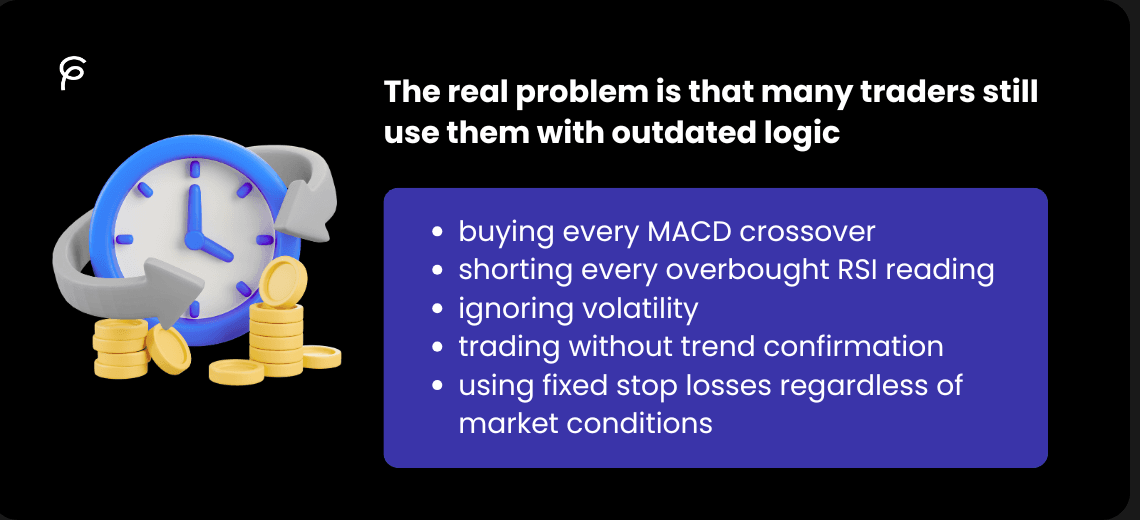
The real problem is not the indicators.
The real problem is that many traders still use them with outdated logic.
For example:
-
buying every MACD crossover
-
shorting every overbought RSI reading
-
ignoring volatility
-
trading without trend confirmation
-
using fixed stop losses regardless of market conditions
Modern markets punish simplistic systems quickly.
That is why traders in 2025 increasingly combine RSI and MACD with:
-
trend filters
-
multi-timeframe confirmation
-
volume participation
-
AI-generated Pine Script refinement
instead of relying on raw crossover signals alone.
2. What RSI and MACD Actually Measure
To use these indicators properly, traders must understand what they are actually measuring.
2.1 RSI Measures Momentum Strength
RSI (Relative Strength Index) tracks momentum speed and momentum pressure.
It helps identify:
-
whether bullish pressure is strengthening
-
whether bearish pressure is weakening
-
whether momentum is becoming overheated
Many beginners misunderstand RSI completely.
They assume:
-
RSI above 70 = immediate sell
-
RSI below 30 = immediate buy
But strong trends can remain:
-
overbought for extended periods
-
oversold during aggressive selloffs
This means RSI works better as:
-
a momentum confirmation tool
-
a trend strength filter
rather than a simple reversal trigger.
2.2 MACD Measures Trend Transition
MACD tracks momentum shifts between moving averages.
It helps traders identify:
-
trend acceleration
-
directional strength changes
MACD crossover systems became popular because they simplify trend transition analysis.
However, MACD naturally lags because it uses moving averages.
This creates delayed entries during fast-moving conditions.
That is why traders now combine MACD with:
-
volatility filters
-
trend alignment
-
momentum confirmation
-
higher timeframe structure
to reduce poor entries.
3 Why Most RSI MACD Strategies Fail?
This is where most traders lose consistency.
The indicators themselves are not broken.
The strategy structure is usually weak.
3.1 Problem 1: Traders Use Signals Without Market Context
A bullish MACD crossover during:
-
weak liquidity
-
bearish higher timeframe structure
-
unstable volatility
can easily fail.
Modern markets require context.
Professional traders usually analyze:
-
trend direction
-
market structure
-
volatility conditions
-
volume participation
before trusting crossover signals.
3.2 Problem 2: Volatility Destroys Static Systems
Markets in 2025 move far faster than older trading systems expected.
During:
-
CPI releases
-
Fed announcements
-
overnight volatility spikes
price behavior changes dramatically.
Fixed stop losses often fail because:
-
volatility expands rapidly
-
spreads widen
-
fake breakouts increase
This is why traders increasingly use:
-
ATR-based risk management
-
adaptive stop logic
-
volatility-aware exits
instead of static fixed-percentage stops.
3.3 Problem 3: Overfitting Creates Fake Confidence
One of the biggest issues in AI-generated and manually coded systems is overfitting.
A trader may optimize:
-
RSI periods
-
MACD settings
-
stop-loss percentages
-
take-profit targets
until the backtest appears perfect.
But the strategy becomes too tailored to historical conditions.
Once markets shift:
-
performance weakens
-
drawdowns expand
-
execution quality collapses
That is why professional traders focus on:
-
adaptability
-
consistency
-
execution stability
instead of unrealistic backtest perfection.
4. How Modern Traders Improve Crossover Systems
Modern crossover systems are far more sophisticated than older versions.
Instead of:
“Buy when MACD crosses bullish.”
traders now build layered systems.
For example:
A modern RSI + MACD strategy may require:
-
bullish higher timeframe trend
-
MACD crossover confirmation
-
RSI above momentum threshold
-
ATR volatility stability
-
volume participation above average
before entering positions.
This reduces:
-
false signals
-
weak breakout entries
-
unstable market participation
significantly.
5. Traders Now Blend Multiple Signals Together
Signal blending has become extremely important.
Why?
Because markets have become noisier.
Single indicators struggle because:
-
algorithms create fake moves
-
volatility spikes distort signals
-
liquidity fragmentation increases randomness
By combining:
-
trend filters
-
momentum confirmation
-
volatility conditions
-
volume analysis
traders create stronger probability frameworks.
6. How AI Is Changing Pine Script Strategy Development
This is where Pine Script AI workflows become powerful.
Traditionally, traders had to:
-
manually write Pine Script
-
rebuild logic repeatedly
-
spend hours testing variations
That slowed development significantly.
Now traders increasingly use:
-
Pine Script AI generators
-
AI Pine Script code generators
-
TradingView Pine Script generators
-
Pine Script debugger AI systems
to speed up workflows dramatically.
The biggest advantage is not “automatic profits.”
The biggest advantage is:
iteration speed.
AI allows traders to:
-
test more strategy ideas
-
generate crossover variations faster
-
optimize workflows quicker
-
refine conditions continuously
This creates a massive efficiency advantage.
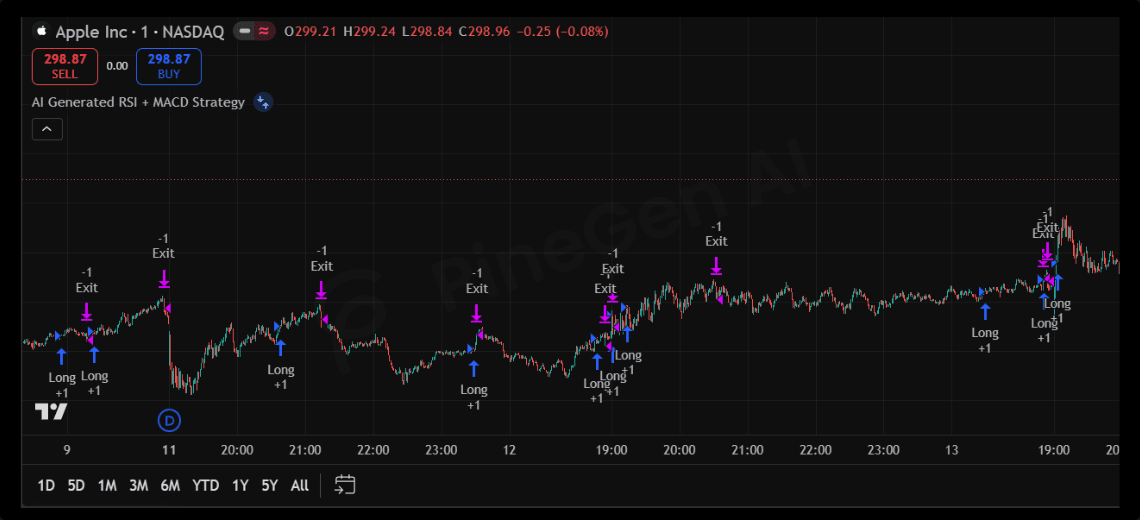
7. AI-Generated Pine Script Example
pinescript//@version=6
strategy("AI Generated RSI + MACD Strategy", overlay=true)

// Indicators
rsiValue = ta.rsi(close, 14)

[macdLine, signalLine, histLine] = ta.macd(close, 12, 26, 9)

emaTrend = ta.ema(close, 200)

atrValue = ta.atr(14)

volumeMA = ta.sma(volume, 20)

// Trend Filter
bullTrend = close > emaTrend

// MACD Confirmation
bullMACD = ta.crossover(macdLine, signalLine)

// RSI Momentum Filter
bullRSI = rsiValue > 55

// Volume Confirmation
bullVolume = volume > volumeMA

// Final Entry Logic
longCondition = bullTrend and bullMACD and bullRSI and bullVolume

if longCondition
    strategy.entry("Long", strategy.long)

// Dynamic Risk Management
strategy.exit(
    "Exit",
    from_entry = "Long",
    stop = close - atrValue * 2,
    limit = close + atrValue * 3
)
This reflects how modern traders structure crossover systems:
-
trend alignment
-
momentum confirmation
-
volatility-aware exits
-
volume participation
-
adaptive risk management
instead of simplistic crossover entries alone.
8. Why PineGen AI Fits TradingView Workflows Better
General AI tools can generate Pine Script syntax.
But TradingView strategy development requires much more than syntax generation.
It requires:
-
strategy architecture
-
execution logic
-
Pine Script structure understanding
-
TradingView compatibility
-
debugging workflows
-
iterative refinement
This is where PineGen AI becomes more useful for traders.
9. PineGen AI Is Built Specifically for Pine Script Workflows
General AI tools are designed for broad coding tasks.
PineGen AI focuses specifically on:
-
Pine Script generation
-
TradingView strategy structure
-
Pine Script debugging
-
workflow refinement
-
TradingView optimization
This creates a smoother experience for traders.
10. PineGen AI Helps Traders Iterate Faster
Markets evolve constantly.
A strategy that worked last month may perform differently today.
PineGen AI helps traders:
-
generate multiple strategy variations quickly
-
test conditions faster
-
compare logic structures efficiently
This matters because trading success often comes from:
-
refinement
-
adaptation
-
iteration
not the first strategy idea.
11. PineGen AI Reduces Repetitive Coding Friction
Many traders waste time:
-
fixing Pine Script syntax
-
restructuring conditions
-
debugging TradingView errors
-
rebuilding similar systems repeatedly
PineGen AI reduces repetitive workflow friction so traders can focus more on:
-
execution quality
-
market behavior
-
strategy refinement
-
risk management
instead of syntax troubleshooting.
12. Common Mistakes Traders Still Make
12.1 Blindly trusting AI-generated strategies
AI-generated systems still require:
-
forward testing
-
optimization
-
market adaptation
before live deployment.
12.2 Ignoring volatility behavior
Markets behave differently during:
-
high volatility
-
low liquidity
-
strong trends
-
sideways conditions
Strategies must adapt dynamically.
12.3 Overcomplicating strategy logic
Too many filters can:
-
reduce quality opportunities
-
delay entries
-
create contradictory conditions
Good systems balance:
-
structure
-
simplicity
-
adaptability
13. Final Conclusion
RSI and MACD crossover systems continue to survive because they still measure two core market behaviors:
-
momentum
-
trend transition
But modern markets require far more than simplistic crossover logic.
Successful traders now combine:
-
volatility filtering
-
trend confirmation
-
adaptive risk management
-
multi-signal frameworks
-
AI-assisted Pine Script development
to improve execution quality and reduce weak setups.
The real advantage of AI-generated Pine Script is not replacing traders.
It is helping traders:
-
build faster
-
test more ideas
-
refine systems continuously
-
optimize TradingView workflows efficiently
And in fast-moving markets, the ability to iterate quickly often becomes one of the biggest competitive advantages.
Markets evolve faster than manual strategy development.
By the time many traders:
-
write Pine Script manually
-
debug TradingView errors
-
rebuild crossover logic
-
optimize risk management
market conditions may already change.
PineGen AI helps traders move faster from: idea → Pine Script generation → testing → optimization → refinement
without getting trapped in endless repetitive coding cycles.
Instead of wasting hours:
-
fixing Pine Script syntax
-
rebuilding strategy structures
-
debugging TradingView logic
-
manually optimizing conditions
use PineGen AI to:
-
generate RSI & MACD strategies faster
-
build smarter TradingView workflows
-
test multiple crossover variations quickly
-
improve risk management systems efficiently
-
refine strategies continuously as markets evolve
Whether you are:
-
a beginner learning Pine Script
-
a trader building automated systems
-
or an advanced user optimizing TradingView workflows
PineGen AI helps reduce development friction so you can focus more on:
-
execution quality
-
strategy refinement
-
market behavior
-
trading performance
Start building smarter AI-assisted TradingView strategies with PineGen AI today.