How 24-Hour Trading Is Changing U.S. Markets
Author : Ranga Technologies
Publish Date : 5 / 11 / 2026 • 2 mins read
Last Updated : 5 / 11 / 2026
What Happens When Markets Never Truly Sleep Anymore?
For decades, U.S. traders worked around a predictable schedule.
The market opened.
Volume entered.
Institutions positioned themselves.
The closing bell arrived.
Activity slowed down.
That structure created rhythm.
Today, that rhythm is disappearing.
Overnight futures markets, global macro events, retail participation, algorithmic execution systems, and growing access to extended-hours trading have fundamentally changed how U.S. markets behave.
The market no longer reacts only during traditional trading hours.
Now, major price moves often happen:
-
before the opening bell
-
during overnight futures sessions
-
immediately after geopolitical headlines
-
while most retail traders are offline
And that shift is changing everything from liquidity behavior to volatility structure.
This is no longer just a “timing” change.
It is a structural transformation in how modern U.S. markets operate.
24-hour trading activity is reshaping U.S. market structure by increasing overnight volatility, fragmenting liquidity, and changing how traders interact with price movement.
Whether you are searching for the best Pine Script AI generator, a TradingView Pine Script generator, or a Pine Script strategy generator, understanding how market structure is evolving is critical for building strategies that survive modern volatility.
1. Why U.S. Markets Are Becoming More Active Overnight
Several structural changes are pushing U.S. markets toward nearly continuous trading behavior.
The first major driver is globalization.
U.S. markets no longer react only to domestic news. Events in:
-
Asia
-
Europe
-
the Middle East
-
energy markets
-
geopolitical conflicts
can trigger large futures moves long before the New York session opens.
Another major factor is algorithmic trading.
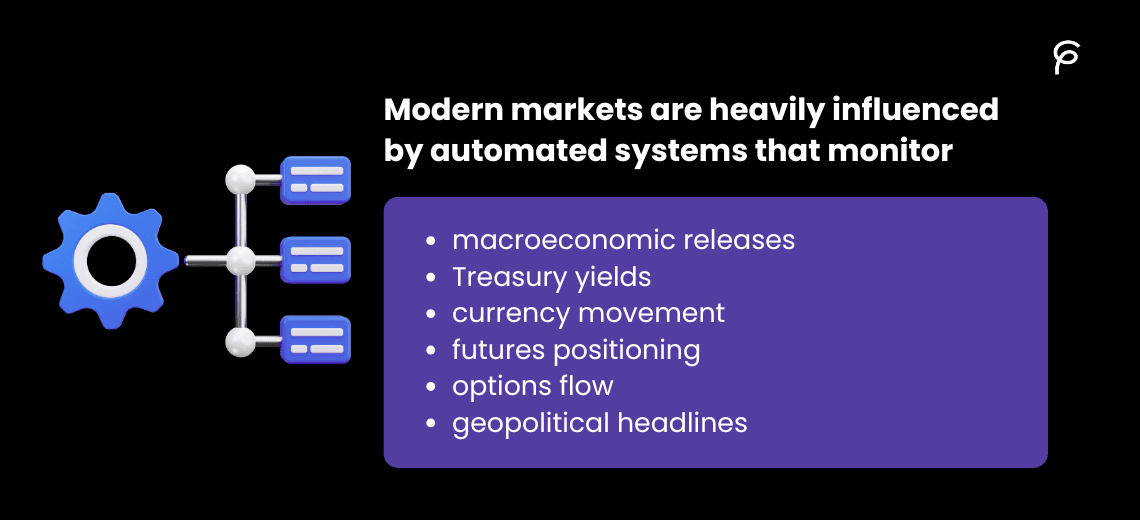
Modern markets are heavily influenced by automated systems that monitor:
-
macroeconomic releases
-
Treasury yields
-
currency movement
-
futures positioning
-
options flow
-
geopolitical headlines
These systems operate continuously.
Unlike human traders, algorithms do not “wait for the opening bell.”
Retail access has also expanded rapidly.
Many brokers now allow:
-
pre-market trading
-
after-hours trading
-
overnight futures access
-
24-hour ETF trading in some cases
As a result, price discovery increasingly happens outside traditional market hours.
2. What 24-Hour Trading Actually Changes
Many traders assume extended-hours trading simply adds “more time” to trade.
But the deeper impact is structural.
When markets remain active nearly all day, the relationship between:
-
liquidity
-
volatility
-
price discovery
-
institutional positioning
-
starts to change.
Traditional trading sessions used to concentrate most activity into a smaller window.
Now liquidity becomes fragmented across multiple sessions.
That creates several important effects.
2.1. Overnight Price Discovery Becomes More Important
Major moves increasingly happen before regular market hours begin.
For example:
-
earnings reactions happen after the close
-
geopolitical headlines emerge overnight
-
global macro events impact futures before the open
This means traders often wake up to markets that have already repriced significantly.
The “real move” may already have happened before the cash session starts.
2.2. Gap Risk Increases
Because markets are reacting continuously, overnight price gaps become more frequent.
This creates:
-
wider opening volatility
-
unstable breakout behavior
-
unpredictable stop-loss execution
Swing traders especially feel this effect because positions held overnight face far more uncertainty than they did years ago.
2.3. Market Structure Becomes More Reactive
Markets now respond faster to headlines than ever before.
Why?
Because algorithmic systems instantly reposition based on:
-
inflation data
-
Federal Reserve comments
-
oil price spikes
-
geopolitical events
-
bond market movement
This accelerates short-term volatility dramatically.
3. Why Volatility Feels More Aggressive Today
Many traders feel like modern markets are “harder to read.”
That feeling is not imaginary.
Modern volatility behaves differently because market structure itself has changed.
Today’s volatility is often:
-
faster
-
more headline-driven
-
less trend-consistent
-
more liquidity-sensitive
A major reason for this is that overnight trading sessions typically operate with thinner liquidity than regular market hours.
When liquidity is thinner:
-
smaller orders can move price more aggressively
-
stop hunts become more common
-
reversals become sharper
-
fake breakouts appear more frequently
This is why many traders now experience:
-
sudden reversals
-
breakout failures
-
unstable intraday momentum
-
even when technical setups look clean.
4. The Liquidity Problem Nobody Talks About
One of the biggest misconceptions about modern U.S. markets is that “high volume” automatically means “high liquidity.”
That is not always true anymore.
Liquidity has become fragmented.
A large percentage of trading activity now occurs through:
-
dark pools
-
high-frequency systems
-
internalized order flow
-
overnight futures markets
This creates an environment where displayed liquidity may look healthy, while actual executable liquidity becomes inconsistent.
For traders, that means:
-
increased slippage
-
faster reversals
-
more unstable execution
This is one reason why many traditional TradingView strategies underperform in modern markets.
5. How Institutions Trade Differently Overnight
Institutional behavior changes significantly outside regular sessions.
During overnight periods:
-
many institutions reduce aggressive positioning
-
liquidity providers widen spreads
-
large funds hedge selectively instead of fully deploying capital
Meanwhile, algorithms continue operating aggressively.
This creates an imbalance where machine-driven activity becomes more dominant relative to human discretionary trading.
As a result:
-
short-term moves can become exaggerated
-
volatility clusters appear unexpectedly
-
trend continuation becomes less reliable
6. Why Many Traditional Strategies Are Breaking
A large percentage of retail trading strategies were built for older market conditions.
They assume:
-
stable liquidity
-
slower reactions
-
smoother trends
Modern markets no longer behave consistently that way.
Strategies based purely on:
-
breakout continuation
-
static momentum
-
fixed stop-losses
-
often struggle during overnight volatility transitions.
This is why adaptive systems are becoming increasingly important.
7. Pine Script Example: Overnight Volatility Strategy
Below is an example of a Pine Script strategy designed to react to overnight volatility expansion.
//@version=6
strategy("Overnight Volatility Breakout", overlay=true)

// Inputs
atrLength = input.int(14)
atrMultiplier = input.float(1.5)

overnightHigh = request.security(syminfo.tickerid, "60", high)
overnightLow = request.security(syminfo.tickerid, "60", low)

atrValue = ta.atr(atrLength)

// Conditions
longCondition = close > overnightHigh
shortCondition = close < overnightLow

// Entries
if longCondition
    strategy.entry("Long", strategy.long)

if shortCondition
    strategy.entry("Short", strategy.short)

// Dynamic exits
strategy.exit("Long Exit",
     from_entry="Long",
     stop=close - atrValue * atrMultiplier)

strategy.exit("Short Exit",
     from_entry="Short",
     stop=close + atrValue * atrMultiplier)
This type of strategy attempts to adapt to volatility expansion rather than assuming stable intraday conditions.
8. Why PineGen AI Matters in This Environment
Modern trading environments are becoming harder to model manually.
Strategies now need to account for:
-
overnight volatility
-
liquidity instability
-
adaptive risk management
-
changing market structure
-
fast macro reactions
This is where specialized Pine Script AI tools become valuable.
General AI coding tools may generate Pine Script syntax, but they often miss:
-
TradingView execution structure
-
strategy tester compatibility
-
repainting prevention
-
realistic risk handling
PineGen AI focuses specifically on TradingView strategy development.
That allows traders to:
-
generate Pine Script faster
-
refine volatility-based logic
-
debug strategy issues more efficiently
-
iterate through multiple strategy variations rapidly
9. How Pine Script AI Improves Modern Strategy Development
The biggest advantage of Pine Script AI is not simply “faster coding.”
It improves iteration speed.
That matters because modern market conditions change quickly.
A strategy that worked six months ago may behave differently today because:
-
volatility regimes shifted
-
overnight activity increased
-
liquidity behavior changed
-
options positioning evolved
PineGen AI helps traders adapt faster by reducing the time required to:
-
build strategies
-
test new logic
-
optimize risk models
That flexibility is becoming increasingly important in modern markets.
10. Final Thoughts
24-hour trading is reshaping U.S. market structure in ways many traders still underestimate.
Markets are becoming:
-
more reactive
-
more fragmented
-
more volatility-sensitive
-
more globally connected
The traditional idea of “market hours” matters less than it used to.
Now, overnight activity, futures positioning, and algorithmic execution influence market behavior continuously.
For traders, this means one major thing:
-
Strategies must become more adaptive.
-
Systems built for older, slower market environments often struggle under modern conditions.
The traders who adapt fastest are usually the ones who:
-
iterate quickly
-
refine continuously
-
understand changing market structure
-
use tools built for modern trading workflows
Modern markets move faster than ever.
That means strategy development also needs to move faster.
PineGen AI helps traders build TradingView-ready Pine Script strategies designed for today’s volatility-driven environment.
-
Generate Pine Script Faster: Turn trading ideas into structured Pine Script within minutes.
-
Debug Smarter: Reduce hours spent fixing TradingView syntax and logic issues.
-
Adapt to Changing Markets: Test more strategy variations and improve systems continuously.
Built Specifically for TradingView, Unlike generic AI tools, PineGen AI focuses on Pine Script strategy workflows and TradingView compatibility.
If your strategies need to evolve with modern market structure, PineGen AI helps you iterate faster and trade smarter.
Try PineGen AI and accelerate your TradingView strategy development today.