War-Driven Supply Chain Disruptions and Their Impact on Trading Behavior
Author : Ranga Technologies
Publish Date : 4 / 9 / 2026 • 2 mins read
Last Updated : 4 / 9 / 2026
When global supply chains break, markets don’t just move, they reprice risk. So what actually happens inside a trading system when disruption hits?
This case study analyzes how war-related supply chain disruptions reshape trading behavior in U.S. markets, focusing on volatility expansion, liquidity fragmentation, sector rotation, and structural breakdowns in price action. It connects macro shocks to trader decisions, institutional positioning, and algorithmic behavior.
1. Why Supply Chain Disruptions Matter
Modern financial markets depend on tightly connected global supply chains. When conflict impacts logistics routes, production hubs, or raw material flows, the effects cascade across multiple asset classes within days. Energy is usually the first channel of impact. Disruptions in oil transportation routes immediately influence fuel prices, which then affect logistics costs, manufacturing expenses, and ultimately corporate earnings.
For example, when energy prices rise due to supply constraints in the Crude Oil market, transportation and production costs increase globally. This leads to inflationary pressure, which directly impacts equity valuations.
Markets like the S&P 500 react not only to current earnings but to expected future conditions, especially supply-related risks.
At a structural level, the chain reaction is:
-
Reduced supply → higher prices
-
Higher prices → margin compression
-
Margin compression → valuation adjustments
-
Valuation adjustments → market repricing
This is the core mechanism traders are indirectly responding to.
For deeper structural concepts related to how markets expand after compression, you can refer to
“Range Compression → Expansion Detector”
“Volatility Expansion + Fake Breakout Strategy”
These internal concepts align strongly with how supply shocks influence market behavior.
2. What Changes in Market Structure
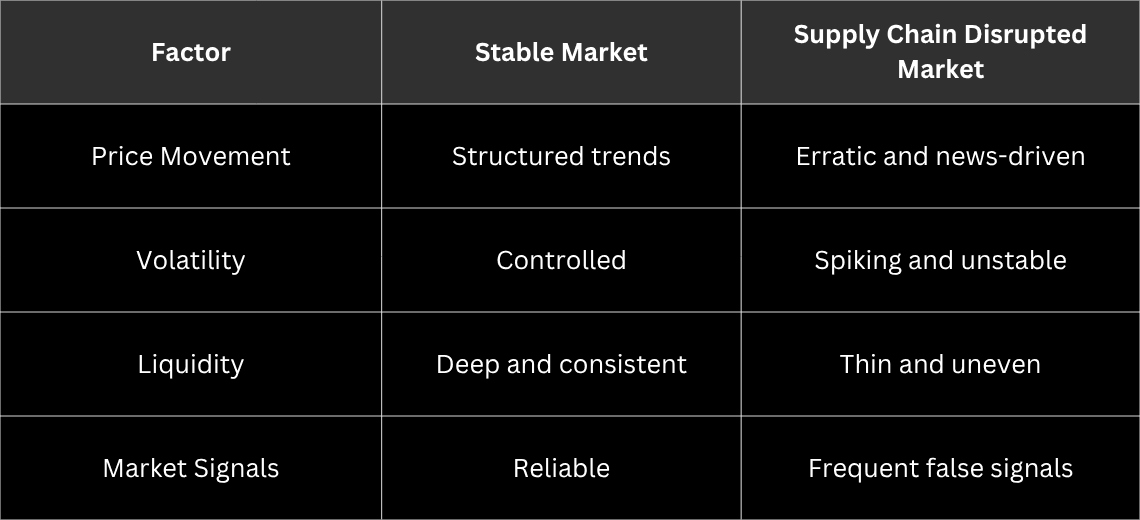
1. Volatility Regime Shift
Markets transition from:
- stable, trend-driven conditions to unstable, event-driven conditions
This results in:
-
wider price swings
-
sudden reversals
-
increased noise in signals
Historically, volatility indices such as the VIX tend to spike during periods of global uncertainty, reflecting rising market fear and hedging activity.
2. Liquidity Compression
During disruption:
-
large participants reduce exposure
-
order book depth decreases
-
execution becomes less predictable
This doesn’t remove liquidity completely, but it makes it uneven and fragile.
A small order can now move price more than usual, which increases slippage risk.
3. Sector Imbalance and Rotation
Supply chain shocks do not impact all sectors equally.
-
Energy → reacts first due to supply constraints
-
Industrials → affected by input costs
-
Technology → impacted by semiconductor shortages
-
Consumer sectors → hit by inflation pressure
This creates sector rotation, where capital shifts instead of moving uniformly.
3. Stable vs Disrupted Market Conditions
4. How Trading Behavior Adapts
Different types of traders respond differently:
4.1 Short-Term Traders
-
Focus on volatility spikes
-
Trade breakouts and reversals
-
Exploit inefficiencies
4.2 Swing Traders
-
Follow macro trend shifts
-
Wait for confirmation signals
-
Avoid early entries
4.3 Institutional Traders
-
Hedge exposure
-
Reduce risk
-
Adjust portfolio allocations
4.4 Systematic Traders
-
Adjust volatility filters
-
Modify ATR-based stops
-
Change position sizing dynamically
This is where structured logic becomes essential. Many traders combine ideas with frameworks like:
“How Traders Can Use the TradingView Earnings Calendar With Pine Script Strategies”
“AI Tools Speed Up Pine Coding Workflow”
These approaches help convert macro conditions into structured trading rules.
5. Data-Backed Market Behavior Patterns
Based on observed market behavior across major disruptions:
-
Volatility tends to increase sharply during uncertainty phases
-
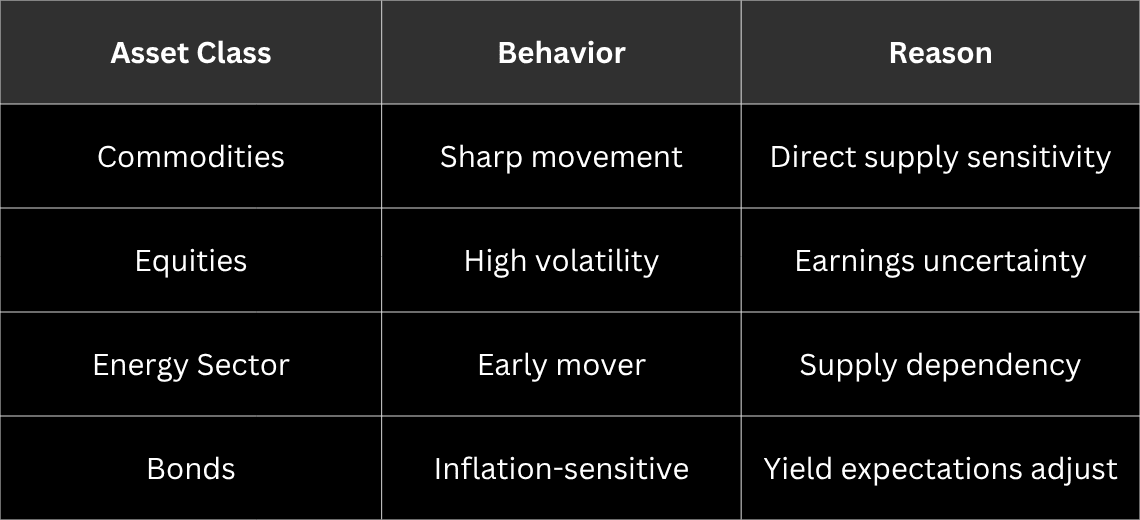
Commodity-linked assets react faster than equity indices
-
Equity markets often experience drawdowns followed by uneven recoveries
-
Short-term behavior shifts toward mean reversion rather than trend continuation
-
Commodity markets, especially oil, often act as an early signal of supply stress.
This is why monitoring the Crude Oil can provide early insights into broader market shifts.
6. Asset Behavior Under Stress
7. Trading Strategy Implications
Traditional strategies often fail in these conditions because:
-
They assume stable market environments
-
They ignore real-world execution issues (slippage, spreads)
-
They rely heavily on historical patterns that may no longer hold
Effective approaches during disruptions include:
-
volatility-aware systems
-
models
-
dynamic position sizing
-
confirmation-based entries
Tools like PineGen AI help bridge the gap between idea and implementation, allowing traders to convert adaptive logic into executable Pine Script strategies faster and with fewer errors.
8. Conclusion
War-driven supply chain disruptions reshape markets at a structural level. They don’t just move prices, they alter how markets function.
Markets transition from:
-
predictable → unpredictable
-
stable → reactive
-
trend-based → volatility-driven
For traders, the key takeaway is clear:
Strategies must adapt to conditions rather than assume them.
A system that performs well in stable environments may fail when supply chains are under stress. The traders who stay consistent are the ones who build adaptive, structure-aware systems that respond to changing market behavior instead of resisting it.
If you want to turn these ideas into a working strategy without spending hours on coding, try using PineGen AI to quickly convert your logic into clean Pine Script and test it properly inside TradingView.