The Impact of AI on Software Quality, Testing, and Security
Author : Ranga Technologies
Publish Date : 5 / 12 / 2026 • 2 mins read
Last Updated : 5 / 12 / 2026
When Code Is No Longer Fully Human… What Happens to Quality?
Software development is going through a shift that feels simple on the surface but is actually structural underneath.
AI now writes code in seconds.
It builds functions, suggests logic, and even produces full trading strategies for platforms like TradingView using Pine Script AI tools. At first glance, this looks like progress, faster development, fewer errors, less effort. But when you look deeper, a harder question appears; If software is being generated instead of carefully written, who ensures it behaves correctly in real conditions?
Because software quality was never just about producing code. It has always been about understanding behavior under pressure, edge cases, and real execution environments.
And this is where AI introduces both improvement and hidden risk at the same time.
AI is reshaping software development by accelerating coding, testing, and debugging workflows. However, this speed introduces challenges in software quality, testing depth, and security reliability.
1. Why AI Is Changing Software Development
AI has not removed the need for software engineers.
Instead, it has changed what developers spend time on.
Earlier, most effort went into:
-
writing syntax correctly
-
building logic step by step
-
fixing compilation errors
Now, AI handles much of that initial workload.
Developers now focus more on:
-
refining outputs
-
testing multiple variations
-
improving system behavior
This shift is especially visible in trading environments where Pine Script AI generators can instantly turn ideas into strategy code.
But faster generation does not automatically mean better systems. It only means more code is produced in less time.
2. The Hidden Problem in AI Code Generation
The main limitation of AI-generated code is not syntax.
Modern AI is usually very good at producing code that compiles correctly.
The real issue lies deeper:
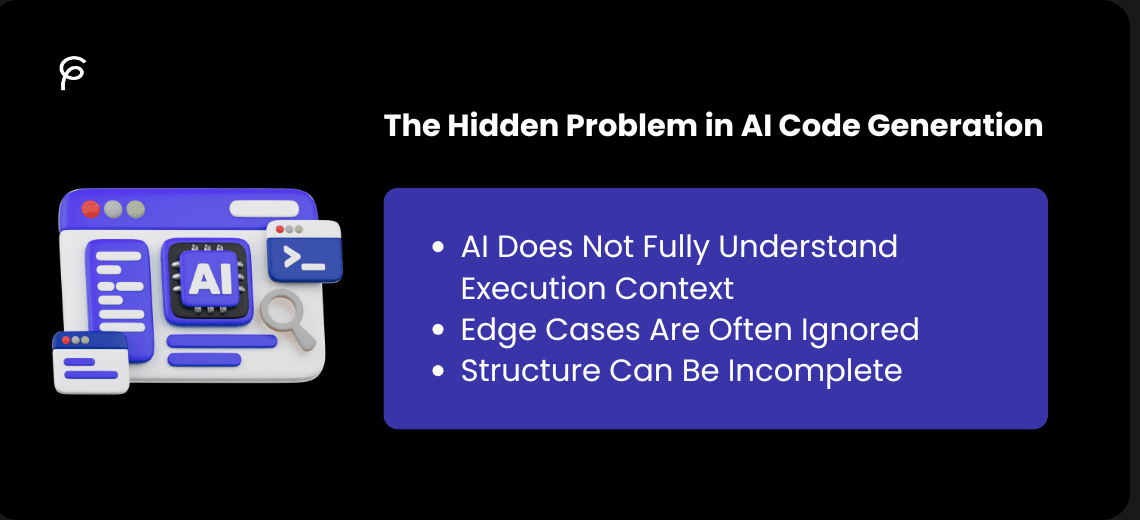
2.1 AI Does Not Fully Understand Execution Context
AI generates logic based on patterns, not real-world execution behavior.
That means it may miss:
-
timing dependencies
-
order execution rules
-
system constraints
-
platform-specific behaviors (like TradingView strategy rules)
2.2 Edge Cases Are Often Ignored
In real systems, unexpected scenarios matter:
-
sudden price gaps
-
missing data points
-
inconsistent signals
AI often assumes “ideal conditions” unless explicitly guided.
2.3 Structure Can Be Incomplete
AI may generate:
-
entry logic without proper exits
-
signals without risk management
-
indicators without confirmation layers
So the code may look complete but behave incomplete.
3. How AI Impacts Software Quality
Software quality is not just about whether code runs.
It is about whether it behaves correctly under real conditions.
AI changes this in several important ways:
3.1 Faster Development, Less Deep Review
Because code is generated quickly, developers often:
-
review less carefully
-
rely more on first output
-
skip deeper validation steps
This increases the risk of subtle logic errors going unnoticed.
3.2 “Working Code” Illusion
If code compiles, it is often assumed to be correct.
But compilation only confirms syntax, not logic accuracy.
This creates a false sense of reliability.
3.3 Reduced Consistency Across Versions
If the same prompt is used multiple times, AI may generate:
-
different structure layouts
-
different logic flows
-
different risk handling approaches
This makes long-term system consistency harder.
4. How Testing Is Changing in AI-Driven Development
Testing used to be a controlled stage after development.
Now it is continuous and iterative.
1. More Testing, But Less Depth
AI allows rapid generation of test cases and variations.
But because there are more outputs, each version may receive less deep analysis.
2. Shift Toward Automated Validation
Instead of manual inspection:
-
developers rely on repeated AI regeneration
-
testing becomes “generate and retry” cycles
This increases speed but reduces careful inspection.
3. False Confidence Problem
A system may:
-
behave correctly in sample data
-
but fail in live or edge conditions
This is especially common in trading systems.
5. Security Risks in AI-Generated Code
Security is not always about malicious intent.
Often it is about missing structure.
AI-generated systems may introduce:
-
Missing Validation Layers: Inputs or conditions may not be fully validated.
-
Weak Error Handling: Unexpected failures may not be properly managed.
-
Incorrect Assumptions
AI may assume:
-
data is always clean
-
signals are always valid
-
execution always succeeds
In real systems, these assumptions fail.
In trading environments, this becomes even more critical because:
-
incorrect logic affects money directly
-
execution errors distort results
-
small bugs can scale into large losses
6. Trading Systems and Pine Script AI Context
In TradingView development, AI is not just writing code, it is designing decision systems.
A Pine Script strategy controls:
-
when trades open
-
when trades close
-
how risk is calculated
-
how signals are interpreted
So if AI introduces even small logic issues, the entire strategy performance changes.
This is why traders increasingly rely on:
-
Pine Script AI generators
-
TradingView Pine Script generator tools
-
Pine Script debugger AI systems
But not all tools behave the same.
7. Why Structure Matters More Than Speed
Speed is not the real advantage anymore.
Structure is.
A good system must:
-
define clear entry conditions
-
handle exits properly
-
manage risk consistently
-
avoid repainting behavior
-
behave the same in backtest and live conditions
AI helps with speed.
But structure still determines reliability.
8. Why PineGen AI Fits This Shift
PineGen AI is built specifically for Pine Script workflows rather than general coding. That creates a different output behavior.
-
Structured Strategy Generation: Instead of partial snippets, it focuses on complete TradingView-compatible strategies.
-
Debugging-Oriented Output: It does not just generate code, it helps identify logic-level issues that affect strategy behavior.
-
Iterative Improvement Flow: Strategies are not treated as one-time outputs, but as evolving systems.
-
Trading Context Awareness: It is designed around real TradingView execution behavior, not generic programming assumptions.
This becomes especially important when using different PineGen AI pricing plans, since higher tiers support deeper iteration, debugging, and scaling of strategies.
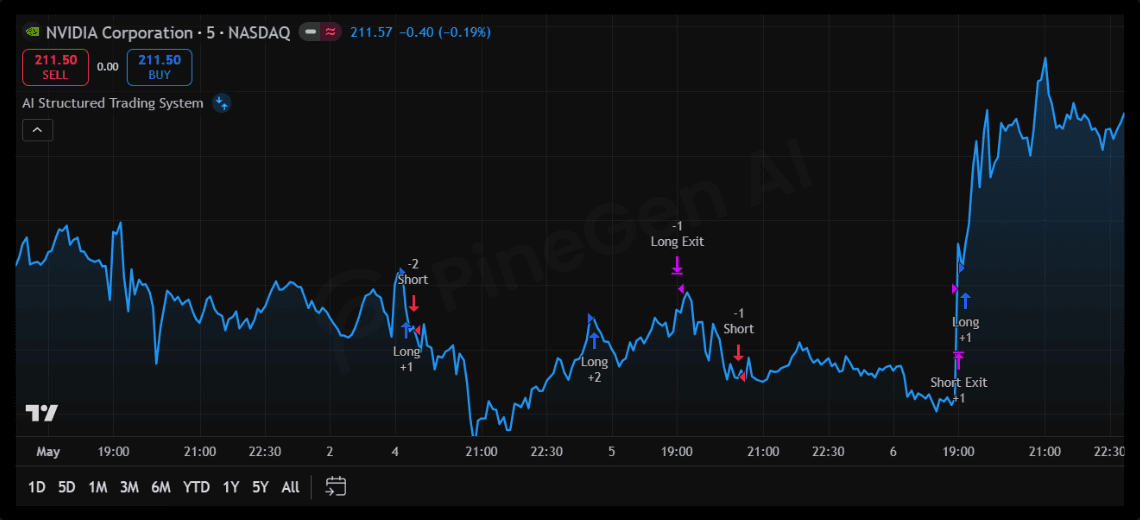
9. Pine Script Example (AI-Based Strategy Structure)
//@version=6
strategy("AI Structured Trading System", overlay=true)

// Core indicators
emaFast = ta.ema(close, 20)
emaSlow = ta.ema(close, 50)
rsiVal  = ta.rsi(close, 14)
atrVal  = ta.atr(14)

// Entry logic
longSignal = ta.crossover(emaFast, emaSlow) and rsiVal > 50
shortSignal = ta.crossunder(emaFast, emaSlow) and rsiVal < 50

if longSignal
    strategy.entry("Long", strategy.long)

if shortSignal
    strategy.entry("Short", strategy.short)

// Risk management
strategy.exit("Long Exit", from_entry="Long",
     stop=close - atrVal * 2,
     limit=close + atrVal * 3)

strategy.exit("Short Exit", from_entry="Short",
     stop=close + atrVal * 2,
     limit=close - atrVal * 3)
AI helps generate this structure quickly, but reliability still depends on validation and refinement.
10. Final Conclusion
AI is not replacing software development, it is changing its rhythm.
Code is now generated faster than it can be validated.
That creates a new reality:
The bottleneck is no longer writing code, it is ensuring correctness.
In trading systems, where execution behavior directly impacts outcomes, structure and validation matter more than speed. This is why specialized tools like Pine Script AI generators are becoming essential, not just for productivity, but for reliability.
AI can generate code instantly. But turning that code into a reliable system requires structure.
PineGen AI helps traders:
-
generate Pine Script faster
-
debug logic more effectively
-
refine strategies through iteration
-
build TradingView-ready systems
Instead of just producing code, it helps build working trading systems that can actually be tested and improved. If you are building serious TradingView strategies, PineGen AI helps you move from raw ideas → structured systems → refined strategies faster.