Unlocking Trading Strategy Creation with Just a Prompt
Author : Ranga Technologies
Publish Date : 4 / 5 / 2026 • 2 mins read
Last Updated : 4 / 5 / 2026
What if a single sentence like
“Build a volatility breakout strategy with risk control”
could turn into a working trading system?
That’s not science fiction anymore,but the real question is:
Does it actually work in trading?
Prompt-based trading strategy creation uses Large Language Models (LLMs) to convert natural language into structured Pine Script code. Traders use this approach to speed up idea generation, coding, and testing. However, LLMs have limitations such as lack of market awareness and potential inaccuracies. This blog explains how prompt-based strategy creation works, includes a practical Pine Script example, and explores why PineGen AI is more suitable for trading-focused workflows.
1. Why Prompt-Based Strategy Creation Matters
Trading has always been about ideas → execution → validation.
Traditionally, this meant:
-
manually writing Pine Script
-
testing multiple variations
-
debugging syntax issues
Now, with prompt-based systems, you can:
-
describe your logic in plain language
-
generate structured code faster
-
explore more strategies in less time
This is not about replacing trading skills, it’s about reducing friction in development.
2. What LLMs Are
Large Language Models (LLMs) are AI systems trained on massive datasets to predict and generate text.
They:
-
understand patterns in language
-
generate code based on examples
-
respond to structured prompts
But they do NOT:
-
think
-
reason like humans
-
access live market data
They work by predicting the most likely output based on input patterns.
3. How Prompt to Strategy Works
The process is simple, but powerful when done correctly:
Step 1: Define the Idea
Example:
“Create a trend-following strategy using moving average and RSI confirmation with ATR-based stop loss.”
Step 2: Convert to Code (via AI)
LLM generates structured Pine Script.
Step 3: Validate the Output
Run it on TradingView.
Step 4: Backtest & Adjust
Optimize based on performance.
This approach aligns with how AI models are evaluated in research, converting natural language into executable logic and testing accuracy.
4. Big Code Example (Prompt → Pine Script Strategy)
//@version=6
strategy("Prompt-Based Trading Strategy", overlay=true)

// =====================
// INPUTS
// =====================
maLength = input.int(50, "Trend Length")
rsiLength = input.int(14, "RSI Length")
atrLength = input.int(14, "ATR Length")
riskMultiplier = input.float(1.5, "Risk Multiplier")

// =====================
// INDICATORS
// =====================
trendMA = ta.sma(close, maLength)
rsi = ta.rsi(close, rsiLength)
atr = ta.atr(atrLength)

// =====================
// LOGIC (FROM PROMPT)
// =====================
// "Trend + Momentum + Volatility expansion"

// Trend
isBullTrend = close > trendMA
isBearTrend = close  55
bearMomentum = rsi  ta.sma(atr, atrLength)

// Combined signals
longCondition = isBullTrend and bullMomentum and volatilityExpansion
shortCondition = isBearTrend and bearMomentum and volatilityExpansion

// =====================
// RISK MANAGEMENT
// =====================
stopDistance = atr * riskMultiplier
takeDistance = stopDistance * 2

// =====================
// EXECUTION
// =====================
if (longCondition)
    strategy.entry("Long", strategy.long)
    strategy.exit("Exit Long", from_entry="Long", stop=close - stopDistance, limit=close + takeDistance)

if (shortCondition)
    strategy.entry("Short", strategy.short)
    strategy.exit("Exit Short", from_entry="Short", stop=close + stopDistance, limit=close - takeDistance)

// =====================
// VISUALS
// =====================
plot(trendMA, title="Trend MA")

plotshape(longCondition, title="BUY", location=location.belowbar)
plotshape(shortCondition, title="SELL", location=location.abovebar)
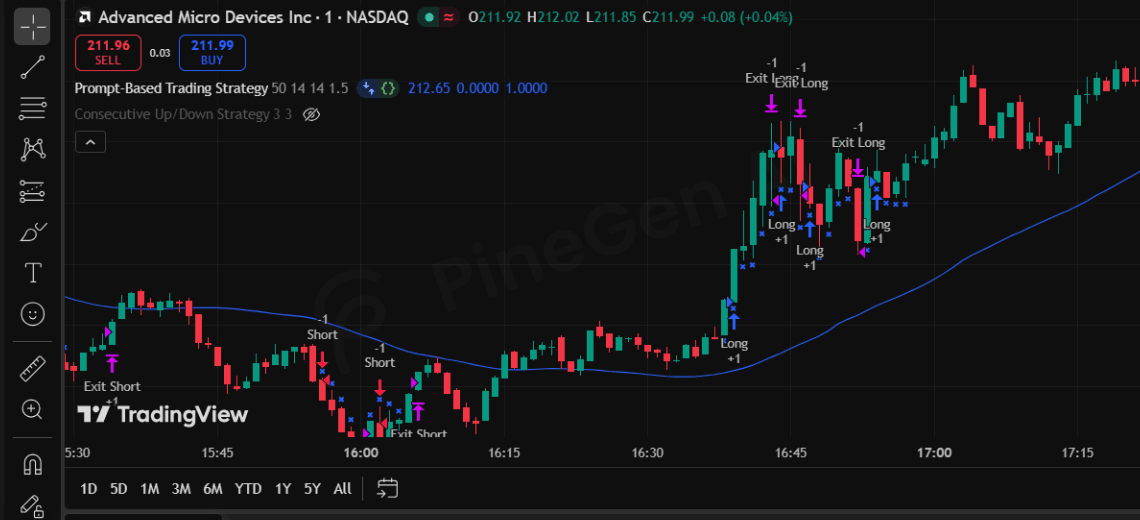
This is how a simple prompt turns into a working strategy structure.
5. Real Limitations
LLMs are powerful, but not perfect.
1. No Market Awareness
They don’t understand real-time price movement.
2. Incorrect Logic Risk
They can produce syntactically correct but logically weak strategies.
3. No Built-In Validation
They don’t backtest unless you do it manually.
4. Overconfidence in Output
The output often looks correct even when it isn’t.
Research and real-world usage both show that LLMs are better as assistants, not decision systems.
6. Why PineGen AI Fits Better
General AI tools are built for everything.
That’s the problem.
PineGen AI focuses specifically on:
-
Pine Script generation
-
TradingView strategy logic
-
trading-oriented outputs
This reduces:
-
syntax errors
-
irrelevant outputs
For traders, that specialization matters more than general capability.
7. Conclusion
Prompt-based strategy creation is not about replacing traders.
It’s about changing how strategies are built.
Instead of spending hours writing code, traders can:
-
describe ideas
-
generate structure quickly
-
focus on testing and improvement
But the real edge still comes from:
-
discipline
-
validation
AI helps you move faster.
It does not remove the need to think.
When used correctly, especially with trading-focused tools like PineGen AI, prompts become a powerful way to speed up your entire workflow.