How Traders Are Creating Better Alerts in TradingView Strategies for SPY, QQQ, and U.S. Stocks
Author : Ranga Technologies
Publish Date : 4 / 29 / 2026 • 2 mins read
Last Updated : 4 / 29 / 2026
For many traders building strategies on TradingView, writing profitable Pine Script logic is only half the challenge. The other half, and often the more overlooked part, is transforming that strategy into a reliable alert system that can operate effectively in live U.S. markets.
This becomes especially important when trading fast-moving instruments such as SPY, QQQ, and individual U.S. stocks, where timing matters far more than many traders initially expect. A strategy that backtests well but delivers poor alerts can lead to late entries, duplicate executions, false triggers, and missed opportunities.
As more traders move toward semi-automated and fully automated execution workflows, properly engineered alert logic is no longer optional. It has become a critical component of successful Pine Script strategy design.
This case study explores why alert construction matters more than ever for SPY, QQQ, and U.S. equities, the most common mistakes traders make when configuring TradingView alerts, and how PineGen AI helps users build cleaner, more execution-ready Pine Script strategies.
1. Why Alert Design Has Become a Major Challenge for U.S. Market Traders
U.S. equities behave differently from many slower-moving forex, crypto, or international instruments.
SPY, QQQ, and large-cap U.S. stocks frequently experience:
-
Violent market-open volatility
-
Rapid institutional order flow shifts
-
Sharp reactions to economic data releases
-
Midday liquidity slowdowns
-
End-of-day momentum bursts
-
Options-driven price acceleration
Because of this, even small alert delays or structural flaws can materially affect trading performance.
A signal that arrives 30 seconds late on a volatile SPY breakout may completely alter trade quality. An alert that fires twice during the same breakout can cause duplicate positions. A signal triggered during pre-market hours may create entries outside a trader’s intended execution window.
In short: A strategy is only as useful as the alert system that delivers its signals.
2. The Misconception Many Pine Script Traders Have
A common assumption among TradingView users is: “If my strategy backtests properly, I can just add alerts and trade it live.”
'This often leads to disappointment.
The reason is simple:
Backtest logic and live alert logic operate under different practical conditions.
Backtests evaluate strategy conditions on historical bars under idealized assumptions. Live alerts must function in real time while handling:
-
Incomplete candles
-
Intrabar price fluctuations
-
Market session restrictions
-
Duplicate condition evaluations
-
Real-time execution timing
Without dedicated alert engineering, a strategy that looks excellent in the Strategy Tester can perform poorly in live deployment.
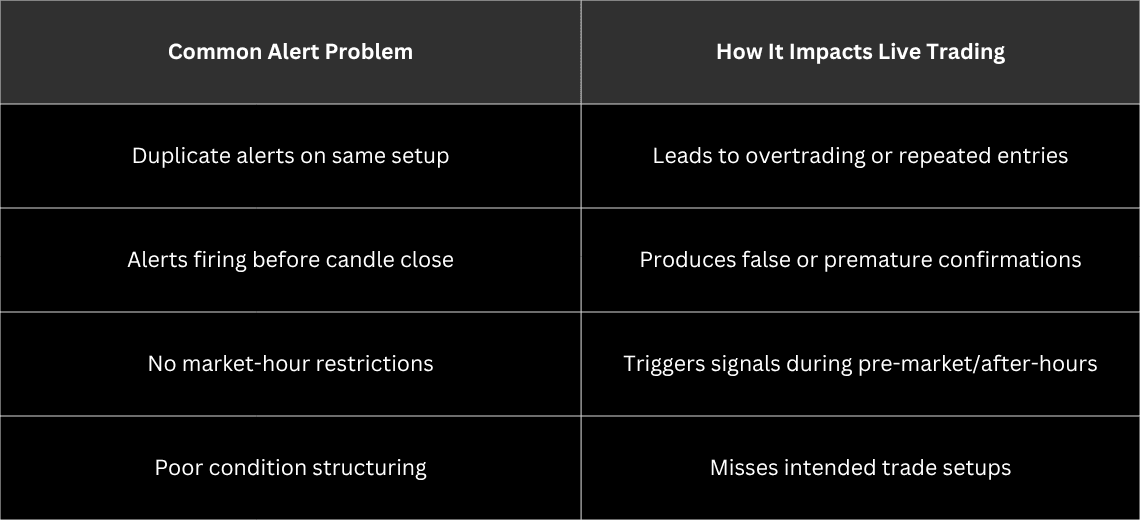
3. Common Problems Traders Face When Creating Alerts
4. Why SPY and QQQ Expose Alert Problems Faster Than Other Markets
SPY and QQQ are particularly unforgiving when alert systems are poorly structured because of their unique market behavior.
High Institutional Participation
Institutional flows create rapid and often abrupt directional moves.
Heavy Options Market Influence
Dealer hedging and gamma exposure can create violent intraday swings.
Tight Reaction Windows
Breakout opportunities may only remain optimal for a few minutes.
High Noise During Open/Close
The first and last hour of U.S. trading sessions can generate extreme volatility.
Because of this, a flawed alert system on SPY or QQQ can damage performance much faster than on slower-moving instruments.
5. Real Trader Scenario: When a Good Strategy Produces Bad Alerts
Consider a trader building a QQQ momentum breakout strategy with the following logic:
-
Price breaks prior 15-minute high
-
Relative volume confirmation
-
ATR-based stop-loss
Backtesting results look promising.
The trader then enables alerts.
6. Immediate Problems Appear
-
Three alerts fire during one breakout candle
-
Alerts trigger before candle confirmation
-
Some alerts appear during pre-market
-
Breakout fakeouts generate excessive noise
-
Alerts occasionally miss valid setups entirely
The trader assumes the strategy is broken.
In reality:
The strategy may be fine. The alert logic is not.
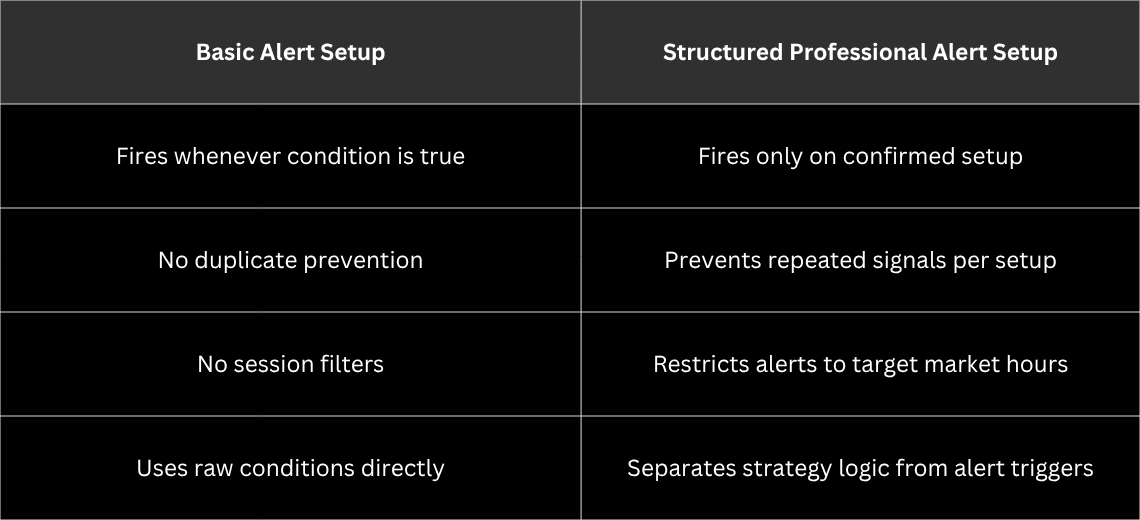
7. Basic Alert Logic vs Properly Structured Alert Logic
8. Why Traditional Pine Script Alert Setups Fail
8.1 Alerts Evaluate Continuously
Many traders do not realize alert conditions can be evaluated multiple times during bar formation.
This means a simple condition like: close > breakoutLevel may become true, false, and true again within one candle, causing multiple unwanted alerts.
8.2 Candle Confirmation Matters
Without confirmation controls, alerts may trigger before a candle closes.
This causes:
-
False breakout alerts
-
Early momentum entries
-
Signals that disappear after candle close
8.3 Session Awareness Is Often Missing
U.S. equities require awareness of:
-
Pre-market
-
After-hours
-
Economic news windows
Alerts without session filtering often trigger outside intended trading periods.
9. How PineGen AI Improves Alert-Ready Pine Script Development
PineGen AI helps traders generate Pine Script strategies with alert implementation considered during the build process, not added afterward as an afterthought.
1. Confirmed Alert Triggers
PineGen structures alerts to trigger only when setup criteria are fully met.
2. Duplicate Prevention Logic
Reduces repeated alerts during prolonged breakout candles.
3. Session-Based Filtering
Supports logic that limits signals to active U.S. trading windows.
4. Strategy-to-Alert Alignment
Keeps alert conditions synchronized with actual strategy entries/exits.
10. Why This Matters for Automated Trading Workflows
Alert quality matters even more when connected to automation systems.
Modern traders increasingly use TradingView alerts for:
-
Webhook execution
-
Broker API integrations
-
Bot automation
-
Portfolio-wide monitoring
-
Multi-strategy execution systems
In these workflows:
-
One flawed alert can trigger real financial consequences.
-
A duplicated webhook alert may open multiple positions.
-
A delayed exit alert may increase drawdown.
-
A false entry signal may cause a bot to trade invalid setups.
11. The Growing Importance of Alert Engineering in 2026
As more traders automate their Pine Script workflows, alert design is becoming a competitive edge.
The market is shifting from: “Can I build a strategy?”
to:
“Can I deploy a strategy reliably in live conditions?”
That second question depends heavily on alert quality.
12. Final Takeaway
Many traders spend weeks optimizing entries, exits, and risk management while spending only minutes configuring alerts.
That imbalance creates one of the biggest gaps between backtest performance and live execution.
For SPY, QQQ, and U.S. stocks, where volatility, liquidity, and institutional participation amplify timing errors, alert quality can directly influence whether a strategy performs as intended.
PineGen AI helps traders close that gap by generating Pine Script strategies built with execution-ready alert logic from the start, allowing users to move from strategy creation to live deployment with greater confidence.