How US Retail Traders Are Building Systematic TradingView Strategies for the Hottest Nasdaq Trade
Author : Ranga Technologies
Publish Date : 6 / 24 / 2026 • 9 mins read
Last Updated : 6 / 24 / 2026

Everyone Knows These Stocks Are Moving. The Question Is: Do You Have a Plan?
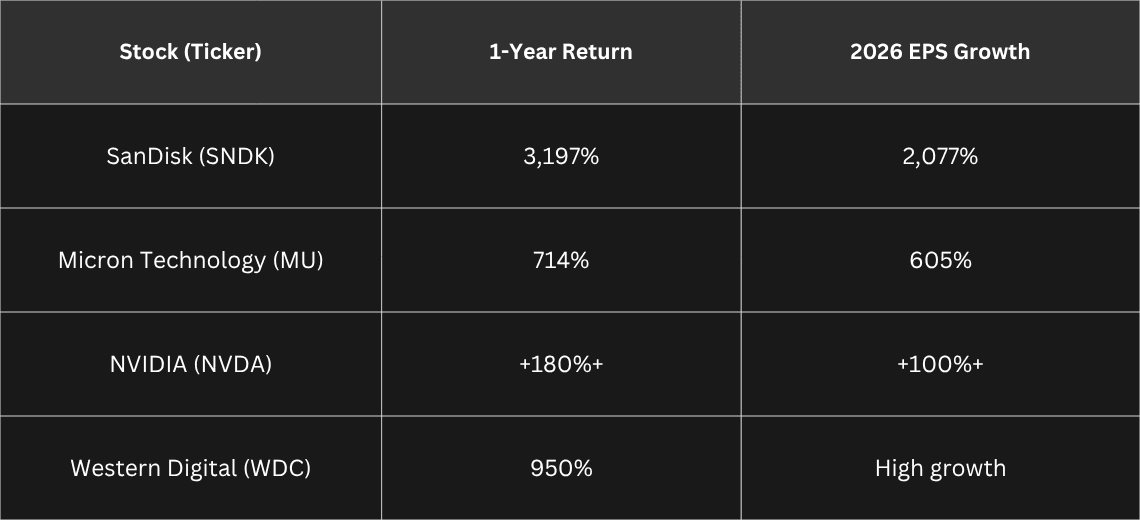
SanDisk is up more than 3,000% over the past year. Micron hit a $1 trillion market cap in under 50 trading days, a feat that took Nvidia nearly 500 days to accomplish. Western Digital is up 950% over the same period. A newly launched DRAM-focused ETF rose 61% in a single month. For context on what this kind of sector performance means for traders building systematic approaches, the best Pine Script AI tools case studies for 2026 document exactly how real traders are capitalising on moves like this.
This isn't a rumour from a Reddit thread. This is the US stock market in 2026, and the AI memory trade is the single biggest wealth creation story in Nasdaq history since the dot-com era. The traders making consistent money from it aren't just riding the wave, they're doing what every algorithmic trader now needs to do: building a systematic, backtested framework before they risk a dollar.
Every US retail trader has an opinion on these stocks. Most of them are watching the same charts. But watching a stock go up 3,000% and actually trading it profitably are two fundamentally different things. If this is your first time building a systematic strategy for a high-volatility sector, the best Pine Script AI generator for beginners walks through the right starting workflow.
The traders making real, repeatable money from this trade aren't the ones refreshing CNBC. They're the ones who built a system, defined entry conditions, ATR-based stops that scale with the sector's extreme volatility, and alert conditions firing to their phone when the setup is clean. They did it in minutes using PineGen AI on TradingView. And they were in the trade before the FOMO crowd arrived.
This case study documents exactly how US retail traders are approaching the AI memory boom systematically, the three trader profiles, the strategies working in this market right now, and the two key frameworks that separate the disciplined from the desperate. The complete foundation for how prompt-based Pine Script generation has revolutionised trading strategy development is the starting point for understanding why the systematic traders in this case study are winning.
1. The Trade That's Defining 2026
To understand why systematic strategy matters here more than almost anywhere else, you need to understand the scale and volatility of what's happening in AI memory stocks right now. The challenge of scaling code quality for professional traders in this environment, managing multiple strategies across a volatile sector, is one of the primary reasons experienced traders are leaning into AI-assisted workflows.
Micron Technology (MU) is at the center of it. The company is no longer selling generic DRAM. Its HBM4 (High Bandwidth Memory 4) is a co-designed component for Nvidia's Vera Rubin architecture, the chip that powers the next generation of AI training. Management has confirmed that Micron's HBM supply for all of 2026 and 2027 is already essentially sold out. Revenue is expected to grow 194.3% in 2026, and earnings are projected to surge 605% after already gaining 538% in 2025. Every major Wall Street institution, 32 out of 32 analysts tracked, has a Buy or Strong Buy rating on the stock. Understanding whether EMA or SMA best captures Micron's momentum is one of the first decisions any systematic trader needs to resolve before building a strategy on this ticker.
SanDisk (SNDK), which spun off from Western Digital in February 2025, has become the even more explosive play in the sector. Revenue jumped more than 250% in its latest earnings report. Earnings per share are expected to soar 2,077% in 2026. Despite this, the stock trades at a forward P/E of just 22, cheaper than most consumer software companies by that metric. Thirteen of the sixteen sell-side analysts who've published on the stock have recently increased their price targets. For traders who want to build custom TradingView indicators and strategies specifically for this kind of breakout-heavy momentum stock, the Pine Script basics are the right starting point.
Nvidia (NVDA) hit an all-time high of $236.54 on May 14, 2026, crossing a $5.05 trillion market cap. Western Digital has returned 950% over the past year. A DRAM-focused ETF launched in April 2026 rose 61% in May alone. For US day traders especially, the June 4 PDT rule elimination has removed the final barrier between small-account retail traders and unrestricted intraday strategies on these volatile Nasdaq names.
This is not a niche trade. Retail investors now account for 20–25% of daily US equity volume, and 80% of fund managers surveyed identified semiconductors as the most crowded trade in markets, the highest reading in the survey's history. The real-world data on which AI tools for Pine Script are actually producing results in this environment, versus which are generating broken code, matters more in a sector moving this fast.
Here's the problem with that last statistic: the most crowded trade is also the most dangerous one to enter without a clear plan. When 80% of participants are in the same side of the same trade, a rotation, an earnings miss, or a sector sentiment shift can produce the kind of move that wipes out a week's gains in two hours. That's exactly what happened to Micron and SanDisk in early June when Broadcom's earnings triggered a sector-wide selloff, both stocks dropped double digits in a single session before recovering. The tips for writing effective Pine Script prompts that describe volatile sector conditions, high ATR, correlated earnings events, volume spikes, are what separate strategies that survive these moves from those that don't.
Crowded trades reward the disciplined and punish the reactive. Systematic traders had their stops defined before the drop hit. Discretionary traders were making emotional decisions in real time. The difference in outcome was significant, and the difference in workflow is exactly what prompt-based strategy generation makes accessible to every US retail trader, not just developers.
2. The Three Types of US Traders in This Market
The AI memory boom has attracted US retail traders across every experience level. But they're approaching it in fundamentally different ways, and getting fundamentally different results. For traders who want to build TradingView strategies without writing a line of code, the contrast between these three profiles is the clearest argument for why systematic generation tools matter.
2.1 Trader Profile 1: The Momentum Chaser
This trader saw SanDisk's monthly performance chart in May 2026, up 70% in a single month, and entered on the peak. No defined stop-loss. No understanding of the ATR (the stock's average daily range is several percentage points, meaning a normal intraday move can look like a disaster without context). No alert conditions. Just a market order and a hope that momentum continued. The PDT rule change opened the door to more frequent intraday trading for this profile, but without a systematic framework, more access simply means more exposure to the same undisciplined approach.
When the Broadcom-triggered selloff hit and both MU and SNDK dropped 10–15% in hours, this trader panic-sold near the low, missed the recovery, and concluded that the trade "doesn't work." The trade worked fine. The approach did not. The EMA vs SMA analysis shows exactly why momentum stocks need faster, EMA-based signals rather than slow lagging averages, and why even the right indicator gives wrong results without a defined stop. This profile accounts for the majority of retail losses in momentum sectors. The stocks move correctly, in the direction of the trend, but the trader's entry timing, position sizing, and absence of a systematic exit plan turn a profitable trade into a losing one. The beginner's guide to systematic Pine Script strategy building is the clearest starting point for traders at this stage.
2.2 Trader Profile 2: The Technical Trader Without a System
This trader knows what they're looking at. They understand breakout levels, EMA crossovers, and RSI confluences. They've identified that Micron's key support sits around the 20-day EMA on the daily chart, and that the stock's bull flag setups have historically resolved upward in the current trend structure. Their indicator instincts are correct, but the detailed comparison of EMA periods, SMA periods, and what each captures differently in a high-volatility momentum sector is the knowledge they're missing.
The problem: they're re-analysing the chart from scratch every morning, making manual entry and exit decisions in real time during market hours, and inconsistently applying their own rules under pressure. Some days they take the setup. Other days they hesitate because "it looks extended." There's no systematic test of whether their logic actually has a positive expected value across hundreds of trades. This is precisely the scaling problem that AI-assisted Pine Script workflows solve, removing the manual decision loop and replacing it with validated, consistently-applied logic.
This profile describes the majority of technically-literate retail traders. They understand the concepts but haven't formalised them into a testable, repeatable system. Pine Script explained, what the language actually does, and how indicators translate into executable strategy logic, is the bridge between this trader profile and the systematic one.
2.3 Trader Profile 3: The Systematic Trader
This trader approached the AI memory sector the same way they approach every market: build a clear strategy, backtest it with Pine Script on TradingView, validate that the logic has worked historically across enough trades, and deploy with defined risk management.
They used PineGen AI to generate a Micron breakout strategy from a plain-English description: long when price closes above the prior swing high with volume above the 20-bar average and the 21 EMA trending up, stop-loss at 2x ATR below entry, take-profit at 3x ATR, alert conditions firing to their phone. The strategy generated in under 90 seconds. They ran it through TradingView's Strategy Tester across 18 months of MU data. The results were statistically meaningful. They deployed it. The tips that made their prompt work on the first generation, specifying ATR-based stops, naming the EMA period, describing the volume filter, are what separated their output from a generic strategy.
When the June selloff hit, their ATR-based stop-loss exited the position automatically at a predefined level. They were out before the worst of the drop, with a defined small loss that the system had already accounted for as a possibility. They re-entered on the recovery bounce, again triggered by the systematic signal. Why every serious algorithmic trader now needs a Pine Script AI workflow is exactly this story, same market, same stock, completely different outcome because of the presence or absence of a system.
This is what systematic trading looks like in a crowded, volatile sector. Same stocks. Same market. Completely different outcome process.
3. The 2026 AI Memory Sector, Key Performance Data
4. Why These Stocks Demand a Systematic Approach
The AI memory sector in 2026 presents a specific challenge that's distinct from most trading environments: the stocks have massive structural tailwinds that justify the long-term trend, but they're subject to violent intraday and intraweek swings driven by sector rotation, macroeconomic data, earnings from correlated names like Broadcom and TSMC, and the psychological dynamics of 80% of the market being on the same side of the trade. Scaling code quality and workflow discipline is what keeps a multi-strategy approach to this sector manageable rather than chaotic.
Micron has a daily ATR, its average true range, or typical daily price movement, that frequently exceeds 3–5% of its share price. SanDisk moves even more violently. This means a fixed-percentage stop-loss is meaningless: a 2% stop on a stock with a 4% average daily range gets taken out by normal noise before the real move has even started. Tips for building prompts that produce ATR-aware risk management in PineGen AI cover exactly how to describe this in plain English so the generated strategy uses volatile stock-appropriate stop sizing.
ATR-based risk management, setting your stop at a multiple of the stock's actual average volatility rather than an arbitrary fixed percentage, is the professional approach to this environment. It scales the stop to what the stock actually does, not to an arbitrary threshold that has no relationship to the instrument's behaviour.
In a momentum sector like AI memory, the EMA is generally preferable to the SMA because it reacts faster to price changes. When Micron surges 19% in a single session on a UBS upgrade, an EMA-based signal adapts within the same day. A 200-period SMA is still processing that move a week later. This is not a minor preference, it directly determines whether your trend filter keeps you in a fast-moving trade or signals exit just as the move is beginning.
The June 2026 PDT rule elimination adds another dimension for US traders specifically. With the $25,000 minimum equity requirement removed as of June 4, 2026, US retail traders with accounts under $25K can now run systematic intraday strategies on these stocks without the three-day-trade-per-week restriction that previously forced them into swing trading regardless of their preferred approach. A trader with a $10,000 account can now run an Opening Range Breakout strategy on Micron or SanDisk every session without constraint. The opportunity is real. The need for a systematic approach is now more critical than ever.
5. The Four Strategy Frameworks Working in This Market
Systematic traders approaching the AI memory boom aren't using a single strategy. The sector's behaviour changes across market conditions, trending strongly one week, consolidating tightly the next. Experienced TradingView traders are using different frameworks for different market environments, built with PineGen AI and validated in TradingView's Strategy Tester before any live capital is deployed.
5.1 Framework 1: The Breakout from Consolidation
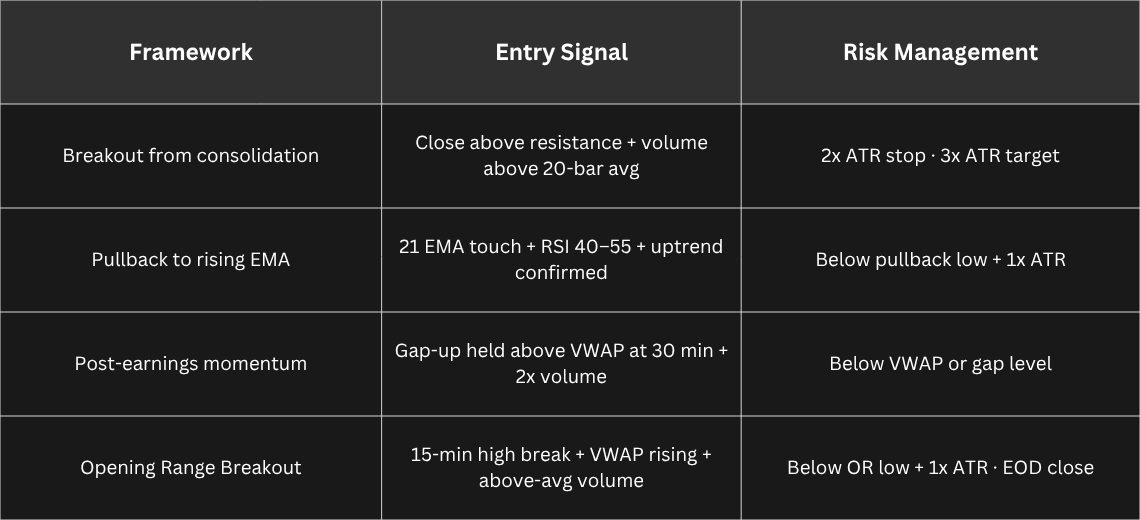
After major earnings-driven moves, AI memory stocks frequently enter tight consolidation phases where the stock digests the gain. These consolidation periods are bull flags in strong uptrends, temporary pauses before continuation. The breakout strategy waits for a confirmed close above the consolidation high, with volume on the breakout bar exceeding the 20-bar average. Stop-loss sits at 2x ATR below the breakout bar's low. Target is 3x ATR above entry. The complete guide to how prompt-based Pine Script generation works shows how to turn this exact logic into a validated, deployable strategy from a single descriptive prompt.
This is the framework that captured Micron's breakout above $460 in early 2026, which subsequently extended to $525 and beyond. The key discipline: only take the breakout when it closes above the level, not when it briefly touches and pulls back. Volume confirmation filters out the fake breakouts that trap discretionary traders. Case studies from traders using Pine Script AI tools in 2026 include breakout frameworks applied to exactly these kind of momentum semiconductor names.
5.2 Framework 2: The Pullback to Rising EMA
In a strong uptrend, and the AI memory sector has been in a relentless uptrend through most of 2026, stocks regularly pull back to test the rising 21 EMA before continuing. This is where institutional money adds to winning positions. Retail traders using the pullback framework wait for price to return to the 21 EMA during an established uptrend (defined as the 21 EMA being above the 50 EMA), with RSI pulling back to the 40–55 zone indicating the momentum has cooled without reversing. The EMA vs SMA comparison explains with backtested data why the 21 EMA provides more reliable dynamic support than a 20-period SMA on fast-moving momentum stocks.
Entry is on a candle close back above the EMA. Stop-loss below the pullback low plus 1x ATR. This framework had extremely high accuracy on Micron through the first half of 2026 because the trend was consistent and the 21 EMA provided reliable dynamic support. How Pine Script AI helps build TradingView strategies instantly includes a walkthrough of building this exact type of pullback-to-EMA strategy from a plain-English prompt in under two minutes.
5.3 Framework 3: Post-Earnings Momentum
This is the highest-risk, highest-reward framework, and the one most dependent on systematic execution rather than emotional judgment. When an AI memory stock reports blowout earnings and gaps up significantly at the open, the systematic trader looks for specific conditions that suggest the gap will hold and extend rather than fade: price above VWAP within the first 30 minutes, volume on the move at least 2x the 20-bar average, and the stock holding above the opening gap range. Tips and tricks for prompting PineGen AI to generate a validated post-earnings momentum strategy, describing the VWAP condition, the gap-hold requirement, and the volume filter in a single prompt, is how systematic traders prepare for earnings before the announcement, not after.
This framework captured the massive post-earnings move in SanDisk following its fiscal Q1 2026 results, when the stock surged and held above its opening level for the entire session. Discretionary traders hesitated because the stock "looked extended." Systematic traders had pre-defined conditions that said "this specific configuration has historically continued", and took the trade accordingly. Why every algorithmic trader needs Pine Script AI is the explanation for why post-earnings momentum systems, which fire exactly once after an announcement, are precisely the kind of high-stakes, time-critical strategies that benefit most from pre-built, validated logic.
5.4 Framework 4: Opening Range Breakout (Post-PDT)
For US traders now freed from the PDT rule, the Opening Range Breakout (ORB) strategy on individual AI memory stocks is one of the cleanest systematic approaches for intraday trading in this sector. The opening 15 minutes of the NYSE session establishes the day's initial price discovery zone. A clean break above the opening range high with VWAP rising and above-average volume has strong follow-through characteristics in trending momentum stocks. The PDT rule elimination means US traders can now run this strategy as many times per week as the setup generates, without artificial trade-count restrictions. Pine Script fundamentals covers how session-based time filtering and VWAP calculations are correctly structured in Pine Script v6 for US equity intraday strategies like ORB.
6. Strategy Framework Comparison for Trading AI Memory Stocks on TradingView
7. Why Systematic Traders Are Using PineGen AI for This Sector
The AI memory trade is moving too fast for slow workflows. These stocks can move 10–25% in a single session on analyst upgrades, earnings beats, Nvidia supply chain news, or macroeconomic triggers. By the time a trader manually codes a breakout strategy, debugs it, validates the logic, and runs the backtest, the setup they were trying to capture has already been resolved. How Pine Script AI helps build TradingView strategies instantly documents the precise workflow that compresses that development cycle from hours or days to under two minutes.
PineGen AI compresses that workflow from hours to minutes. A trader describes their Micron breakout setup in plain English, entry conditions, stop-loss method, take-profit level, volume filter, alert requirements. PineGen AI generates a validated Pine Script v6 strategy ready to paste into TradingView's Pine editor in under two minutes. The live chart preview shows immediately whether the signals are firing at the right levels. The backtesting summary gives a quick read on profit factor, win rate, and drawdown before a full strategy tester run.
The advantage isn't just speed, it's iteration speed. A trader who can test 10 variations of their Micron strategy in an afternoon has a fundamentally different ability to find and validate an edge compared to a trader who can only test one per week due to manual development time. Prompt-based Pine Script generation is what makes that iteration velocity possible, changing one condition in the prompt produces a new validated strategy in the same time it takes to type a sentence.
Effective prompting matters here specifically because AI memory stocks have unique characteristics: high ATR values, strong volume spikes on catalyst days, and sector correlation that means multiple stocks move together. Prompts that describe these specifics, "use ATR 14 with a 2x multiplier for the stop-loss because this stock has high average daily range", "add a volume filter requiring 2x average volume on the entry bar to filter out low-conviction breakouts", produce far more accurately calibrated strategies than generic descriptions.
As strategies become more complex, adding sector ETF filters, multi-timeframe confirmation, earnings calendar awareness, the workflow for scaling Pine Script quality becomes critical. PineGen AI's chat-based refinement maintains full context across a conversation, so complexity can be added incrementally without rebuilding from scratch. Managing four different strategy frameworks across four different AI memory tickers is a workflow management challenge as much as a strategy challenge.
The traders capturing the AI memory boom systematically aren't doing anything that requires a computer science degree or an institutional budget. They're describing their trading logic in plain English, validating it against real historical data, and deploying with defined risk management. The complete 2026 guide to Pine Script AI is the full reference for every stage of that workflow, from the first prompt to a live, alert-ready strategy on TradingView. That workflow is now available to every US retail trader with a clear idea of how they want to approach the trade.
8. Conclusion: The AI Memory Trade Rewards the Prepared
SanDisk up 3,197%. Micron's HBM supply sold out for two years. Nvidia at $5 trillion. Western Digital up 950%. The AI memory boom is the defining trade of 2026, every US retail trader watching a Nasdaq chart has noticed. The 2026 case studies of traders using Pine Script AI tools document exactly who is profiting from this and what their workflows look like.
But noticing a trade and profiting from it systematically are different skills. The traders profiting consistently from this sector defined their entry conditions, validated their risk management against real historical data, and deployed a system that executes the same logic every time, without hesitation, without emotional overrides. Prompt-based Pine Script generation is what made it possible for them to build and validate those systems faster than the market moved away from the opportunity.
The crowded trade is dangerous precisely because it concentrates both opportunity and risk. When 80% of the market is in the same direction, the downside swings are fast and deep. Systematic risk management, ATR-based stops, defined position sizing, alert-triggered entries, is what separates compounders from capitulators. Effective prompting techniques for volatile stock strategies are the specific skills that produce strategies calibrated for this environment rather than generic strategies applied to it.
PineGen AI makes that systematic framework accessible to every US retail trader who has a clear trading thesis but lacks either the time or the Pine Script knowledge to code it into a validated TradingView strategy. The AI memory trade is here. The tools to trade it systematically are ready. The only question is whether you approach it with a plan or without one.
Build Your AI Memory Stock Strategy in Minutes
Describe your Micron breakout, SanDisk pullback, or Nvidia momentum setup in plain English. Get validated Pine Script v6. See it on a live TradingView chart. Run the backtest. No coding required.