Why AI Infrastructure Spending Is Reshaping U.S. Tech Stock Volatility
Author : Ranga Technologies
Publish Date : 5 / 4 / 2026 • 3 mins read
Last Updated : 5 / 4 / 2026
What Happens When AI Spending Becomes the Market’s Main Obsession?
Not long ago, most U.S. tech earnings reactions came down to familiar metrics, revenue growth, user numbers, margins, guidance. That is no longer enough.
In 2026, traders are watching something else just as closely: How much major technology companies are spending to build AI infrastructure.
Every quarter, firms across the U.S. tech sector are allocating billions toward GPUs, data centers, cloud expansion, and AI compute capacity. These investments are changing how analysts value companies, how institutions position themselves, and how traders react to earnings reports.
AI infrastructure spending has emerged as one of the most important forces shaping U.S. tech stock volatility in 2026. As companies increase spending on data centers, GPUs, and AI compute resources, traders are seeing larger earnings reactions, more aggressive sector rotation, and wider intraday ranges across major tech names.
This article explores why AI infrastructure spending is affecting market behavior, how it is changing modern trading strategies, and why traders are increasingly turning to Pine Script AI tools like PineGen AI to adapt their strategies faster.
1. Why AI Infrastructure Spending Matters to Traders
At first glance, infrastructure spending sounds like something investors, not traders, should care about.
But in 2026, that line has blurred.
Markets are no longer reacting only to what a company earned last quarter.
They are reacting to:
-
How much it is spending on AI expansion
-
Whether that spending is accelerating
-
Whether margins are being compressed by infrastructure costs
-
Whether management expects returns on AI investment soon
-
Whether competitors are spending more or less aggressively
That means a company can beat revenue expectations and still sell off sharply if traders dislike its AI spending outlook.
Likewise, a company can miss on near-term margins but rally because investors believe its AI investment will create future dominance.
For traders, this creates a more complex and volatile environment.
2. What Is Fueling the AI Infrastructure Spending Boom?
Several forces are pushing spending higher across the U.S. tech sector.
Exploding Demand for AI Compute
Training and deploying large AI models requires enormous computing power. Cloud providers and tech platforms are racing to expand capacity.
Competitive Pressure
No major tech firm wants to appear behind in the AI race. Infrastructure spending has become part necessity, part signaling.
Investor Expectations
Public markets are rewarding companies perceived as AI leaders, which encourages continued aggressive investment.
3. How This Is Changing U.S. Tech Stock Behavior
AI infrastructure spending is not just influencing valuations. It is changing how prices move.
3.1 Earnings Reactions Are Becoming More Violent
Traders now react sharply to:
-
AI capex guidance
-
Data center spending plans
-
Margin compression tied to infrastructure
-
Forward-looking AI monetization commentary
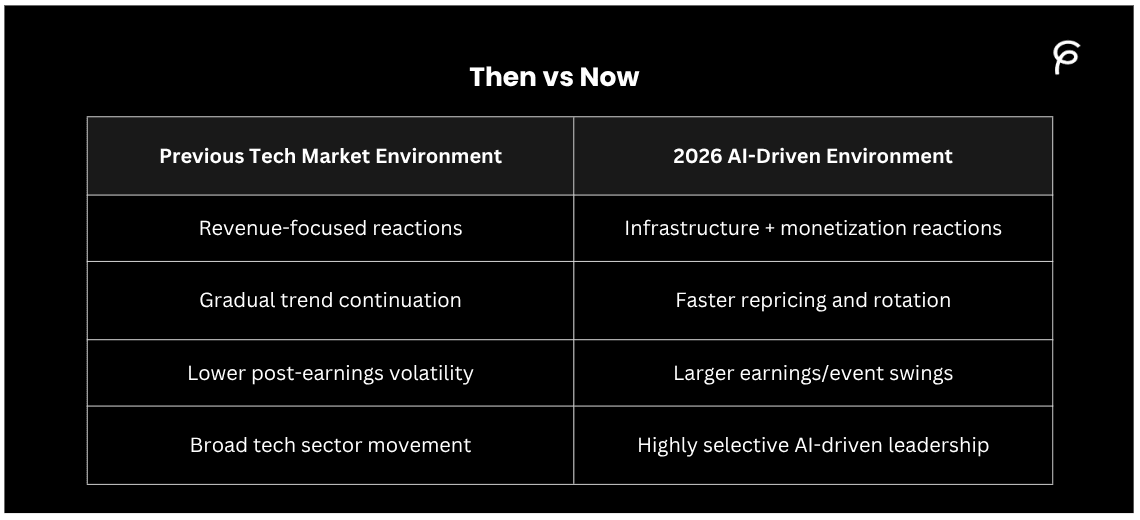
Stocks that once moved 3–5% after earnings are now seeing much larger reactions when AI spending expectations shift materially.
3.2 Sector Rotation Is Faster and Less Predictable
Money rotates quickly between:
-
Semiconductor names
-
Cloud providers
-
Infrastructure suppliers
-
AI software companies
-
Broader Nasdaq components
That means correlation structures can shift faster than many TradingView strategies expect.
3.3 Volatility Is Expanding Around AI-Related News
Even outside earnings season, headlines tied to AI partnerships, chip supply, regulation, or infrastructure expansion can trigger abrupt repricing.
4. Then vs Now
5. Why Many TradingView Strategies Are Struggling
A large percentage of Trading strategies currently used in tech trading were built for a different market environment.
They assume:
-
Stable volatility ranges
-
Cleaner breakout continuation
-
Less event-driven noise
-
More predictable sector correlation
Those assumptions break down when volatility expands suddenly.
This is why traders are increasingly reporting that strategies which worked well from 2022–2024 feel less reliable now.
6. What Traders Need to Change in Their Strategies
6.1 Dynamic Volatility Controls
Static stop-loss and take-profit models become less reliable when ATR expands rapidly.
6.2 Better Event Awareness
Strategies should account for earnings, macro releases, and AI-related catalysts.
6.3 More Confirmation Before Entry
Breakouts and momentum signals need stronger confirmation in volatile environments.
6.4 Sector-Specific Logic
Treating all tech stocks the same no longer works when AI infrastructure beneficiaries and laggards behave differently.
7. Why Traders Are Using Pine Script AI to Adapt Faster
Rebuilding strategies manually every time market conditions shift is slow.
That is why demand for Pine Script AI, and AI trading strategies continues to rise.
Traders want to:
-
Test more ideas faster
-
Adjust logic without rewriting everything manually
-
Iterate on volatility filters quickly
-
Explore alternative risk models
8. Why PineGen AI Instead of Generic AI Tools?
Many traders first try general-purpose AI for coding help.
The issue is that generic AI often understands programming broadly, but not trading logic deeply.
It may produce code that:
-
Compiles incorrectly in TradingView
-
Uses outdated Pine syntax
-
Mishandles multi-timeframe logic
-
Creates repainting issues
-
Fails strategy tester assumptions
PineGen AI is built specifically for Pine Script TradingView workflows.
That specialization matters because trading strategy generation is not just coding, it requires understanding market logic, TradingView structure, and strategy-testing constraints.
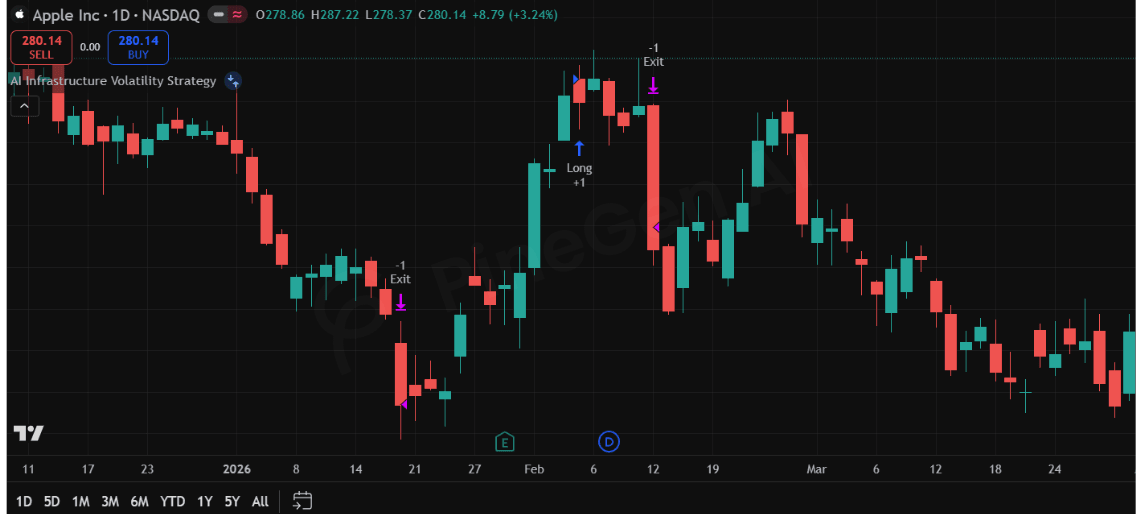
9. Pine Script Framework for Volatility-Aware Tech Strategy
//@version=6
strategy("AI Infrastructure Volatility Strategy", overlay=true)

emaTrend = ta.ema(close, 50)
atrValue = ta.atr(14)

volatilityThreshold = atrValue > ta.sma(atrValue, 20)

longCondition = close > ta.highest(high, 20)[1] and close > emaTrend and volatilityThreshold

if longCondition
    strategy.entry("Long", strategy.long)

strategy.exit(
    "Exit",
    from_entry = "Long",
    stop = close - atrValue * 2,
    limit = close + atrValue * 4
)
This type of adaptive framework helps traders respond to expanding volatility rather than assuming market behavior remains static.
10. Final Thoughts
AI infrastructure spending is no longer just a corporate finance discussion.
It is reshaping how U.S. tech stocks move, how volatility expands, and how traders need to approach the market.
For traders building Trading strategies in today’s environment, adapting to this shift is becoming increasingly important.
The challenge is not simply understanding the macro trend.
It is adjusting strategy logic quickly enough to keep pace with a market structure that is evolving in real time. That is why more traders are moving toward Pine Script AI workflows.
Use PineGen AI to create and refine Pine Script TradingView strategies faster, so you can adapt to shifting volatility, changing sector behavior, and modern U.S. market conditions with less coding friction. Try PineGen AI today and build smarter, faster.