Why More U.S. Traders Are Moving From Manual Trading to AI-Assisted Systems
Author : Ranga Technologies
Publish Date : 5 / 19 / 2026 • 2 mins read
Last Updated : 5 / 19 / 2026
Are Retail Traders Losing the Speed Battle Against Modern Markets?
A few years ago, most traders in the United States relied heavily on manual chart analysis.
They opened TradingView, watched candlestick patterns, checked indicators one by one, entered trades manually, and reacted to market movement based on experience and instinct.
That approach still exists today.
But the market around traders has changed dramatically.
Modern financial markets now move through:
-
High-frequency systems
-
AI-assisted analytics
-
Automated liquidity management
-
Real-time institutional trading infrastructure
At the same time, retail traders are exposed to more information than ever before:
-
Economic data
-
Inflation reports
-
Federal Reserve announcements
-
Earnings releases
-
Overnight futures movement
-
Sector rotation
-
Geopolitical news
Trying to manually process all of this in real time has become increasingly difficult.
This is why many U.S. traders are shifting toward AI-assisted trading workflows.
Not because AI guarantees profits.
Not because human traders are obsolete.
But because modern markets became too fast, too complex, and too data-heavy for purely manual systems alone.
The goal is to improve workflow speed, strategy development, testing, and automation.
The goal is no longer just:
“Find a good strategy.”
The goal is:
“Build, test, refine, and adapt strategies faster than before.”
This article will help you understand why AI-assisted workflows are becoming part of modern U.S. trading culture.
1. Why Manual Trading Is Becoming Harder
Manual trading is not dead.
But the environment surrounding trading has changed faster than many traders expected.
A decade ago, many retail traders could rely mostly on:
-
Chart reading
-
Price action
-
Manual execution
The pace of the market was slower, competition was lower, and information moved less aggressively.
Today, markets are heavily influenced by automation.
Institutional firms use:
-
Algorithmic execution systems
-
Machine learning analytics
-
Automated order routing
-
High-frequency infrastructure
These systems process market information within milliseconds.
Retail traders are no longer competing only against other humans.
They are competing against systems designed to:
-
React faster
-
Analyze more variables
-
Process information continuously
-
Execute without emotion
This creates a major challenge for purely manual workflows.
2. Information Overload Is Exhausting Traders
Modern traders are exposed to massive amounts of information daily.
A single trading session may involve:
-
Inflation data
-
Interest rate expectations
-
Futures market movement
-
Crypto volatility
-
Breaking news
-
Institutional positioning
-
Sector rotation
Trying to process all of these factors manually becomes mentally exhausting over time.
Many traders eventually experience:
-
Analysis paralysis
-
Decision fatigue
-
Emotional inconsistency
-
Impulsive execution
This happens because the human brain struggles to monitor multiple market variables continuously.
This is one of the biggest reasons traders are adopting AI-assisted systems.
Not to remove human thinking.
But to reduce repetitive analysis and improve workflow structure.
3. Markets Move Faster Than Human Reaction
Volatility spikes now happen extremely fast.
During:
-
Economic announcements
-
Earnings releases
-
Federal Reserve statements
Price movement can change dramatically within seconds.
Manual traders often react after the market has already moved.
AI-assisted systems can:
-
Monitor conditions continuously
-
Automate alerts
-
Filter setups
-
Organize signals systematically
This improves workflow speed significantly.
4. Emotional Trading Still Destroys Consistency
One of the biggest problems in manual trading is emotional behavior.
Even experienced traders struggle with:
-
Fear during volatility
-
Greed during momentum
-
Revenge trading after losses
-
Hesitation before entries
-
Panic exits during pullbacks
Emotional reactions create inconsistency.
Two traders may use the exact same strategy but produce completely different results because execution behavior changes under pressure.
AI-assisted workflows help reduce this issue by converting trading logic into predefined conditions and structured systems.
That does not remove risk.
But it reduces emotional randomness.
5. What AI-Assisted Trading Actually Means
Many beginners misunderstand AI-assisted trading completely.
AI-assisted trading does not mean: “AI automatically generates profitable trades.”
And it does not mean: “Human traders are no longer necessary.”
Instead, AI-assisted trading means using artificial intelligence to improve parts of the trading workflow itself.
The real advantage is workflow acceleration.
6. AI Helps Traders Build Faster
Modern traders use AI to:
-
Generate Pine Script strategies
-
Create TradingView indicators
-
Optimize conditions
-
Test multiple variations
-
Automate repetitive development work
Without AI assistance, building a TradingView strategy manually may require:
-
Writing Pine Script line by line
-
Fixing syntax issues
-
Restructuring conditions repeatedly
-
Debugging TradingView errors manually
That process can consume hours.
AI-assisted systems dramatically reduce this friction.
For example, a trader can describe: “Create an RSI and MACD momentum strategy with an ATR stop loss and volatility filter.”
An AI Pine Script generator can convert that idea into a structured starting point within seconds.
This allows traders to focus more on:
-
Testing
-
Refinement
-
Optimization
-
Market adaptation
Instead of spending most of their time manually coding.
7. AI Improves Iteration Speed
This is one of the most important advantages.
Most profitable trading systems are not built instantly.
They improve gradually through:
-
Repeated testing
-
Parameter refinement
-
Volatility adaptation
-
Market condition filtering
AI allows traders to move through these cycles faster.
Instead of spending days building one version manually, traders can test multiple concepts more efficiently.
That iteration speed becomes extremely valuable over time.
8. AI Still Requires Human Oversight
This part is extremely important.
AI can generate:
-
Weak logic
-
Unrealistic assumptions
-
Incorrect execution handling
-
Poor risk structures
This means human validation is still necessary.
Successful traders still need to:
-
Test strategies properly
-
Understand market conditions
-
Review risk exposure
-
Adapt systems over time
AI improves efficiency.
It does not replace responsibility.
9. Why U.S. Markets Are Changing So Quickly
Several major structural shifts are reshaping U.S. trading behavior.
9.1 Retail Participation Increased Massively
Retail participation in U.S. markets expanded rapidly because of:
-
Commission-free trading apps
-
Mobile investing platforms
-
Easier market access
-
Social trading communities
More retail participation means:
-
Faster crowd reactions
-
Stronger momentum moves
-
More competitive execution environments
9.2 Algorithmic Trading Dominates Market Volume
Various market structure reports estimate that algorithmic and automated systems now account for a majority of U.S. equity trading activity.
That means much of modern market behavior is influenced by systems reacting automatically to:
-
Price movement
-
Volatility
-
Macroeconomic data
-
Statistical models
Retail traders are adapting to this reality by adopting more systematic workflows themselves.
9.3 TradingView Automation Is Expanding
TradingView has become one of the most widely used platforms among retail traders.
As Pine Script adoption grows, traders increasingly want:
-
Faster strategy generation
-
Easier debugging
-
AI-assisted automation
-
Strategy optimization support
This is why Pine Script AI tools are growing rapidly.
10. Why PineGen AI Fits TradingView Workflows Better
General AI tools are designed broadly across many subjects.
PineGen AI focuses specifically on Pine Script and TradingView workflows.
That specialization matters.
10.1 PineGen AI Understands TradingView Structure Better
Many general AI coding tools generate Pine Script that:
-
Compiles incorrectly
-
Lacks proper execution logic
-
Misses TradingView structure
-
Requires heavy manual correction
PineGen AI focuses directly on:
-
Pine Script generation
-
TradingView strategy workflows
-
Debugging
-
Structured iteration
-
Strategy refinement
This improves workflow consistency significantly.
10.2 PineGen AI Helps Traders Iterate Faster
Real strategy development is not linear.
Most traders continuously:
-
Refine entries
-
Adjust risk conditions
-
Test volatility filters
-
Optimize momentum signals
PineGen AI helps reduce development friction across this process.
Instead of repeatedly rewriting large sections of code manually, traders can iterate faster and focus more on optimization.
10.3 PineGen AI Supports Learning Through Practice
Many beginners struggle with Pine Script because they learn syntax before understanding structure.
AI-assisted workflows allow users to:
-
Analyze generated strategies
-
Understand logic visually
-
Experiment with conditions
-
Improve gradually through iteration
This often creates a smoother learning process.
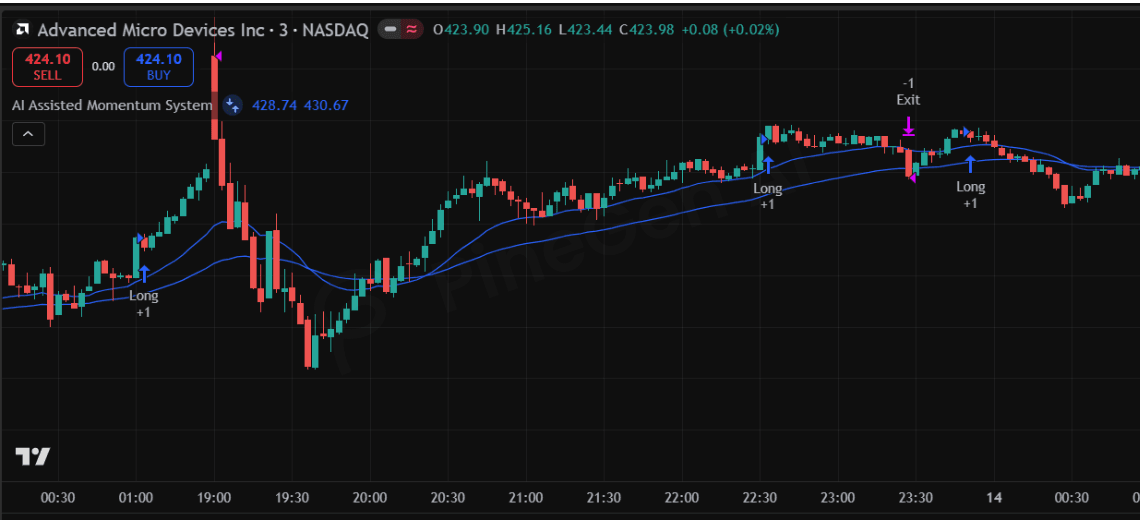
11. Large AI-Generated Pine Script Example
pinescript//@version=6
strategy("AI Assisted Momentum System", overlay=true)

// Trend Filters
fastEMA = ta.ema(close, 20)
slowEMA = ta.ema(close, 50)

// RSI Momentum
rsiValue = ta.rsi(close, 14)

// MACD Signals
[macdLine, signalLine, histLine] = ta.macd(close, 12, 26, 9)

// ATR Volatility
atrValue = ta.atr(14)

// Volume Filter
volumeMA = ta.sma(volume, 20)

// Market Structure
bullTrend = fastEMA > slowEMA
bullMomentum = rsiValue > 55
bullCross = ta.crossover(macdLine, signalLine)
strongVolume = volume > volumeMA

// Entry Logic
longCondition =
    bullTrend and
    bullMomentum and
    bullCross and
    strongVolume

if longCondition
    strategy.entry("Long", strategy.long)

// Dynamic Exit System
strategy.exit(
    "Exit",
    from_entry = "Long",
    stop = close - atrValue * 2,
    limit = close + atrValue * 3
)

// Visual Plots
plot(fastEMA)
plot(slowEMA)
This type of AI-assisted Pine Script structure helps traders combine:
-
Momentum confirmation
-
Volatility management
-
Trend filtering
-
Dynamic exits
-
TradingView strategy execution
Into one organized workflow.
12. What AI Still Cannot Do
Despite rapid progress, AI still has limitations.
AI does not truly understand:
-
Market psychology
-
Emotional behavior
-
Macroeconomic uncertainty
-
Unpredictable events
It predicts patterns based on data.
That means traders still need:
-
Validation
-
Testing
-
Adaptation
-
Risk management
-
Strategic judgment
AI can improve workflow speed significantly.
But it cannot eliminate uncertainty from markets.
13. The Future of AI-Assisted Trading
The future of trading is likely not: Humans versus AI.
Instead, it is becoming: Humans working alongside AI-assisted systems.
Traders who combine:
-
Market understanding
-
Disciplined risk management
-
AI-assisted strategy development
-
Systematic workflows
Will likely adapt faster than traders relying entirely on manual processes alone.
AI is changing how strategies are built, tested, and refined.
And that shift is already happening across modern U.S. trading culture.
14. Build Smarter TradingView Strategies With PineGen AI
Modern markets move too quickly for slow development workflows.
Many traders lose valuable time:
-
Rewriting strategy conditions
-
Debugging TradingView issues
-
Manually testing endless variations
That slows improvement.
PineGen AI helps traders move faster from: Idea → Strategy → Testing → Optimization
With PineGen AI, you can:
-
Generate Pine Script from natural language
-
Build TradingView strategies faster
-
Reduce debugging frustration
-
Test more ideas efficiently
-
Improve workflow consistency
Whether you are:
-
Learning Pine Script
-
Building TradingView automation
-
Refining momentum systems
-
Optimizing volatility strategies
PineGen AI helps reduce friction across the entire development process.
The advantage is not: “Automatic profits.”
The real advantage is:
-
Faster learning
-
Cleaner workflows
-
Better iteration
-
More efficient strategy development
Start building AI-assisted TradingView strategies with PineGen AI today.
15. Conclusion
U.S. markets are becoming increasingly fast, automated, and data-driven.
As this shift continues, more traders are moving from purely manual workflows toward AI-assisted systems designed to improve:
-
Strategy generation
-
TradingView automation
-
Testing workflows
-
Debugging
-
Execution consistency
AI is not replacing traders.
But it is changing how traders build, refine, and optimize systems.
And platforms like PineGen AI are helping traders adapt to this new environment by reducing development friction and accelerating TradingView strategy workflows.