The Rise of “Vibe Coding” in Trading: How AI Is Changing Pine Script Development
Author : Ranga Technologies
Publish Date : 5 / 27 / 2026 • 5 mins read
Last Updated : 5 / 27 / 2026
Are Traders Still Manually Writing Pine Script in 2026? Trading is changing fast, and now coding workflows are changing too.
In 2026, traders are no longer spending endless hours manually writing Pine Script line by line, fixing syntax errors, and debugging TradingView strategies from scratch. A new workflow is taking over: vibe coding.
The concept is simple. Instead of manually building every condition, traders describe strategy ideas naturally, and AI helps generate the code. What started as a trend inside the software industry is now rapidly entering the TradingView ecosystem.
More traders are using AI-assisted workflows to:
-
refine trading logic
-
accelerate backtesting
-
simplify debugging
-
automate TradingView workflows faster
And platforms like PineGen AI are becoming part of that transformation.
Vibe coding is becoming one of the biggest AI-assisted development trends in 2026, especially among TradingView and retail trading communities. Instead of manually writing every Pine Script condition, traders are increasingly using AI to generate strategies, debug scripts, refine trading logic, and accelerate backtesting workflows.
This article explores what vibe coding means in trading, how AI is changing Pine Script development, why traders are moving toward AI-assisted workflows, and how platforms like PineGen AI are simplifying TradingView automation for beginners, non-programmers, and retail algo traders.
1. What Is Vibe Coding?
The term “vibe coding” became popular after AI-assisted coding workflows exploded across the tech industry. Instead of manually writing every line of code, users describe what they want naturally while AI generates the structure for them.
That same concept is now entering trading. Instead of learning Pine Script syntax first, traders can now describe strategy ideas conversationally and use AI to generate TradingView-compatible code.
For example, instead of manually coding:
-
RSI conditions - Traders normally need to manually define RSI calculations, overbought and oversold levels, crossover conditions, and signal confirmations inside Pine Script.
-
EMA crossovers - Moving average strategies require traders to structure crossover logic correctly, define fast and slow EMA conditions, and ensure entries trigger properly during backtesting.
-
Stop-loss logic - Risk management rules must be manually configured by setting stop-loss percentages, ATR levels, trailing stops, or exit conditions within the strategy structure.
-
Breakout confirmations - Traders often need to code price breakout validation using volume conditions, support and resistance levels, candle confirmations, or volatility filters.
A trader can simply describe the setup naturally and refine the generated strategy afterward. This is fundamentally changing how Pine Script development works in 2026.
2. Why Vibe Coding Is Growing in Trading
TradingView strategy development has traditionally been difficult for non-programmers.
Many traders understand:
-
chart patterns
-
market structure
-
technical indicators
-
risk management
but struggle with coding syntax, debugging, and TradingView-specific implementation.
That gap created friction between trading ideas and actual execution.
AI-assisted development is reducing that friction.
Instead of spending hours learning Pine Script formatting, traders can now focus more on:
-
strategy refinement - Traders can spend more time improving entries, exits, confirmations, and overall trading performance instead of struggling with syntax errors and code structure.
-
faster experimentation - Multiple strategy ideas can be tested and modified quickly without manually rebuilding scripts every time a condition changes.
-
backtesting workflows - Traders can validate strategies against historical market data faster, helping them analyze performance and identify weaknesses more efficiently.
-
optimization - AI-assisted workflows make it easier to fine-tune indicators, risk settings, stop-loss levels, and trade conditions to improve overall strategy behavior.
-
execution logic - Traders can focus more on how strategies actually behave in real market conditions, including entries, exits, confirmations, and trade management rules.
This makes algorithmic trading more accessible for:
-
Beginner traders who want to test strategies without learning advanced Pine Script syntax first.
-
TradingView users who already analyze charts daily and now want a faster way to automate trading ideas.
-
Retail investors who previously viewed algorithmic trading as something only developers or hedge funds could build.
-
Non-programmers who understand market behavior but struggle with debugging and technical coding workflows.
That accessibility is one of the biggest reasons AI-powered Pine Script development is growing so quickly.
3. The Rise of AI-Assisted Development
Artificial intelligence is transforming how modern development workflows operate across multiple industries, and trading technology is evolving alongside it.
Recent industry reports show that AI-assisted coding adoption is growing rapidly among developers, startups, and technical teams. That same shift is now reshaping TradingView strategy development.
In the past, traders spent most of their time learning syntax, fixing compiler errors, and manually debugging Pine Script strategies before they could properly test an idea.
Today, the focus is shifting toward:
-
Strategy refinement - Traders spend more time improving entries, exits, and risk management instead of fixing syntax issues.
-
Faster experimentation - Multiple strategy variations can be tested quickly without rebuilding scripts manually every time.
-
AI-assisted automation - Artificial intelligence helps generate Pine Script structures, simplify debugging, and reduce repetitive development work.
-
Rapid backtesting - Traders can validate and optimize strategies faster, allowing quicker iteration and performance analysis.
The workflow is becoming smarter, faster, and more focused on strategy logic rather than manual coding effort.
4. How AI Is Changing Pine Script Workflows
Many traders still wonder what AI-assisted Pine Script development actually looks like in practice.
The process is much simpler than most people expect.
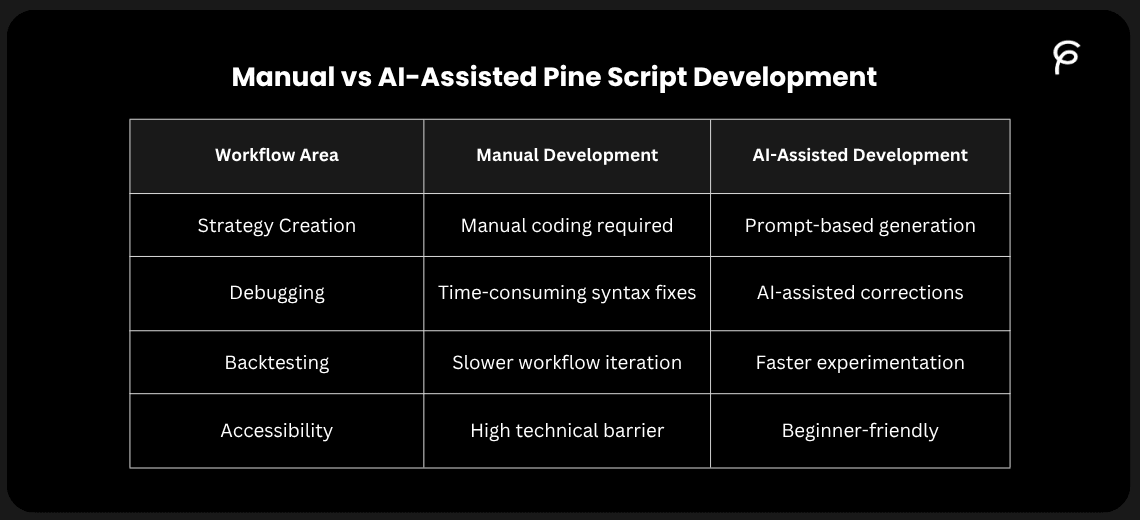
Traditionally, a trader would manually:
-
write strategy conditions
-
structure entries and exits
-
debug syntax errors
-
fix TradingView compatibility issues
-
repeatedly optimize logic
With AI-assisted workflows, traders can describe strategies naturally.
For example: “Create a TradingView strategy where RSI crossing above 30 generates a buy signal when price is above EMA 50.”
The AI then generates the Pine Script structure automatically. From there, traders can continue refining:
-
entries
-
confirmations
-
stop-loss logic
-
take-profit conditions
-
timeframe optimization
Instead of rebuilding everything from scratch, the workflow becomes iterative and much faster.
5. How PineGen AI Fits Into This Shift
Many general AI chatbots can generate code, but Pine Script development requires TradingView-specific understanding.
That specialization matters because TradingView automation depends on:
-
Pine Script syntax - TradingView strategies require precise Pine Script formatting and compatible functions.
-
Strategy structure - Entries, exits, confirmations, and risk logic must work correctly during backtesting.
-
Chart logic - Strategies must properly interact with indicators, candles, and TradingView chart behavior.
-
TradingView compatibility - Pine Script versions and execution behavior must align with TradingView requirements.
Platforms like PineGen AI are built specifically around these workflows instead of acting as general-purpose AI chatbots.
According to the platform, PineGen AI focuses on:
-
Pine Script generation
-
AI-assisted debugging
-
strategy refinement
-
backtesting workflows
-
TradingView-focused automation
That focused workflow reduces many of the frustrations traders experience with broader AI tools.
6. Example of AI-Assisted Pine Script Development
pinescript//@version=6
strategy("AI-Assisted EMA + RSI Strategy", overlay=true)

// Indicators
fastEMA = ta.ema(close, 9)
slowEMA = ta.ema(close, 21)
rsiValue = ta.rsi(close, 14)

// Buy Condition
longCondition = ta.crossover(fastEMA, slowEMA) and rsiValue > 50

// Sell Condition
shortCondition = ta.crossunder(fastEMA, slowEMA) and rsiValue < 50

// Execute Trades
if longCondition
    strategy.entry("Buy", strategy.long)

if shortCondition
    strategy.entry("Sell", strategy.short)

// Risk Management
strategy.exit("Take Profit/Stop Loss",
     profit = 100,
     loss = 50)
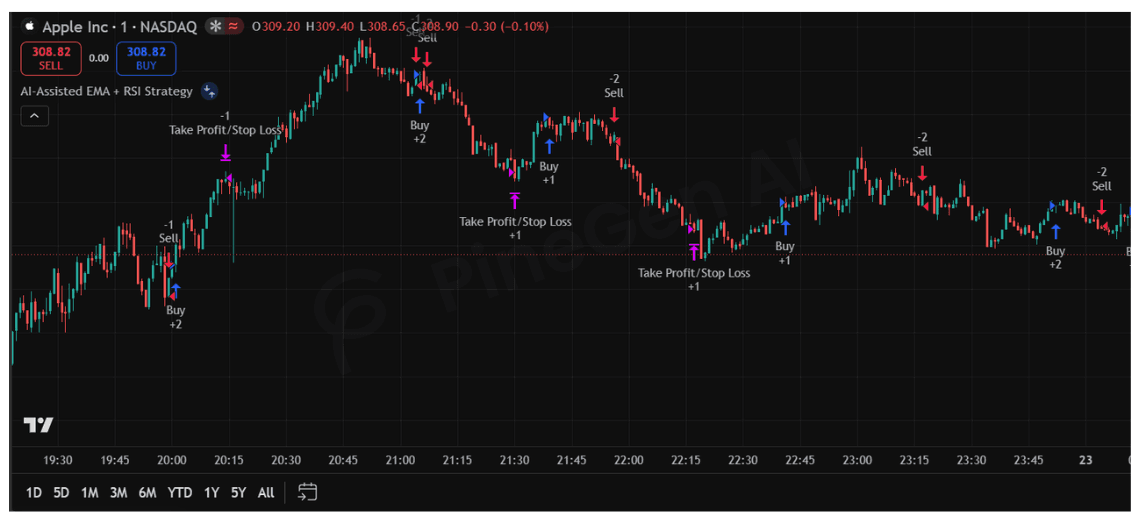
This is a basic example of a TradingView strategy combining EMA crossovers with RSI confirmation.
Traditionally, traders would manually:
-
structure the strategy
-
debug errors
-
fix compiler issues
-
optimize conditions
-
repeatedly test logic
AI-assisted workflows simplify much of that process by helping traders generate and refine Pine Script structures faster.
7. Why Traders Are Moving Toward Specialized Pine Script AI
One of the biggest frustrations traders discuss online is that general AI tools sometimes generate:
-
Outdated Pine Script versions - Some AI models produce older Pine Script syntax or deprecated functions that no longer work properly on the latest TradingView versions.
-
Broken strategy logic - Generated strategies may contain incorrect entries, faulty exit conditions, or unrealistic trading behavior that fails during backtesting.
-
Invalid TradingView functions - General AI tools sometimes suggest unsupported or incorrect TradingView functions, causing compilation errors and compatibility issues.
-
Incomplete strategy structures - Certain AI-generated scripts may miss important components such as risk management, stop-loss rules, confirmations, or proper strategy execution logic.
Reddit discussions around TradingView automation frequently highlight these workflow frustrations and debugging challenges. That is why specialized Pine Script AI platforms are becoming more important.
Instead of trying to support every programming language equally, specialized tools focus directly on TradingView workflows, Pine Script generation, and strategy refinement.
That focused workflow improves:
-
Pine Script compatibility
-
debugging efficiency
-
TradingView automation workflows
8. The Future of TradingView Development
The future of TradingView strategy development is becoming increasingly AI-assisted.
Traders are moving away from workflows that require:
-
hours of manual coding
-
repetitive debugging
-
syntax-heavy development
-
slower experimentation cycles
and toward systems that prioritize:
-
rapid testing
-
workflow efficiency
-
AI-assisted generation
-
faster optimization
But AI is not replacing trading knowledge.
Research around vibe coding also highlights an important reality: traders still need to validate logic, verify outputs, and understand strategy behavior properly.
The strongest workflows combine:
-
AI-assisted generation
-
proper backtesting
-
trading experience
That balance is likely to define the next generation of TradingView automation.
9. Conclusion: The Future of Pine Script Development Is Becoming AI-Assisted
TradingView development is evolving rapidly.
What once required deep coding experience, manual debugging, and time-consuming strategy building is now becoming faster, more accessible, and increasingly AI-assisted.
Vibe coding is changing how traders interact with Pine Script by allowing them to move from: idea → generation → testing → refinement far more efficiently than traditional workflows.
Platforms like PineGen AI are helping accelerate that transition by focusing specifically on Pine Script workflows, TradingView automation, and strategy refinement instead of generic AI coding tasks.
But the future is not about replacing traders with AI.
It is about giving traders faster tools to experiment, iterate, and improve strategies more efficiently.
And in modern trading, faster iteration often creates a real competitive advantage.