The Complete Beginner’s Guide to Pine Script AI
Author : Ranga Technologies
Publish Date : 6 / 18 / 2026 • 26 mins read
Last Updated : 6 / 18 / 2026
In Today's Markets, Execution Speed and Iteration Capability Are Just as Important, If Not More Important, Than the Idea Itself
A brilliant trading idea means nothing if you can't act on it at the right time, markets don't wait, and neither do the opportunities within them.
A strategy that looks strong on paper is meaningless if it takes days to implement, weeks to properly test, and even longer to refine. Those days and weeks aren't neutral time. The specific condition or inefficiency your strategy was built around is already playing out in real markets while you're still writing and debugging code. And since the first version of any strategy is rarely the final one, refinement adds another layer of delay on top of everything else.
Markets move continuously. Conditions change. Volatility shifts, sometimes overnight, sometimes within hours, fundamentally altering how price behaves and how strategies need to be calibrated. By the time a manually coded strategy is fully built and tested, the opportunity it was designed for may already be gone. You're left with a perfectly engineered solution to a problem that no longer exists.
This creates a fundamental challenge in trading: the gap between idea and execution is too slow. The human mind can generate and evaluate a trading thesis in minutes, but the traditional development process operates on an entirely different timescale, one completely misaligned with the pace of modern markets.
In a traditional workflow, turning a trading idea into a working strategy is not a single step. It's a chain of technical tasks, writing logic, debugging, backtesting, adjusting parameters, handling edge cases, and repeating, each one adding friction and slowing you down. Every link in that chain is a potential delay, and every delay increases the risk that the window you were chasing has already closed.
Let's break down where that friction actually comes from.
Translating Trading Logic into Code
Every strategy starts as a simple idea, "buy when RSI is low, sell when it's high." Clear, intuitive, easy to understand. But platforms like TradingView don't understand ideas, they understand code. That simple idea now requires you to declare variables, convert indicators into proper functions, define conditions using exact syntax, and structure entry and exit rules in a way the platform can actually execute. Even the most straightforward concept becomes a multi-step technical task. This translation step is where many traders, especially beginners, hit their first wall. The problem isn't the idea, it's expressing it in a language the platform accepts.
Structuring Conditions Correctly
Once you're writing code, the next challenge is getting the logic right. Real strategies rarely have a single condition, they involve multiple signals combined with AND/OR logic, confirmations like trend alignment plus indicator agreement, and timing rules like crossovers or threshold breaches. A small mistake, using the wrong operator, misplacing a condition, or incorrectly combining rules, can completely change how the strategy behaves. The code may run without errors, but the underlying logic may be entirely wrong. This makes strategy building not just technical, but genuinely error-prone even for experienced coders.
Handling Edge Cases and Exceptions
Markets are not clean or predictable, and your strategy has to account for that. Sudden volatility spikes, sideways price action with no clear trend, conflicting signals from multiple indicators, these situations happen regularly. If your strategy isn't built to handle them, it will overtrade, generate false signals, or behave inconsistently across different market conditions. Solving this means layering in additional conditions, filters, and safeguards. What started as a simple idea gradually becomes a complex system, and that complexity introduces new opportunities for errors and new rounds of testing.
Debugging Syntax and Logical Errors
Even after writing everything out, things rarely work correctly on the first try. Syntax errors stop the code from running at all. Logical errors are worse, the code runs, but it doesn't do what you intended. Debugging means reading through the code line by line, identifying exactly where the logic breaks, fixing it, and retesting. Then repeating that cycle until the behavior matches the original idea. This process is time-consuming, mentally draining, and especially difficult for traders who aren't professional programmers. A large portion of total development time ends up being spent fixing problems rather than actually building the strategy.
Running Repeated Backtests
Once the code is working, testing begins, but testing is not a one-time step. Backtesting means running the strategy against historical data, evaluating performance metrics, and identifying weaknesses. The problem is that every small adjustment requires rerunning the entire test, re-analyzing the results, and comparing performance across versions. If this process is slow, you naturally test fewer variations, which means you miss potential improvements and leave optimization on the table. What should be an advantage, the ability to validate and refine, becomes yet another bottleneck in an already slow workflow.
The Bigger Problem: Compounding Delays
Individually, each step is manageable.
But together, they create a slow and repetitive cycle:
Idea → Code → Debug → Test → Fix → Repeat
Each loop takes time.
And that leads to the real limitation:
Because success doesn’t come from one perfect idea, it comes from:
-
Testing many variations
-
Refining based on results
-
Iterating continuously
Manual coding slows this entire cycle down.
This is where tools like PineGen AI fundamentally change the workflow.
Instead of forcing traders to think in terms of code, Pine Script AI allows them to think in terms of logic and intent.
You no longer start with syntax, you start with an idea:
“Enter when RSI crosses above 30 and trend is bullish, exit with a fixed risk level.”
The system then:
-
Interprets your logic
-
Structures the conditions
-
Converts it into Pine Script
-
Prepares it for testing
What used to take hours (or even days) can now happen in seconds.
1. The Gap Between Trading Ideas and Real Execution
Building a trading strategy has traditionally been slow, technical, and inefficient. Not because ideas are hard, but because execution is. To turn a simple idea into a working strategy, traders had to learn Pine Script syntax, translate their logic into code, debug errors, and run multiple backtests. Even small changes, like adjusting an indicator or tweaking an entry condition, meant going back into the code, editing manually, and testing all over again.
1.1 Where the Friction Comes In
Even a simple idea doesn't stay simple for long. Take something basic like "buy when RSI is low and sell when it's high." To actually implement this, you need to define the RSI indicator, specify exact thresholds, handle crossover conditions, and structure entry and exit rules correctly. What starts as a one-line idea quickly turns into multiple lines of code, and multiple points where things can go wrong.
1.2 The Cost of Small Changes
The biggest inefficiency comes from iteration. Strategies are rarely perfect on the first attempt. You need to adjust indicator values, add filters, and refine entry or exit logic. But in a traditional workflow, even a minor change means going back into the code, editing the logic manually, fixing any new errors that appear, and running the entire backtest again from scratch. This makes iteration slow, repetitive, and frustrating.
1.3 The Bigger Problem
Over time, this creates a compounding bottleneck. You spend more time coding than actually testing ideas. You end up testing fewer variations. You improve strategies more slowly. And in trading, that's a significant disadvantage, because strong strategies don't come from a single idea, they come from continuous testing and refinement over many iterations.
1.4 The Real Problem: Slow Execution
The biggest challenge isn't coding itself. It's this: ideas move faster than your ability to test them. In a manual workflow, you spend more time coding than thinking, test fewer strategies, and iterate slowly. That creates a widening gap between what you want to try and what you actually get around to testing. In trading, that gap is costly, because better strategies come from testing many variations quickly, not from perfecting one slowly.
1.5 Why Traditional Workflows Fall Short
Manual development creates three key bottlenecks.
-
Time, strategy creation simply takes too long.
-
Complexity, debugging slows everything down and pulls focus away from the actual strategy.
-
Limited iteration, fewer experiments means slower improvement.
This is why many traders end up sticking to basic strategies, avoid experimenting with new ideas, or abandon concepts entirely before properly testing them.
1.6 The Shift to AI-Assisted Workflows
The move to AI isn't just about automation, it's about removing friction from the entire workflow so the process adapts to you, rather than forcing you to adapt to code.
The key shift is moving from coding-first to logic-first thinking.
Old workflow: "How do I code this idea?"
New workflow: "What is the logic of my strategy?"
AI handles the translation between the two.
1.7 Why This Matters
This shift directly improves productivity.
You can test more ideas, iterate faster, and spend less time debugging and more time refining.
The entire development cycle compresses.
Old workflow: Idea → Code → Debug → Test → Repeat
New workflow: Idea → Prompt → Strategy → Test → Improve
That difference in workflow isn't just a convenience, it's a fundamental change in how quickly a trader can move from thinking to testing, and from testing to results.
2. How AI Turns Trading Ideas Into Real Pine Script Code
Pine Script AI is a system that converts trading ideas into executable trading scripts. Instead of manually writing code, you describe your strategy in plain language and the AI translates that into working Pine Script. At a high level, it removes the single biggest barrier in algorithmic trading, the need to manually convert ideas into code.
Core Mechanism
The entire process simplifies into one flow: Prompt → Logic → Code
You describe your strategy, entry conditions, exit rules, indicators. The system interprets those rules and the relationships between them. Then it generates Pine Script that can be tested immediately. This transformation, from natural language to structured trading logic, is what makes Pine Script AI genuinely powerful rather than just convenient.
2.1 What Pine Script AI Actually Does
Pine Script AI is often misunderstood as simply a code generator. In reality, it supports multiple stages of the entire strategy development process, from initial idea all the way through to refinement and optimization.
1. Strategy Generation
At its core, Pine Script AI turns a simple idea into a complete, structured trading system. You define your logic in plain language and the system generates strategies that include entry and exit conditions, indicator-based logic using tools like RSI, EMA, MACD, and volume, along with risk parameters such as stop-loss, take-profit, and position sizing. What normally requires writing and carefully structuring multiple lines of code can now be created in seconds, dramatically reducing the time between having an idea and having something testable.
2. Indicator Creation
Beyond full strategies, Pine Script AI can generate custom indicators. Traditionally, building an indicator means defining formulas, handling calculations, and structuring outputs for visualization, all of which require both mathematical and coding knowledge. With AI, you simply describe what you want: "Create an indicator that shows momentum strength with smoothing."
The system handles the rest. This makes it far easier to experiment with new concepts without needing deep technical expertise.
3. Debugging
Debugging is one of the most frustrating and time-consuming parts of strategy development. Errors come from incorrect syntax, misplaced conditions, and incomplete logic, and finding them manually means reading through code line by line.
Pine Script AI speeds this up by identifying syntax errors that prevent execution, highlighting logical mistakes that affect behavior, detecting missing conditions that make strategies incomplete.
Instead of hunting for problems yourself, you get faster feedback and clearer fixes, shifting your focus from fixing errors to actually improving the strategy.
4. Optimization
A strategy is rarely effective on the first attempt. Improvement comes from iteration, testing variations, adjusting parameters, and refining logic based on results. Pine Script AI supports this by allowing you to adjust parameters like RSI levels or moving average lengths easily, test multiple variations quickly without rewriting code each time, improve logic clarity by restructuring conditions at the prompt level rather than the code level.
Because changes happen through prompts instead of manual edits, the iteration cycle becomes significantly faster. More iterations lead to better insights, and better insights lead to stronger strategies.
2.2 What Pine Script AI Is NOT
This is where many beginners develop the wrong expectations.
Pine Script AI does not predict the market, does not guarantee profitable strategies, does not replace trading knowledge or judgment.
What it focuses on is execution, speed, and efficiency. It improves how strategies are built, not what the market will do. The quality of the output still depends entirely on the quality of the trader's thinking behind it.
3. Why More Traders Are Replacing Manual Coding
The growth of Pine Script AI isn't driven by hype, it's driven by real limitations in how trading strategies are built today. As markets evolve, the traditional approach to strategy development is starting to break down under its own weight.
Increasing Complexity
Modern trading strategies are no longer simple.
Instead of relying on one or two indicators, traders now combine multi-timeframe analysis across different timeframes, multiple indicators like RSI, MACD, moving averages, and volume layers of conditional logic including filters, confirmations, and risk rules
What used to be a straightforward strategy has become a layered system of interdependent conditions. Manually coding this kind of logic takes time, increases the chance of errors, and becomes progressively harder to maintain and modify as the system grows.
As complexity increases, so does the need for a faster and more flexible way to build.
Time Constraints
Markets move quickly, but traditional development doesn't. By the time a strategy is written, debugged, and tested, the market conditions it was designed for may already have changed. This is why speed has become a genuine competitive advantage. Traders who can test and iterate faster are in a meaningfully stronger position than those still relying on slow, manual workflows.
Workflow Bottlenecks
Manual coding introduces friction at every stage writing repetitive code, fixing small but time-consuming errors, re-running tests after every change. Even minor adjustments can slow the entire process down. Over time, this compounds into fewer strategies tested, slower improvement cycles, missed opportunities that faster-moving traders are already capitalizing on
3.1 The Industry Shift
Because of these limitations, the way trading strategies are built is no longer static, it's evolving. What we're seeing is not just the adoption of new tools, but a fundamental shift in workflow, moving away from slow, code-heavy processes toward faster and more adaptive systems.
This evolution happens in three clear stages.
Stage 1 - Manual Development
This is the traditional approach most traders started with. It offers full control, but with significant trade-offs.
- Every line of code is written manually, which provides complete flexibility but demands strong knowledge of Pine Script and programming concepts.
- Testing multiple strategies becomes difficult due to time constraints.
- Progress is heavily tied to how fast you can code and debug.
The result is fewer ideas tested, slow iteration cycles, strategy development becoming a bottleneck in itself.
Stage 2 - AI-Assisted Development
This is where most modern traders are now transitioning. AI doesn't replace the development process, it enhances it.
- Strategies can be created from prompts instead of manual coding.
- Built-in structure reduces common errors.
- Changes can be made quickly without rewriting entire scripts.
The focus shifts from writing code to defining strategy logic. This unlocks faster experimentation, more strategy variations, improved learning through iteration.
Stage 3 - Automated Workflows
This represents the direction the industry is moving toward.
It goes beyond generating code to streamlining the entire strategy lifecycle.
- Ideas can be converted into testable systems almost instantly.
- Strategies can be evaluated and re-tested in shorter cycles.
- Traders can work on multiple strategies simultaneously.
At this stage, the advantage is no longer just speed, it's consistency and scalability.
The workflow becomes: > Idea → Generate → Test → Improve → Repeat at scale.
3.2 What This Shift Really Means
This isn't just about adopting new tools, it's about changing how traders work entirely.
Instead of being limited by coding skills, time constraints, and technical complexity, traders can now focus entirely on what actually matters strategy logic, experimentation, continuous improvement.
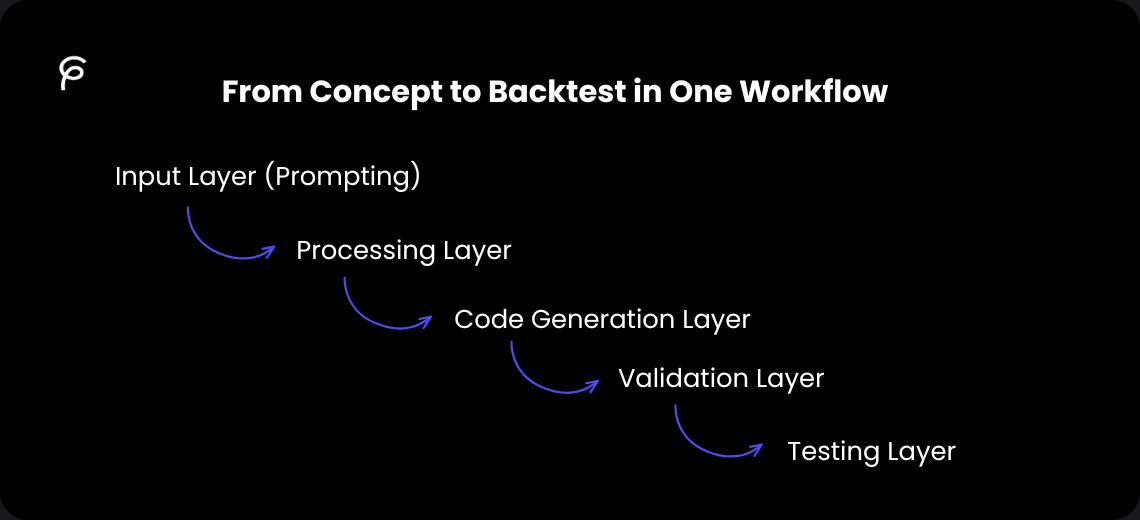
4. From Concept to Backtest in One Workflow
To use Pine Script AI effectively, it helps to understand what's actually happening behind the scenes. The process feels simple from the outside, but it follows a structured, multi-layered workflow that transforms your idea into a working, testable strategy.
4.1 Input Layer - Prompting
Everything starts with your prompt.
A vague input like: "create a profitable strategy" produces weak results.
A structured input like: "buy when RSI crosses above 30, sell when RSI crosses below 70, use a 2% stop loss" gives the system enough detail to generate meaningful logic.
The quality of your output depends directly on the quality of your input.
4.2 Processing Layer
The AI breaks your description down into conditions, indicators, and logical relationships, converting natural language into structured trading logic. This is the most critical step. Misinterpreted logic produces an incorrect strategy. Clear logic produces accurate output.
4.3 Code Generation Layer
Once the logic is understood, the system converts it into Pine Script, defining indicators, writing entry and exit conditions, and structuring the strategy correctly. What used to require manual coding now happens automatically, shifting the process from slow and technical to instant and structured.
4.4 Validation Layer
The generated code is then checked for syntax errors, undefined variables, and logical inconsistencies. This eliminates the debugging step that typically consumes the most time in manual development, letting you move straight to testing.
4.5 Testing Layer
With a validated strategy ready, backtesting begins, evaluating performance, identifying weaknesses, and refining based on results. This is not a one-time step but a continuous loop: test → adjust → test again. Real improvement lives here. The full flow: Prompt → Interpretation → Code → Validation → Testing → Iteration. Each stage feeds into the next, creating a clean pipeline from idea to tested strategy.
5. Powerful Ways Traders Use Pine Script AI Today
Pine Script AI isn't limited to one specific task, it supports multiple stages of the strategy development lifecycle, helping traders reduce friction and move faster at every step.
5.1 Strategy Creation
The most immediate use case is turning ideas into executable strategies instantly. Instead of spending hours writing code, you describe your logic, define entry and exit rules, and specify your indicators, and generate a complete strategy in seconds. This lowers the barrier to entry for beginners who lack coding experience, while also allowing experienced traders to prototype and explore ideas far more quickly than before.
5.2 Debugging
Even small issues like a misplaced condition or incorrect variable can break an entire strategy. Pine Script AI speeds up this process by identifying syntax errors, highlighting logical inconsistencies, suggesting fixes. This reduces the time spent troubleshooting and keeps your focus on improving strategy logic rather than hunting through code.
5.3 Optimization
The first version of a strategy is rarely the best. Improvement comes from testing different parameters, adjusting conditions, and comparing variations. Pine Script AI makes this faster by letting you modify prompts instead of rewriting code, generate multiple versions quickly and, experiment with different configurations. More variations tested means a better chance of finding setups that actually work.
5.4 Complex Systems
Modern strategies often involve multiple layers multi-timeframe analysis, indicator combinations, conditional filters. Manually building and maintaining these systems is difficult and error-prone. Pine Script AI handles structured logic, layered conditions, cross-timeframe dependencies making it practical to build sophisticated systems without getting lost in the technical complexity.
5.5 Workflow Automation
Beyond individual tasks, Pine Script AI improves the entire development cycle. Instead of repeating the same manual steps, you build faster, test immediately, and iterate continuously. The loop becomes: Build → Test → Improve → Repeat. Automation doesn't remove the need for strategic thinking, it removes the repetitive parts that slow it down.
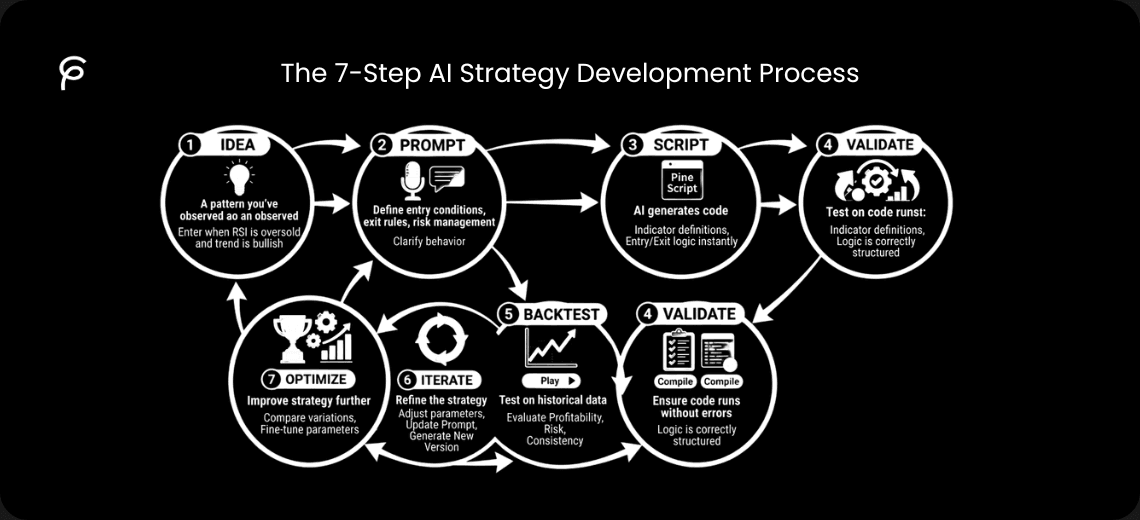
6. The 7-Step AI Strategy Development Process
Pine Script AI doesn't just speed up coding, it restructures the entire strategy development workflow into a clear, repeatable process that takes you from raw idea to optimized strategy with far less friction.
Step 1 - Idea
Everything strategy with an observation. A pattern you've noticed, a combination of indicators, a reaction to specific market conditions. At this stage the focus is purely on logic, not implementation.
Example: "Enter when RSI is oversold and trend is bullish."
Step 2 - Prompt
The idea gets converted into a structured prompt, defining entry conditions, exit rules, indicators, and risk parameters. The clearer your prompt, the better the output. You're essentially telling the system exactly how your strategy should behave.
Step 3 - Script
The AI generates Pine Script based on your prompt, including indicator definitions, entry and exit logic, and overall strategy structure. What used to require manual coding happens instantly.
Step 4 - Validate
Before testing, the script is checked to ensure the code runs without errors and the logic is correctly structured. This step eliminates the debugging phase that typically consumes the most time in manual development.
Step 5 - Backtest
The validated strategy is tested against historical data to evaluate profitability, risk levels, and consistency. Backtesting answers the core question: does this idea actually work?
Step 6 - Iterate
Based on backtest results, you refine the strategy, adjusting indicator settings, changing conditions, or adding filters. Instead of rewriting code, you update the prompt and generate a new version immediately.
Step 7 - Optimize
Finally, you compare multiple variations, fine-tune parameters, and eliminate weak conditions. Optimization isn't about building something new, it's about making what already works perform better.
6.1 Why Iteration Matters
Iteration is the core advantage of AI-driven workflows. In traditional development, each cycle is slow and testing multiple ideas is time-consuming. With Pine Script AI, you can test many variations quickly, refine continuously, learn faster from results. The effect compounds: More iterations lead to better insights, and better insights lead to stronger strategies.
7. Where Human Judgment Still Wins
Pine Script AI significantly improves how strategies are built, but it's important to understand what it can and cannot do. It's a powerful tool, not a shortcut to guaranteed success.
7.1 No Market Prediction
The most common misconception is that AI can predict the market. It cannot. Pine Script AI doesn't analyze future price movements, doesn't generate winning signals on its own, and doesn't replace trading judgment. It works entirely with the logic you provide. If the underlying strategy logic is weak, the output will be weak, regardless of how advanced the tool is.
7.2 Depends on User Input
The quality of the result depends directly on the quality of your input. Clear, structured prompts produce better strategies. Vague or incomplete prompts produce inaccurate or unusable outputs. A well-defined entry and exit condition generates meaningful results. A generic request like "make a profitable strategy" does not. AI amplifies your thinking, it doesn't replace it.
7.3 Requires Validation
Even when the code is technically correct, the strategy still needs to be tested. AI-generated strategies must go through backtesting, performance evaluation, and risk analysis before they can be trusted. Without validation, you risk overfitting, unrealistic results, and poor real-world performance. Testing remains a non-negotiable part of the workflow.
7.4 Why Strategies Still Fail
Even with AI, strategies can fail due to poor market assumptions, over-optimized parameters, weak risk management, or simply changing market conditions. AI accelerates development, it does not eliminate these risks.
7.5 The Right Approach
Treat Pine Script AI as a tool for building and testing, not predicting. Focus on improving your logic, not chasing shortcuts. Always validate before using a strategy in live conditions. AI shapes the future of strategy development, but it works best when combined with the judgment, experience, and critical thinking that only a trader can bring.
8. Common Trading Challenges AI Helps Solve
Pine Script AI doesn't eliminate trading challenges, but it makes them easier to manage by improving how strategies are built, tested, and refined.
8.1 Strategy Inconsistency
A strategy may perform well in one market condition and fail in another, producing unstable results over time. The issue is often not the idea itself, but the lack of proper testing and refinement. Pine Script AI helps by enabling faster iteration, testing multiple variations, and refining logic based on results, so instead of relying on a single version, traders can continuously improve.
8.2 Volatility Handling
Markets are not stable. Strategies that work in trending conditions may break down in sideways or high-volatility environments. Manually adjusting for different conditions is slow and complex. With AI, traders can quickly test different configurations, add filters, and adapt strategies to changing market behavior without starting from scratch each time.
8.3 False Signals
Many strategies generate too many signals in noisy markets, leading to overtrading, reduced accuracy, and poor overall performance. Pine Script AI helps by making it easier to combine multiple conditions, add confirmation logic, and experiment with different filters. Because iteration is faster, refining signal quality becomes a practical, ongoing process rather than a one-off effort.
8.4 Asset-Specific Differences
A strategy that works on crypto may not work on stocks or forex. Each market has different volatility patterns, liquidity levels, and price behavior. AI helps traders adapt by quickly modifying logic, testing across multiple assets, and adjusting parameters without rewriting code, making cross-market experimentation far more accessible than it was before.
9. Why Specialized AI Wins
PineGen AI is built specifically for Pine Script-based trading workflows, and that specialization is what sets it apart.
9.1 Specialized for Trading
Unlike general AI tools, PineGen AI is designed specifically for Pine Script generation, trading strategy workflows, and TradingView compatibility. This focused scope allows it to produce outputs that are more relevant, more structured, and more immediately usable than what a general-purpose tool would generate.
9.2 Structured Outputs
Instead of generic responses that require heavy interpretation, PineGen AI generates organized code, clear logic structures, and ready-to-test strategies. This reduces the need for manual adjustments after generation, keeping the workflow moving forward rather than introducing new editing cycles.
9.3 Faster Debugging
Because the system understands Pine Script context specifically, errors are identified faster, fixes are more accurate, and debugging time is significantly reduced compared to trying to get the same results from a tool with no domain focus.
9.4 Compared to General AI Tools
General AI tools offer broad knowledge but produce less specialized outputs and require more manual refinement to get to something usable. PineGen AI is domain-specific and workflow-focused, which makes it more precise for real-world trading use cases. The advantage isn't simply that it uses AI, it's that it's built around the specific demands of trading strategy development. That alignment between tool and workflow is what makes it more effective in practice.
10. The Next Generation of Trading Automation
Pine Script AI is still evolving, but the direction is clear.
10.1 Increasing Automation
Strategy development is moving toward faster generation, reduced manual intervention, and more streamlined workflows. The goal isn't full automation, it's reducing the friction that slows traders down at every stage of the process, so more time and energy can go toward thinking rather than building.
10.2 Real-Time Integration
Future systems are expected to connect more closely with live market data, support faster testing cycles, and enable quicker decision-making. This will further close the gap between idea and execution, the core challenge that has always defined algorithmic trading.
10.3 Faster Development Cycles
As AI improves, traders will be able to generate strategies instantly, test them more efficiently, and iterate continuously. The result is a more dynamic and adaptive approach to trading, one where strategy development keeps pace with the market rather than lagging behind it.
10.4 Where It's Heading
Pine Script itself is evolving alongside AI. Together, they point toward a future where AI-assisted development becomes the standard rather than the exception, strategy creation becomes more accessible to traders at every skill level, and the focus shifts further away from implementation and toward logic, judgment, and continuous improvement.
11. Conclusion
Pine Script AI is not just improving how strategies are coded, it's transforming how they are designed, tested, and refined. The biggest shift is not technical. It's workflow-driven.
Instead of being limited by coding complexity, traders can now focus on defining clear strategy logic, testing ideas quickly, and iterating continuously.
11.1 What Has Changed
Workflows are faster, strategies that once took hours or days can now be generated in minutes. Iteration is easier, traders can test multiple variations without rewriting code each time. And barriers to entry are lower, beginners can start building strategies without deep programming knowledge.
11.2 What Has NOT Changed
Despite these improvements, the core principles of trading remain the same. Strategy success still depends on the quality of your logic. Risk management is still essential. Market understanding is still required. AI does not replace these fundamentals, it supports them.
11.3 The Real Value
The real advantage of Pine Script AI is not that it builds strategies for you. It's that it allows you to build, test, and improve strategies faster than ever before. And in trading, the ability to iterate quickly is what drives long-term improvement. The traders who adapt to faster workflows will have a clear advantage over those who rely on slow, manual processes. The tools have changed. The thinking behind them still has to come from you.