We Tested the Opening Range Breakout Strategy on SPY, Here’s What the Backtest Actually Showed
Author : Ranga Technologies
Publish Date : 7 / 1 / 2026 • 5 mins read
Last Updated : 7 / 1 / 2026
Why SPY ORB Looks Simple but Behaves Very Differently in Reality
The Opening Range Breakout strategy is often one of the first structured intraday systems traders learn when they start working with SPY.
The idea feels almost intuitive. The market opens, creates an early range, and then price either breaks above that range or below it. Traders enter in the direction of the breakout, expecting momentum to carry the move throughout the session.
On paper, this structure feels stable because SPY is highly liquid, widely followed, and actively traded during the U.S. session. Many assume that such a heavily traded instrument should produce clean and repeatable breakout behavior.
But once traders move from backtesting into real execution, the experience changes significantly.
The same strategy that looks consistent in TradingView’s Strategy Tester starts showing inconsistencies in live markets. Entries feel early or late. Breakouts reverse more often than expected. Alerts behave differently than anticipated.
This is not because the strategy is broken. It is because SPY behaves in a more complex way during live trading than what simplified backtests assume.
1. Why SPY Makes Opening Range Breakout Harder Than It Appears
SPY often gets treated like a “clean” intraday instrument because of its liquidity and tight spreads, but that reputation hides a more complicated reality. It is not just a tradable ETF, it behaves like a live reflection of the entire U.S. equity ecosystem, where multiple market participants interact at the same time with different goals, time horizons, and risk models.
This is exactly what makes Opening Range Breakout (ORB) setups on SPY more difficult than they first appear. During the first 30–60 minutes of the U.S. session, price action is not driven by a single force. It is the result of overlapping flows that often conflict with each other before the market finds a temporary direction.
Institutional traders are usually the first major driver of movement. Large funds and execution desks adjust positions based on overnight global cues, macroeconomic expectations, and hedging requirements. These flows are not designed to “create trends” in a retail sense. They are execution-heavy, fragmented, and often split across multiple liquidity levels. This alone can create sharp directional moves that look like breakouts, even when they are simply rebalancing activity.
At the same time, retail participation increases dramatically at the open. Retail traders are highly reactive to early momentum, gap direction, and pre-market sentiment. This behavior adds an additional layer of short-term pressure, often amplifying early moves. The key issue is that retail momentum does not always align with institutional intent, which leads to temporary price expansion followed by rapid reversals once larger participants finish executing.
On top of both of these flows sits the options market, which has become one of the most influential forces on SPY intraday behavior, especially with the rise of 0DTE options. Market makers continuously hedge delta exposure in real time, meaning they buy and sell SPY shares dynamically as option premiums shift. When gamma exposure is high, these hedging flows can accelerate price movement in one direction and then quickly reverse it once positioning shifts. This creates sharp, mechanical moves that can easily resemble breakout structures but lack continuation.
Another often overlooked factor is liquidity behavior around the opening range itself. The first 15–30 minutes of trading tends to attract liquidity-seeking activity, where price temporarily breaks above or below early levels specifically to trigger stop orders and resting liquidity. This is not always a directional signal. In many cases, it is a mechanical sweep designed to fill large institutional orders at better prices before the real directional move begins.
Economic data releases and scheduled news events also distort ORB reliability. Even when no major announcement occurs at the exact open, traders are still reacting to overnight macro developments such as global bond yields, futures positioning, or geopolitical updates. This creates a “delayed reaction effect,” where the opening move is not the beginning of a trend but the continuation of information digestion that started hours earlier in other markets.
Market microstructure also plays a role. SPY is heavily algorithm-driven during the opening session, with execution algorithms breaking large orders into smaller pieces and executing them across rapid price fluctuations. This increases noise inside the opening range, making breakouts less clean compared to slower instruments.
Because of all these overlapping forces, early SPY movement often appears directional on the surface but lacks commitment underneath. What looks like a breakout is frequently just a short-lived imbalance between competing flows rather than a sustained shift in trend direction. This is why SPY can produce strong-looking breakout candles that fail within minutes. The price action itself is real, but the underlying participation behind that move is often temporary, fragmented, or hedging-driven rather than trend-driven.
2. What the Backtest Actually Revealed About SPY ORB Behavior
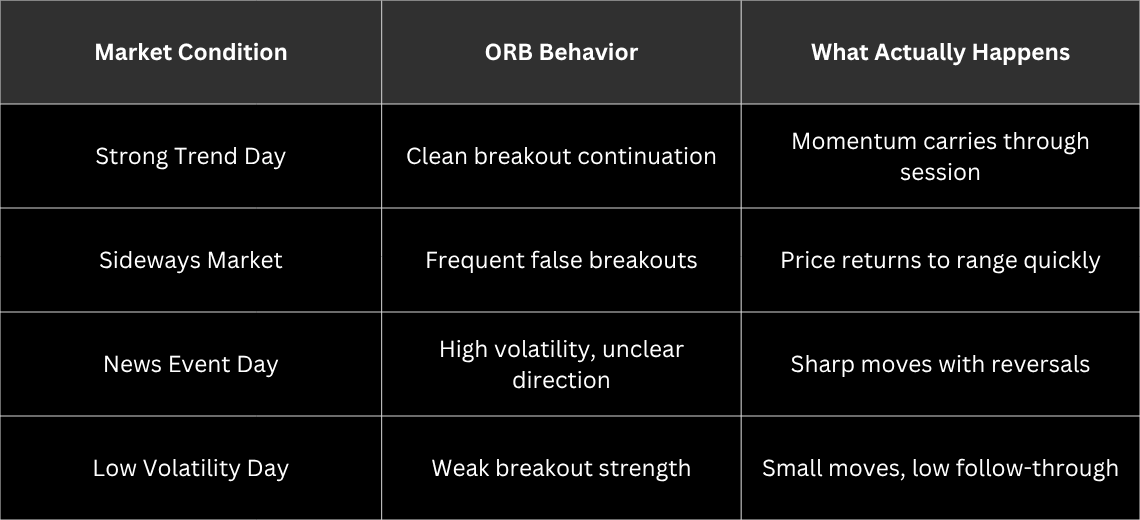
When ORB performance is examined across multiple SPY environments, a clear pattern emerges: the strategy is not inherently inconsistent, but it is extremely sensitive to market context.
In trending environments, SPY often respects breakout levels and continues in the breakout direction. This is when institutional flow aligns with momentum, and ORB captures strong directional moves effectively.
However, in range-bound environments, SPY behaves very differently. Price frequently breaks the opening range only to reverse quickly back inside it. These moves attract breakout traders but lack sustained participation behind them.
During high-impact news events such as CPI or FOMC announcements, SPY volatility expands sharply, but direction becomes less predictable. The breakout still occurs, but follow-through depends entirely on how institutions interpret the data.
The key insight here is that ORB does not fail randomly. It responds directly to the type of market environment it is placed in.
3. SPY Market Conditions vs ORB Behavior
4. Where Traders Misinterpret ORB Performance
4.1 Entry-only evaluation mindset
A major misunderstanding happens when traders judge ORB systems only based on entry signals. On paper, the setup looks simple: price breaks the opening range, trade direction is taken, and the outcome is expected to stay consistent across all sessions. In reality, SPY does not reward that kind of simplified interpretation. The same breakout condition can behave differently depending on volatility, liquidity, and participation. A signal that looks clean in a backtest may not reflect how price actually behaves inside the candle in live conditions.
4.2 Ignoring intrabar volatility
SPY does not move in clean candle-to-candle steps. Inside each candle, price constantly fluctuates as orders are matched between buyers and sellers. This becomes especially important during the opening session when volatility is high. Breakout levels are often crossed multiple times within the same candle before price decides a direction. In live trading, this creates confusion where alerts may trigger too early, trigger multiple times, or trigger and then disappear in effectiveness.
What looks like one clean breakout in a backtest often turns into several unstable micro-moves in real execution.
4.3 Lack of session separation
SPY behaves differently across distinct time blocks of the trading day, yet many ORB systems treat it as one continuous environment. The opening session is driven by institutional positioning and volatility expansion. Mid-session often shifts into consolidation and slower movement. Late-session trading is frequently influenced by portfolio adjustments and reduced participation. When ORB logic does not separate these phases, signals can appear in environments where the strategy was never designed to operate. This leads to trades triggered in low-quality conditions that distort overall performance.
4.4 Misreading breakout intent
Many traders assume that every breakout represents the beginning of a sustained move. This assumption works only in clean trending conditions, which are not consistent in SPY. In many cases, the first breakout is not directional confirmation but a liquidity-driven move. Large players often push price beyond obvious levels to trigger stops and fill orders efficiently.
Once that liquidity is consumed, price frequently reverses or stabilizes instead of continuing. Without confirmation logic, traders end up entering during these temporary expansions rather than true trend continuation phases.
4.5 Fixed stop-loss mismatch
Most basic ORB strategies use static risk parameters, but SPY volatility changes constantly throughout the day.
A fixed stop-loss that works in a calm session may be too tight during high volatility, causing premature exits. The same stop-loss may also be too wide during slow conditions, reducing efficiency and skewing risk-reward balance.
This mismatch creates inconsistent results even when entry logic itself is technically correct. Over time, traders often blame the breakout system, when the real issue lies in rigid risk design that does not adapt to market conditions.
5. Why Basic ORB Logic Starts Breaking Down
5.1 Breakout assumption does not always hold in SPY
At its foundation, basic ORB logic is built on a simple idea: once price breaks the opening range, it should continue in that direction with momentum. This works in ideal trending conditions, but SPY does not consistently behave in a way that supports this assumption.
SPY is heavily influenced by institutional flows, options positioning, and rapid sentiment shifts at the open. Because of this, a breakout is not always the start of a trend. In many cases, it is just a temporary expansion of price before the market re-evaluates direction.
5.2 Liquidity-driven moves distort early signals
A large portion of early SPY movement is driven by liquidity rather than true directional conviction. At the open, market participants are not only reacting to price but also executing large orders, adjusting hedges, and absorbing overnight positioning.
These actions often push price beyond obvious levels, creating what looks like a breakout. However, once the liquidity behind that move is filled, price frequently loses momentum. Instead of continuing in a clean direction, it either reverses sharply or enters a sideways phase. Without additional confirmation filters, traders end up entering during these short-lived liquidity expansions instead of genuine trend moves.
5.3 Lack of confirmation layers leads to weak entries
Basic ORB systems typically trigger entries immediately after a range break. The problem is that without confirmation, there is no distinction between a true directional breakout and a temporary spike caused by order flow imbalance.
This leads to entries being taken at moments where the market has not yet committed to direction. As a result, traders often experience premature entries, quick reversals, or low-quality follow-through even when the breakout condition technically triggered correctly.
5.4 Volatility shifts make fixed logic unreliable
SPY does not maintain consistent volatility throughout the trading session. The opening period can be highly volatile due to institutional activity, while mid-session conditions often become slower and more range-bound. Late-session behavior can shift again due to position adjustments and reduced liquidity.
A fixed ORB structure does not adapt to these changes. A static stop-loss, for example, may be too tight during high volatility, causing premature exits, or too wide during quiet conditions, reducing efficiency and skewing risk-reward balance.
Even if entry logic is accurate, this mismatch between static rules and dynamic volatility leads to inconsistent performance across different trading sessions.
5.5 Resulting inconsistency in real performance
When these factors combine, the weakness of basic ORB logic becomes clear. Breakouts are not always directional, early moves are often liquidity-driven, and volatility constantly shifts throughout the day. Without adaptive confirmation rules and dynamic risk logic, the strategy ends up reacting to noise instead of structured market behavior. This is why many ORB systems that look strong in theory fail to produce consistent results in live SPY trading conditions.
6. Backtest Assumptions vs Live SPY Execution Reality
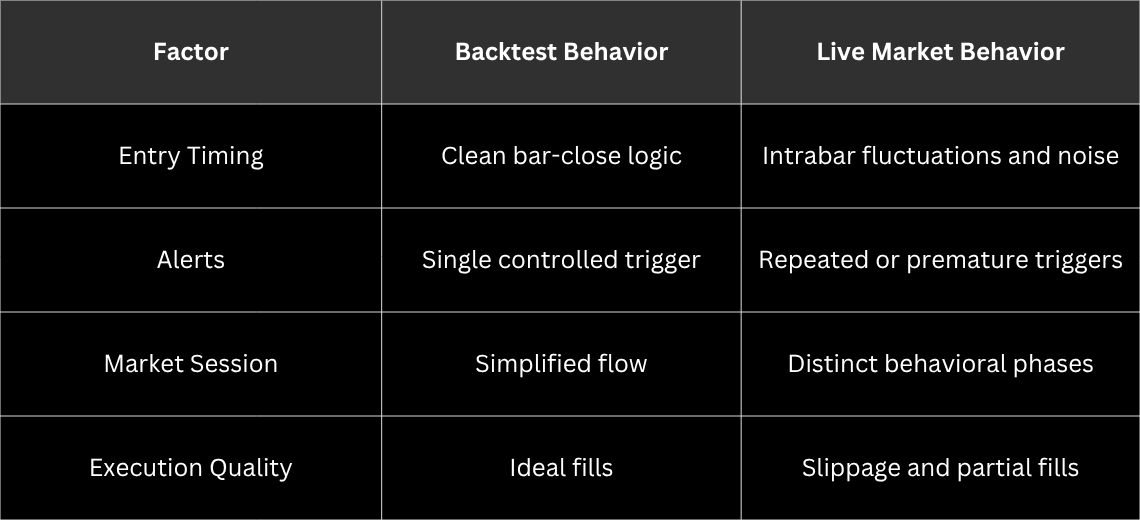
This difference explains why strategies that look reliable in testing often behave differently in real execution.
7. How Structured ORB Systems Improve Reliability
More refined ORB systems introduce additional conditions that filter out low-quality signals.
Instead of relying solely on breakout levels, these systems require confirmation that price is moving in alignment with short-term momentum. They also avoid trading during unstable volatility conditions where breakout behavior is less reliable.
This does not increase trade frequency. In fact, it often reduces the number of trades significantly. However, the quality of each trade improves because entries are filtered based on broader market context rather than isolated price levels.
Over time, this approach produces more stable performance across different SPY environments.
8. Why Pine Script AI Changes How Traders Approach ORB
8.1 Strategy understanding vs implementation gap
The core issue in ORB development is rarely the idea itself. Most traders already understand what they want from the system: breakout conditions, confirmation filters, session rules, and alert triggers.
The real difficulty starts when those ideas need to be converted into working Pine Script. What seems simple in concept often becomes complex in execution due to how conditions, timeframes, and alerts interact inside TradingView’s execution model. Small mistakes in structure can completely change how the strategy behaves in live conditions versus backtests.
8.2 Rewriting burden during strategy iteration
ORB systems are rarely perfect on the first version. Traders constantly test variations such as different opening range windows, added volatility filters, or adjusted confirmation rules.
Without an efficient workflow, each change requires rewriting sections of code, rechecking logic, and retesting behavior across multiple sessions. This slows down iteration and often discourages deeper optimization because even small adjustments feel time-consuming.
Over time, this creates a gap between strategy ideas and actual tested versions, where traders stop refining simply because the process becomes too heavy.
8.3 Natural language to structured logic conversion
Pine Script AI shifts this workflow by allowing traders to describe their strategy in plain language rather than manually building every condition in code.
Instead of focusing on syntax and structure, traders can describe what they want the strategy to do, such as how the opening range should be defined, when confirmation should occur, and what conditions should block trades.
The system then translates that logic into structured Pine Script that is ready for TradingView execution. This reduces friction between strategy design and implementation, making the development process more direct.
8.4 Faster testing of ORB variations
One of the biggest advantages of this approach is speed in experimentation. ORB strategies depend heavily on fine adjustments, such as:
-
Changing opening range duration based on volatility
-
Adding filters for high-impact news sessions
-
Adjusting alert timing to avoid premature triggers
-
Applying session-specific entry rules for different market phases
Traditionally, each of these changes requires manual code edits and repeated debugging. With AI-assisted generation, traders can test multiple versions of the same idea quickly without rebuilding the entire structure each time.
8.5 Focus shift from coding to strategy quality
When coding becomes less of a bottleneck, attention naturally shifts back to what actually matters: strategy logic and market behavior.
Instead of spending time fixing syntax or debugging execution issues, traders can focus on improving entry quality, refining confirmation rules, and testing how the ORB behaves under different volatility conditions.
This shift does not just speed up development. It also improves decision quality because more variations of the strategy can be tested in the same amount of time, leading to better-informed adjustments over time.
9. Why PineGen AI Is More Effective for SPY Strategies
SPY strategies are extremely sensitive to timing and execution structure. Small mistakes in alert logic or session handling can significantly distort performance.
PineGen AI is designed specifically around these types of TradingView strategies. It focuses on generating systems that already include:
-
correct U.S. market session handling
-
ORB structure logic consistency
-
Strategy Tester compatibility
-
reduced duplicate signal risk
This is important because SPY does not tolerate poorly structured execution systems. Even minor inconsistencies can create misleading performance results.
10. What This Case Study Really Shows
The Opening Range Breakout strategy is still widely used on SPY and remains a valid intraday framework. However, this case study shows that its performance is not determined only by the breakout concept itself. Instead, real performance depends on how well the strategy handles:
-
changing market conditions
-
intrabar volatility
-
session-specific behavior
-
alert execution timing
-
structural consistency
The key takeaway is simple.
A strategy does not fail because the idea is wrong. It fails because the execution layer is incomplete. In SPY trading, precision matters more than simplicity. The more structured the system becomes, the more consistent its behavior across different market environments.
Build Better SPY Trading Strategies with PineGen AI
SPY rewards traders who build structured systems rather than relying on simple breakout assumptions.
PineGen AI helps convert trading ideas into fully structured, testable TradingView strategies with proper execution logic built in from the start.
This allows traders to spend less time fixing code issues and more time improving actual strategy performance through real market testing.