Pine Script AI for US Futures and Options Markets: The Faster Way to Build Strategies That Actually Get Tested
Author : Ranga Technologies
Publish Date : 6 / 15 / 2026 • 2 mins read
Last Updated : 6 / 15 / 2026
US Derivatives Markets Just Became the Most Accessible They Have Ever Been. Most Traders Still Can't Move Fast Enough to Capitalize.
Two things happened in 2026 that fundamentally changed the landscape for US retail derivatives traders.
The first was the elimination of the Pattern Day Trader rule on June 4, 2026. For 25 years, the $25,000 minimum equity requirement locked small-account traders out of systematic intraday options trading. Every 0DTE options trade is a day trade by definition. Every round trip on SPY or QQQ options within the same session triggered the PDT counter. The rule is now gone. Small accounts can run full systematic options strategies with no trade-frequency restrictions for the first time in a generation.
The second was quieter but equally significant. The CME Group's expansion of Micro E-mini futures contracts, Micro S&P 500 (/MES), Micro Nasdaq (/MNQ), Micro Russell (/M2K), brought futures market access to accounts that could never afford standard E-mini margin requirements. A single /MES contract requires roughly $1,200 in initial margin. The same directional exposure on a standard /ES contract requires over $12,000. Put these two changes together and the conclusion is clear: US futures and options markets are now the most accessible they have ever been to retail systematic traders.
The problem is that accessibility without preparation is not an edge. Futures and options are the most complex instruments available to retail traders. They carry leverage that amplifies losses as efficiently as it amplifies gains. They have expiration mechanics, volatility behaviors, and session-specific characteristics that equity strategies are not built to handle. And building strategies for them manually, writing Pine Script code, debugging logic, backtesting across different market environments, iterating on parameters, is slow, technical, and error-prone in ways that actively prevent most traders from developing a tested system before risking real capital.
Pine Script AI directly addresses that gap. This is what it does, how it works in a US futures and options context, and the exact process for using it to build a strategy before your first trade.
1. What Makes US Futures and Options Markets Fundamentally Different
To understand why Pine Script AI matters specifically for these instruments, it is important to first understand what makes them structurally different from equity trading, and why those differences create unique strategy development challenges.
1.1 Futures Contracts Have Mechanics Equity Strategies Ignore
A futures contract is an agreement to buy or sell an underlying index or commodity at a specified price on a specified date. The /ES contract tracks the S&P 500. The /NQ tracks the Nasdaq 100. The /CL tracks crude oil. The /GC tracks gold. These markets trade nearly 24 hours a day, five days a week, with distinct behavioral characteristics during the US equity session, the overnight session, and around economic data releases.
Unlike stocks, futures contracts expire. The front-month contract rolls over to the next contract approximately every quarter. Price gaps between contract months, continuous contract adjustments, and the behavior of rollover periods all affect how strategies perform in backtesting if not handled correctly. A momentum strategy that works cleanly on SPY may produce completely different results when applied to /ES,not because the directional logic is wrong, but because the instrument behaves differently.
1.2 Options Pricing Is Driven by More Than Direction
Options traders are not simply betting on whether a stock or index goes up or down. Options premiums are priced by a combination of intrinsic value, time remaining to expiration, implied volatility, and the Greeks, delta, gamma, theta, and vega. A directional call that is correct about market movement can still result in a total loss if the position was entered when implied volatility was elevated and subsequently collapsed, destroying the premium regardless of the underlying's direction.
0DTE options, contracts expiring the same day they are purchased, are the most extreme version of this dynamic. There is no time value left to protect against theta decay. Every hour that passes without the underlying moving in the intended direction erodes premium aggressively. Entry timing is not a minor detail in 0DTE trading. It is the primary determinant of whether a directionally correct trade is profitable or not.
1.3 Volatility Regimes Change Everything
Both futures and options strategies are highly sensitive to volatility regimes. A trend-following strategy on /ES that performs exceptionally well during a trending, low-volatility environment will likely suffer significant drawdowns during a VIX spike or a choppy, range-bound session. An options income strategy that generates consistent returns when implied volatility is elevated will underperform when volatility contracts.
Manually adapting strategies to different volatility regimes, adding VIX filters, adjusting ATR-based stop distances, modifying entry conditions for trending versus ranging markets, requires exactly the kind of iterative development process that manual coding slows down significantly.
2. Where the Friction Comes From in Manual Futures and Options Strategy Development
Every friction point in manual Pine Script development is amplified when building for futures and options specifically.
2.1 Complexity Compounds at Every Layer
A basic equity momentum strategy might involve two or three conditions. A robust /ES futures day trading strategy needs session filters for NYSE hours, overnight gap handling, ATR-based dynamic position sizing, multi-timeframe trend confirmation, and volatility gates that prevent entries during high-uncertainty environments like FOMC announcements. Each additional layer of logic means more code to write, more variables to define, more conditional structures to get exactly right, and more opportunities for a subtle logical error to produce a strategy that backtests beautifully but behaves completely differently in live conditions.
2.2 The Backtesting Environment Is Unforgiving
Futures strategy backtesting on TradingView requires careful handling of session timing, continuous contract data, and realistic commission and slippage assumptions. A strategy that appears profitable in a backtest without accounting for realistic slippage on /ES entries, where even one tick of slippage per trade significantly affects results over hundreds of trades, is not a reliable performance estimate. Manually incorporating these assumptions into Pine Script code and verifying they are functioning correctly adds another layer of development time.
2.3 Iteration Cycles Are Too Slow for Changing Market Conditions
Futures markets are particularly sensitive to macroeconomic regimes. A strategy optimized for the low-volatility trending environment of 2024 may need significant recalibration for a higher-volatility, more news-driven environment. Manually rebuilding and retesting a strategy from scratch each time conditions shift is not a practical workflow. Most traders either stick with one strategy regardless of changing conditions or abandon systematic development entirely and revert to discretionary trading.
2.4 Options Signal Logic Is Technically Demanding
Building a directional signal strategy for 0DTE options in Pine Script requires precise session filtering, timing conditions, volatility gates, and entry conditions that account for how options premiums behave differently from the underlying. Getting the timing right, ensuring signals fire at the correct point within a candle, not one bar late after the best entry price has already passed, requires careful attention to Pine Script execution logic that is easy to get wrong and difficult to debug without significant experience.
3. Who This Affects Most
3.1 Retail Futures Day Traders
Traders focused on intraday /ES, /NQ, or /MES setups who have historically built strategies manually are spending a significant portion of their development time on code rather than on the quality of their market logic. Pine Script AI compresses that development time without changing the trader's responsibility for the quality of the underlying strategy thesis.
3.2 Small-Account Options Traders Post-PDT
The removal of the PDT rule creates an immediate opportunity for small-account traders to run systematic 0DTE options strategies. But entering the 0DTE market without a backtested framework is a reliable way to lose capital quickly. Pine Script AI gives these traders the ability to build, test, and validate a systematic directional signal strategy before placing a single real trade.
3.3 Swing Traders Using Futures
Traders who hold /ES or /CL positions for one to five days often rely on multi-timeframe logic, a daily trend filter combined with a 4-hour entry trigger, for example. Building that multi-timeframe structure correctly in Pine Script requires careful use of request.security() calls and conditional hierarchies that are technically demanding to write correctly. Pine Script AI handles that structure automatically.
3.4 Macro-Driven Traders
Traders who build strategies around economic data releases, FOMC decisions, CPI prints, NFP reports, need to adapt quickly when macro conditions shift. Pine Script AI makes it practical to test different event-driven frameworks rapidly, modifying entry conditions and volatility filters through prompts rather than code rewrites.
4. The Real Risk Nobody Discusses Loudly Enough
The accessibility expansion in US futures and options markets is genuinely positive for retail traders. But the honest version of this story includes what that expansion also creates.
Futures leverage is not a theoretical concept. A single /ES contract controls approximately $250,000 in notional S&P 500 exposure. A 1% adverse move in the S&P 500 produces a $2,500 loss on one contract. With a $12,000 account and standard margin requirements, that is a 20% account loss on a single trade that goes wrong. Micro futures reduce this proportionally but do not eliminate the fundamental dynamic of leveraged instruments.
0DTE options can expire completely worthless within hours. A $200 premium paid for an out-of-the-money SPY call at 10:00 AM can be worth $0 by 1:00 PM if the underlying doesn't move as expected. Unlike stock positions, there is no waiting for a recovery. The capital is gone when the contract expires.
Pine Script AI does not change either of these realities. It generates strategy logic faster and reduces development friction significantly. It does not generate market insight, manage risk on your behalf, or guarantee that a backtested edge will persist in live trading. Every strategy built with Pine Script AI requires rigorous backtesting, honest evaluation of drawdown metrics, and paper trading before real capital is committed.
The traders who will benefit most from improved tools and expanded market access are the ones who pair that access with genuine preparation. The tools have improved. The discipline requirement has not changed.
5. Why Systematic Strategy Development Is the Right Response
There is a version of expanded derivatives market access that ends badly: newly unconstrained traders enter futures and options markets without a defined system, trade on conviction and social media sentiment, and experience the outcomes that underprepared leveraged trading has always produced.
There is another version. Traders who respond to expanded access by building a systematic framework first, defined entries, defined exits, defined risk per trade, backtested logic across multiple market environments, and use that framework to trade consistently rather than reactively.
The difference between those two versions is not capital size or market knowledge. It is preparation. And preparation in algorithmic trading means one thing specifically: a backtested, rule-defined strategy that removes discretion from execution and gives you realistic performance expectations before real money is on the line.
Building that system used to require Pine Script expertise. With Pine Script AI, it requires a clear description of your strategy logic and a structured approach to the development process.
6. The 5-Step Process: Build Your Futures or Options Strategy Before You Trade
6.1 Step 1 — Define Your Setup in Plain Language
Before opening any tool, write out your strategy completely in plain English. What instrument? What session? What conditions create a valid entry? What are your stop-loss and target rules? What filters prevent bad entries?
Example for a /MES futures strategy: "I trade Micro E-mini S&P 500 futures on the 5-minute chart during NYSE hours. I buy when price breaks above the high of the first 15-minute candle after the open, confirmed by VWAP rising and ATR expanding above its 20-period average. Stop-loss at 1.5x ATR below the entry bar low. Target at 2.5x ATR. No entries after 2:30 PM ET. Close all positions at 3:50 PM."
That description contains everything needed to generate a working strategy. The clearer the description, the more accurate the output.
6.2 Step 2 — Generate the Pine Script Strategy with PineGen AI
Take that description and build a structured prompt specifying Pine Script v6, the instrument, the timeframe, every condition, every exit type, risk parameters, session filters, visuals, and alert conditions. PineGen AI generates validated, compilable v6 code from the first prompt. No debugging cycle required, no syntax errors to chase.
6.3 Step 3 — Review on the Live Chart Before Backtesting
Load the generated code on TradingView and check visually before running any backtest. Confirm entry signals fire at the correct point — at the actual breakout candle, not one bar later. Confirm the opening range is plotted correctly. Confirm session filters are cutting off entries at the right time. Catching logical errors visually before they contaminate backtest data is significantly faster than discovering them after running a full test.
6.4 Step 4 — Backtest Rigorously Across Multiple Market Environments
Load the strategy on your instrument and timeframe in TradingView's Strategy Tester. For /ES or /MES, use at least two years of 5-minute data. Target a minimum of 100 trades for statistical relevance. Evaluate profit factor (target above 1.3), maximum drawdown (target under 20%), win rate, average trade duration, and performance separately during high-VIX and low-VIX periods. A strategy that only performs well in one volatility environment is not a robust strategy — it is a regime-specific bet waiting to fail when conditions shift.
6.5 Step 5 — Iterate Through Chat and Paper Trade
Use PineGen AI's chat to refine based on backtest results. One sentence per refinement: "Add a filter that skips entries when the VIX is above 25." The strategy regenerates with the new condition. New backtest. Compare performance. Build iteratively until results are consistent across multiple market environments. Then paper trade the final version for a minimum of two weeks before committing real capital. The futures and options markets will still be there. Your capital needs to survive long enough to deploy a tested edge.
7. The Code: Micro E-mini S&P 500 Opening Range Breakout Strategy
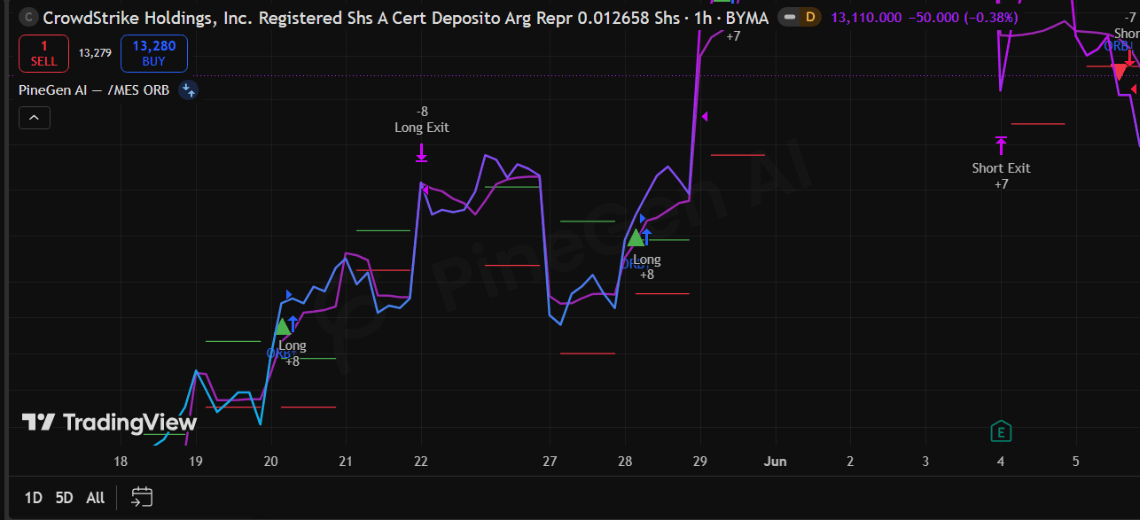
The Opening Range Breakout on /MES is one of the most documented and widely deployed systematic frameworks for US equity index futures. It captures directional breakouts from the first 15 minutes of the NYSE session, filtered by VWAP direction and ATR expansion, with dynamic risk management and a hard close before the final session volatility window.
The prompt that built this:
"Pine Script v6 strategy for Micro E-mini S&P 500 on the 5-minute chart. Long when price breaks above the 15-minute opening range high with VWAP rising. Short when price breaks below the opening range low with VWAP falling. ATR-based stop-loss and take-profit. No entries after 2:30 PM ET. Force-close at 3:50 PM ET. Plot opening range levels and VWAP. Add alerts."
pine//@version=6
strategy("PineGen AI — /MES ORB", overlay=true,
     default_qty_type=strategy.percent_of_equity, default_qty_value=10,
     commission_type=strategy.commission.cash_per_contract, commission_value=2.25)

// ── INPUTS ─────────────────────────────────────────────
atrLen  = input.int(14,    "ATR Length",       group="Risk")
slMult  = input.float(1.5, "SL Multiplier",    group="Risk", step=0.1)
tpMult  = input.float(2.5, "TP Multiplier",    group="Risk", step=0.1)

// ── TIME ───────────────────────────────────────────────
nyOpen    = timestamp("America/New_York", year, month, dayofmonth, 9,  30, 0)
orEnd     = timestamp("America/New_York", year, month, dayofmonth, 9,  45, 0)
cutoff    = timestamp("America/New_York", year, month, dayofmonth, 14, 30, 0)
closeTime = timestamp("America/New_York", year, month, dayofmonth, 15, 50, 0)

isNewDay  = ta.change(time("D")) != 0
inSession = time >= nyOpen and time = nyOpen and time = orEnd and not orSet
    orSet := true

// ── INDICATORS ─────────────────────────────────────────
vwapVal  = ta.vwap(hlc3)
atrVal   = ta.atr(atrLen)
vwapRise = vwapVal > vwapVal[3]
vwapFall = vwapVal = closeTime and strategy.position_size != 0
    strategy.close_all(comment="EOD Close")

// ── VISUALS ────────────────────────────────────────────
plot(orSet ? orHigh : na, "OR High", color=color.green, linewidth=1, style=plot.style_linebr)
plot(orSet ? orLow  : na, "OR Low",  color=color.red,   linewidth=1, style=plot.style_linebr)
plot(vwapVal, "VWAP", color=color.purple, linewidth=2)

plotshape(longSig,  location=location.belowbar, color=color.green, style=shape.triangleup,   size=size.small, text="ORB↑")
plotshape(shortSig, location=location.abovebar, color=color.red,   style=shape.triangledown, size=size.small, text="ORB↓")

// ── ALERTS ─────────────────────────────────────────────
alertcondition(longSig,  "MES Long",  "PineGen AI ▲ /MES LONG  — {{ticker}} @ {{close}}")
alertcondition(shortSig, "MES Short", "PineGen AI ▼ /MES SHORT — {{ticker}} @ {{close}}")
Same logic, cleaner structure, significantly shorter. The opening range, VWAP filter, ATR-based risk management, session cutoff, and force-close are all preserved — just without the extra inputs and line-drawing complexity that added length without adding strategic value.
8. Why PineGen AI Is the Right Tool for US Futures and Options Traders
The combination of expanded market access and increased strategy complexity creates a specific need: a tool that generates accurate, validated Pine Script v6 code for US derivatives workflows without requiring traders to become expert programmers.
8.1 US Derivatives Logic Built In
Opening Range Breakout, VWAP, NYSE session filters, ATR-based dynamic risk management, continuous futures contract handling, VIX conditions, force-close before session end, PineGen AI understands these concepts in US futures and options context and generates the correct Pine Script v6 implementation. The code above compiled and ran on the first attempt without a single error.
8.2 Zero Compile Errors
In a published 20-trader benchmark, PineGen AI produced zero compile errors compared to a 70% failure rate from general-purpose AI tools. In futures trading, where an alert fires and execution happens in seconds, the strategy must work exactly as designed. A compile error discovered during a live session is not a minor inconvenience, it is a missed trade at minimum and a risk management failure at worst.
8.3 Backtest Before Any Real Capital
The TradingView Strategy Tester on a 5-minute /MES chart over two-plus years generates hundreds of ORB trades, enough statistical data to understand realistic performance expectations, maximum drawdown behavior, and how the strategy performs across different VIX environments before a single dollar is committed.
8.4 Chat-Based Refinement
"Add a filter that skips entries when the overnight range is wider than 1% of the prior close." One sentence in the PineGen AI chat. The strategy regenerates with the new condition. New backtest in minutes. Building a robust futures or options framework iteratively, adding volatility filters, session conditions, multi-timeframe confirmations, takes an afternoon instead of days.
9. The Bigger Picture: Accessibility Without Preparation Is Not an Edge
US futures and options markets have never been more accessible to retail traders. Micro futures contracts bring /ES and /NQ exposure within reach of accounts under $5,000. The PDT rule elimination opens systematic 0DTE options trading to accounts that were previously locked out. The infrastructure for retail systematic trading, TradingView, Pine Script, real-time data, mobile execution platforms, has never been better.
What has not changed is the fundamental competitive reality of these markets. Institutional market makers, proprietary trading firms, and algorithmic funds are on the other side of every retail trade in futures and options. They are better capitalised, better informed, and faster. The retail trader's only sustainable edge is a systematically tested, rule-defined strategy that removes emotional decision-making from execution and gives consistent, repeatable behavior across hundreds of trades.
Manual strategy development was always a bottleneck between having that edge and deploying it. Every hour spent debugging Pine Script code was an hour not spent improving strategy logic. Every slow iteration cycle meant fewer variations tested and a less robust final system.
Pine Script AI removes that bottleneck. The development cycle that used to take days now takes hours. The iteration cycle that used to take a week now takes an afternoon. More ideas get tested. More variations get explored. Strategies improve faster.
The traders who will benefit most from expanded access to US futures and options markets are not the ones who simply trade more. They are the ones who use better tools to build better systems, and deploy those systems with the discipline that these markets have always demanded.
Build the strategy before you trade it. Backtest it honestly. Paper trade it. Then deploy it with defined risk management that ensures your capital survives long enough to let the edge play out.
The markets are more accessible than ever. Your preparation is what determines what you do with that access.
Build Your US Futures or Options Strategy Today
Micro E-mini futures and 0DTE options are fully accessible to retail traders. Build, backtest, and validate a systematic strategy before you place your first trade. No Pine Script knowledge required. Validated v6 code. Live chart preview and full Strategy Tester backtesting included.